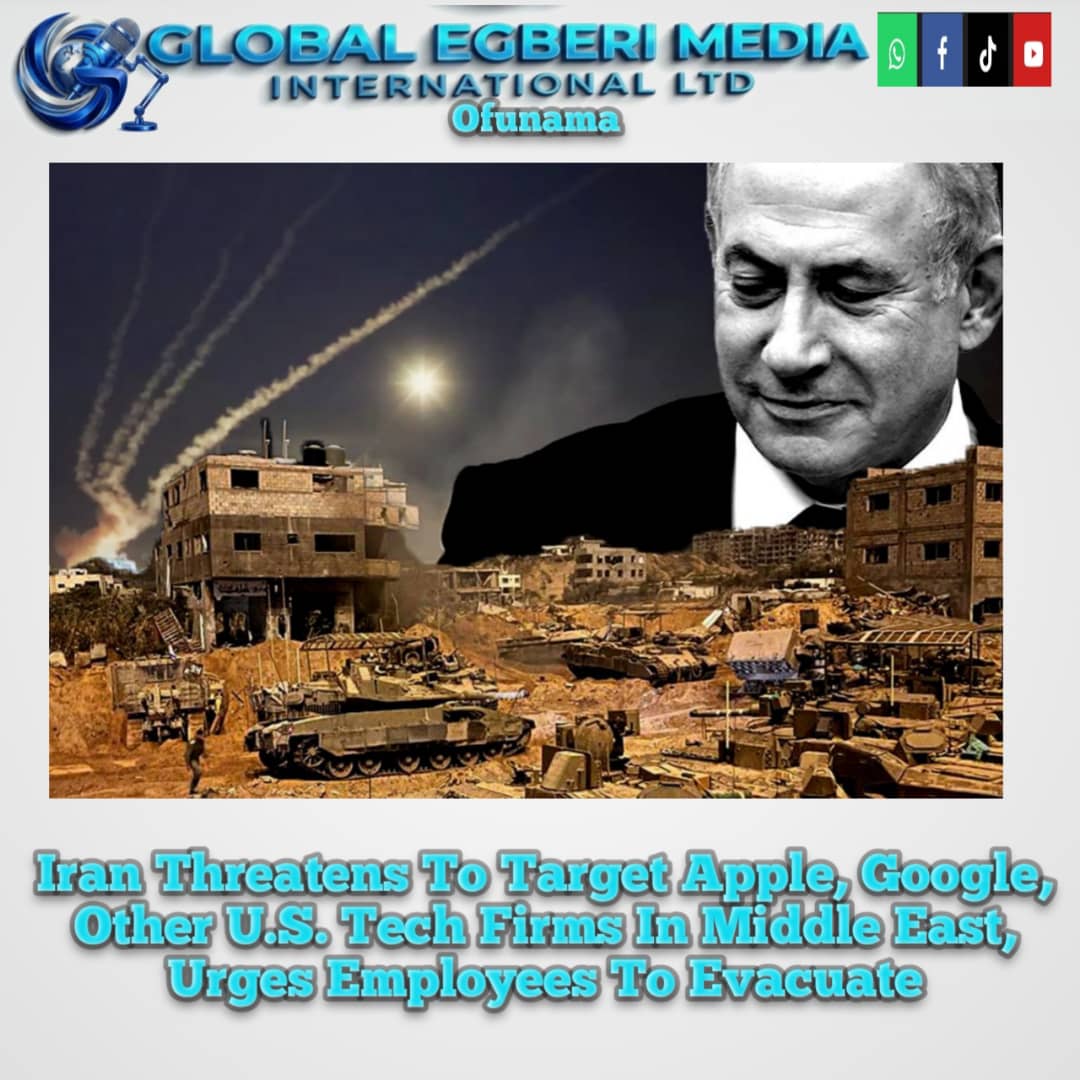
Iran Threatens To Target Apple, Google, Other U.S. Tech Firms In Middle East, Urges Employees To Evacuate
A dramatic escalation in the ongoing geopolitical tensions in the Middle East has emerged after Iranian authorities issued threats against several major American technology companies operating in the region. The warning, reportedly issued by the powerful Islamic Revolutionary Guard Corps (IRGC), lists global tech giants such as Apple, Google, Microsoft and Meta as potential targets in retaliation for what Iran describes as hostile actions by the United States and its allies.
The development has triggered widespread concern across the global technology sector and international diplomatic circles, with employees of American-linked companies in the Middle East reportedly being urged to evacuate immediately for safety reasons.
Iran’s Warning to U.S. Technology Firms
According to reports circulating through Iranian state-linked media and international outlets, the IRGC issued a statement declaring that offices and facilities belonging to several American companies across the Middle East could be attacked. The group accused these firms of assisting U.S. and Israeli intelligence operations allegedly involved in targeted attacks and assassinations within Iran. (Press TV)
Iranian officials claim that the technological infrastructure and artificial intelligence tools developed by these companies are used to support surveillance, intelligence gathering, and military planning against Iranian interests. As a result, Tehran has warned that such companies would now be treated as “legitimate targets” in the escalating conflict. (Business Upturn)
The IRGC statement reportedly advised employees working for the affected companies to evacuate their workplaces immediately. Residents living within a one-kilometer radius of the companies’ facilities were also urged to leave the area as a precaution. (Press TV)
List of Companies Named in the Threat
Beyond the widely known tech giants, Iran reportedly named as many as eighteen U.S.-linked corporations as potential targets in the region. The list includes major technology and industrial companies such as:
- Apple
- Microsoft
- Meta
- Intel
- IBM
- Cisco Systems
- Oracle Corporation
- Tesla
- Boeing
Analysts say the inclusion of such globally influential firms demonstrates how economic and technological infrastructure is increasingly becoming part of modern geopolitical conflict.
Background: Escalating U.S.–Iran Tensions
The threats come against the backdrop of an escalating conflict involving Iran, the United States, and Israel that has intensified in recent months. Military strikes, cyber operations, and covert attacks have been reported across the region, further heightening tensions between Tehran and Washington.
Iran has repeatedly accused the United States and Israel of carrying out targeted killings of Iranian scientists, military officials, and intelligence operatives. In response, Iranian leaders have vowed retaliation not only against military targets but also against institutions they believe support hostile operations against the country. (Business Upturn)
This shift suggests that economic and corporate infrastructure—especially technology companies involved in communication networks, artificial intelligence, and cloud computing—could increasingly become strategic targets in geopolitical confrontations.
Possible Military and Cyber Implications
Security experts warn that Iran’s threats could manifest in multiple forms. While physical attacks on corporate facilities remain possible, analysts believe cyber warfare may be a more likely scenario given Iran’s growing cyber capabilities.
Over the past decade, Iranian-linked hacking groups have been accused of launching cyberattacks on Western financial institutions, energy companies, and government agencies. A coordinated cyber offensive against multinational technology firms could disrupt digital services used by millions worldwide.
In addition to cyber threats, Iran has previously demonstrated its ability to deploy drones and missiles targeting economic infrastructure across the Middle East. Recent attacks linked to Iranian forces have reportedly targeted airports, oil facilities, and commercial centers in Gulf states. (Human Rights Watch)
Impact on the Technology Industry
If the threats materialize, the implications for the global technology industry could be significant. Many American technology firms maintain regional headquarters, data centers, and research facilities in countries such as the United Arab Emirates, Qatar, Bahrain, and Saudi Arabia.
These facilities serve as key hubs for cloud computing services, telecommunications infrastructure, and artificial intelligence development across the Middle East and Africa.
An attack on such infrastructure could disrupt digital services, financial transactions, and business operations across multiple sectors including banking, aviation, and telecommunications.
International Reactions
The threats have sparked concern among Western governments and multinational corporations operating in the Middle East. Security agencies in several Gulf states are reportedly increasing surveillance and protective measures around foreign corporate facilities.
Diplomatic efforts are also underway to prevent the conflict from escalating further. Some international actors, including China and Pakistan, are believed to be exploring mediation options aimed at reducing tensions between Iran and the United States.
Meanwhile, global markets have reacted nervously to the possibility of further escalation. Oil prices have surged amid fears that instability in the region could threaten energy supplies and disrupt major shipping routes such as the Strait of Hormuz. (Reuters)
Growing Concern Over Corporate Targets in War
The situation highlights a troubling trend in modern conflicts where corporations, especially technology companies, increasingly find themselves caught in geopolitical rivalries.
Historically, wars were fought primarily between nation-states and military forces. However, in the digital age, corporations controlling communication networks, artificial intelligence systems, and data infrastructure are now viewed as strategic assets by governments.
Iran’s warning suggests that the boundaries between economic infrastructure and military targets are becoming increasingly blurred in contemporary warfare.
Conclusion
The threat by Iran to target major U.S. technology companies operating in the Middle East marks a significant escalation in the already volatile geopolitical landscape. By naming globally influential firms such as Apple, Google, Microsoft, and Meta as potential targets, Tehran has introduced a new dimension to the conflict—one that extends beyond traditional military confrontations into the realm of corporate and technological infrastructure.
As governments, corporations, and international organizations monitor the unfolding developments, the coming days may prove crucial in determining whether the threats remain rhetorical warnings or evolve into a new phase of cyber and economic warfare in the region.
Author: Dr. Odimientimi Agbedeyi
Source: Sahara Reporters / Reuters / International Media
Homepage: https://globalegberi.com.ng/wp
About the Author