By Dr. Odimientimi Agbedeyi
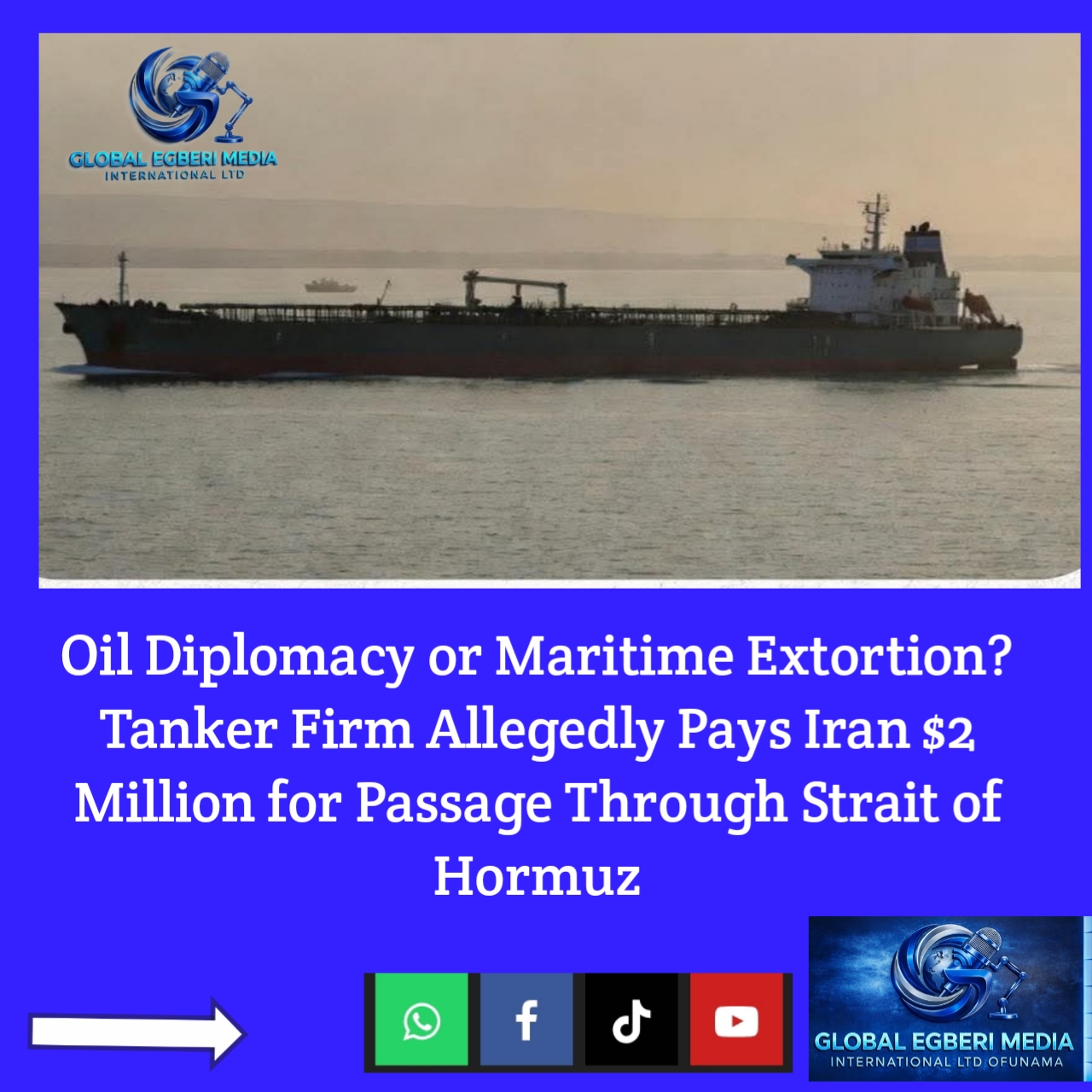
In what analysts describe as a geopolitical spectacle laden with maritime intrigue and strategic brinkmanship, a startling report has surfaced alleging that a private oil tanker company paid approximately $2 million to Iranian authorities to guarantee safe passage through the perilous waters of the Strait of Hormuz.
The revelation, published by the maritime intelligence publication Lloyd’s List, suggests that Iran has quietly instituted a controlled shipping corridor within its territorial waters, where vessels must undergo scrutiny and approval before being permitted to traverse one of the world’s most consequential oil transit arteries.
Emergence of a “Ship Registration Regime”
According to the report, Iranian officials linked to the formidable Islamic Revolutionary Guard Corps (IRGC) have introduced what insiders describe as a nascent maritime registration protocol—a bureaucratic mechanism through which ships are vetted, documented, and subsequently authorised to pass through the volatile corridor.
In essence, the system functions as a maritime filtration apparatus, determining which vessels may safely navigate the narrow strait while geopolitical tensions convulse the region.
The emergence of such a system underscores the profound strategic leverage Iran possesses over the Strait of Hormuz, through which a substantial fraction of the planet’s daily oil supply flows.
A Region in Strategic Turbulence
The revelation arrives against the backdrop of escalating military tensions across West Asia, where naval patrols, aerial surveillance, and intermittent hostilities have transformed the region’s maritime landscape into a theatre of geostrategic contestation.
Shipping operators navigating the corridor increasingly confront a labyrinth of risks—ranging from naval confrontation and drone surveillance to potential interdiction by military forces.
To mitigate these dangers, several nations—including India, Pakistan, Iraq, Malaysia, and China—have reportedly initiated diplomatic engagement with Tehran in an effort to coordinate the safe movement of their vessels.
Maritime data indicates that at least nine ships have already transited the Iranian-controlled corridor, signalling the gradual normalization of this unconventional maritime arrangement.
India’s Delicate Evacuation Effort
Among the nations most affected by the disruption is India, whose merchant fleet has several vessels operating in the volatile waters.
According to the Indian newspaper The Hindu, authorities in New Delhi have identified 22 vessels requiring evacuation, while several others have been instructed to remain stationary due to escalating security threats.
Two Indian naval vessels—INS Shivalik and INS Nanda Devi—were reportedly able to withdraw safely after navigating the conflict-prone maritime corridor.
Richard Meade, Editor-in-Chief of Lloyd’s List Intelligence, offered further insight into the unusual navigational behaviour observed in the region.
He disclosed that tracking data revealed peculiar routing manoeuvres by at least one Indian liquefied petroleum gas (LPG) carrier, which reportedly skirted around Iran’s Larak Island before entering Iranian territorial waters for identity verification by the IRGC Navy and port authorities.
The Strategic Chokepoint of Global Energy
Few maritime corridors command the global strategic significance of the Strait of Hormuz.
Often described by geopolitical scholars as the jugular vein of the global oil economy, the narrow waterway facilitates the daily transit of millions of barrels of crude oil destined for international markets.
Consequently, any disruption within the corridor reverberates through global energy markets, influencing oil prices, shipping insurance premiums, and geopolitical calculations among major powers.
Iran’s Hardline Posture
The situation has been further complicated by pronouncements from Iran’s newly installed Supreme Leader, Mojtaba Khamenei, who reportedly declared that the strait’s closure could serve as a strategic instrument of geopolitical pressure against Western powers.
In remarks broadcast by Iran’s state-run Press TV, Mojtaba—who succeeded his father, Ali Khamenei—warned that the continued presence of foreign military forces in the region could provoke further escalation.
He also issued a stern ultimatum to regional governments hosting American military installations, insisting that such bases must be dismantled or risk becoming legitimate targets of the Islamic Revolutionary Guard Corps.
Implications for Global Shipping
For international shipping operators and maritime insurers, the emergence of a paid “safe passage” regime raises troubling questions about the future of freedom of navigation in one of the world’s most vital sea lanes.
Experts fear that the practice could institutionalise a precedent in which geopolitical leverage translates into financial tolls for commercial navigation, potentially altering the economics of global maritime trade.
Should tensions intensify further, analysts warn that the Strait of Hormuz could become the epicentre of a broader geopolitical confrontation capable of disrupting global energy supply chains.
For now, however, the alleged $2 million payment stands as a potent illustration of how maritime commerce, geopolitical rivalry, and economic necessity intersect in the treacherous waters of the Persian Gulf.
Source: Sahara Reporters
Homepage: https://globalegberi.com.ng/wp
About the Author