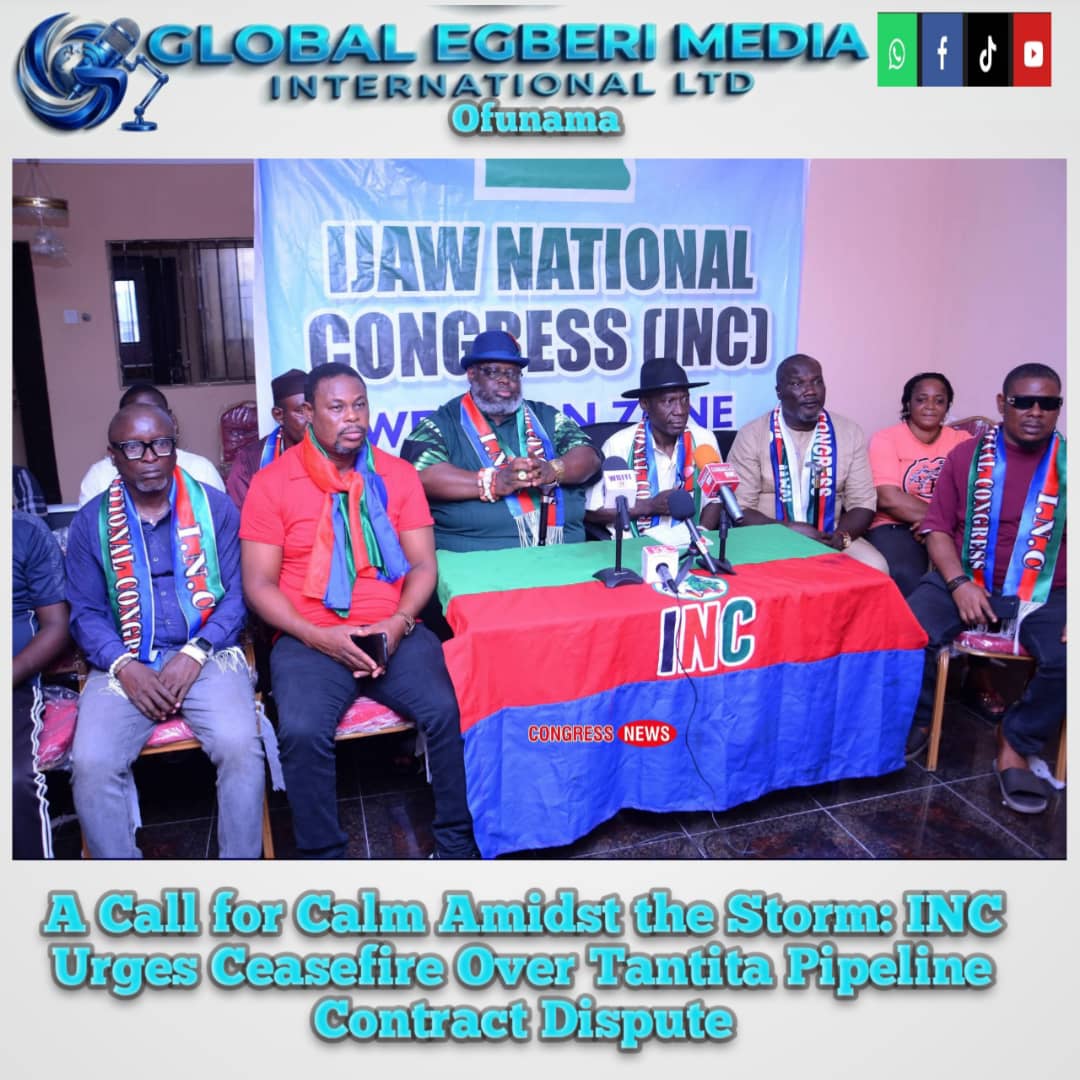
A Call for Calm Amidst the Storm: INC Urges Ceasefire Over Tantita Pipeline Contract Dispute
The leadership of the Ijaw National Congress (INC) has called for restraint and internal dialogue following rising tensions surrounding the controversial pipeline surveillance contract handled by Tantita Security Services Nigeria Limited. In a strongly worded press conference held in Warri, Delta State, leaders of the Congress from the Central and Western zones appealed to aggrieved voices within the Ijaw nation to halt public agitation and instead pursue peaceful engagement through established leadership structures.
The press briefing, which drew the attention of stakeholders across the Niger Delta region, was convened amid growing social media debates and public statements by some activists and stakeholders who have questioned the centralized structure of the pipeline surveillance contract awarded to Tantita. The contract, widely associated with the leadership of former Niger Delta militant commander Government Ekpemupolo, has in recent years been credited with significantly reducing crude oil theft and illegal bunkering in the oil-rich region.
However, the escalating disagreements over the management and structure of the surveillance arrangement have begun to stir controversy within the Ijaw community, prompting the leadership of the INC to intervene with an appeal for unity.
INC Warns Against Public Hostilities
Addressing journalists during the press conference, the INC Chairman for the Central Zone, HRH Amb. Moses Theophilus Kenibara, who also serves as the Amadabo of Moko-Ama, expressed deep concern over the public exchanges and accusations circulating across media platforms.
According to Kenibara, the actions of some respected sons of the Ijaw nation who have taken the dispute to the public space are not only regrettable but potentially damaging to the collective reputation of the Ijaw people.
He stressed that the ongoing social media confrontations have exposed internal disagreements in ways that undermine the unity and dignity of the ethnic nationality.
The monarch-leader explained that while disagreement is a natural part of any evolving society, such disputes should be handled through constructive dialogue within the established leadership structures of the Ijaw nation, rather than through public attacks capable of inflaming tensions.
Kenibara emphasized that the Congress remains committed to protecting the collective interest of the Ijaw people and ensuring that internal conflicts do not escalate into divisions capable of weakening the community’s bargaining strength in national affairs.
Opportunities Beyond Pipeline Surveillance
The INC Central Zone Chairman also highlighted the broader economic opportunities within Nigeria’s oil and gas sector, noting that the surveillance contract currently managed by Tantita represents only one segment of the vast industry.
According to him, numerous business opportunities exist in areas such as:
- crude oil lifting
- pipeline construction and laying
- maintenance of oil infrastructure
- logistics and marine services
- technical operations within the oil and gas value chain
He therefore advised those agitating for the decentralization of the surveillance contract to explore these avenues rather than directing their frustrations toward fellow Niger Delta stakeholders.
Kenibara described the public agitation against Tantita as largely driven by envy and misplaced rivalry, warning that such confrontations risk distracting the region from the larger economic and political struggles that require collective focus.
Focus on Bigger Demands: Resource Control and Ownership
While urging restraint, the INC leader also called on Niger Delta stakeholders to channel their advocacy toward more fundamental issues affecting the region.
He stressed that the agitation of Niger Delta leaders should focus on:
- ownership of oil wells within host communities
- genuine resource control
- employment opportunities for qualified Niger Delta youths
- greater economic participation in the oil and gas sector
According to him, these structural issues carry far greater significance for the long-term development of the Niger Delta than disputes over a single surveillance contract.
Kenibara further commended the role played by Tantita Security Services in engaging thousands of youths in the fight against crude oil theft. He noted that the initiative has reportedly provided meaningful engagement for over twenty thousand young people, contributing to the relative calm currently experienced in parts of the region.
Western Zone Calls for Peaceful Dialogue
Supporting the position of the Central Zone leadership, the Chairman of the INC Western Zone, Barrister Preye Nuel Kuete, also appealed to the aggrieved parties to adopt a more constructive approach.
Kuete urged those dissatisfied with the current arrangement to formally present their grievances through the leadership of the Ijaw National Congress and the Council of Traditional Institutions and Authorities (CITA), which he described as appropriate platforms for resolving internal disputes.
According to him, resorting to public confrontations risks destabilizing the fragile peace that has gradually returned to the Niger Delta after years of unrest linked to militancy and oil pipeline sabotage.
He warned that renewed tensions could undermine investor confidence and delay much-needed development projects in the region.
Kuete emphasized that dialogue, patience, and collective wisdom have historically guided the Ijaw people through difficult periods and should remain the preferred path in the present situation.
Tompolo Described as a Peacemaker
During the briefing, the Western Zone Chairman also spoke about the personality at the center of the controversy. Kuete described Government Ekpemupolo, popularly known as Tompolo, as a peace-loving and accommodating leader who has played significant roles in stabilizing the Niger Delta.
He appealed to those engaged in media attacks against the former militant leader to reconsider their approach and instead embrace dialogue and reconciliation.
According to Kuete, campaigns of calumny and public hostility are unlikely to yield productive outcomes but may instead deepen divisions within the Ijaw nation.
Protecting the Fragile Peace in the Niger Delta
The INC leaders concluded their remarks by emphasizing the importance of sustaining peace in the Niger Delta, noting that the region’s stability remains crucial for Nigeria’s economic prosperity.
For decades, the Niger Delta has been the backbone of Nigeria’s oil-driven economy, yet it has also witnessed cycles of unrest fueled by grievances over environmental degradation, resource control, and economic marginalization.
The INC therefore warned that rekindling internal disputes could jeopardize the fragile calm that has allowed economic activities to stabilize in recent years.
They urged all stakeholders, activists, and community leaders to prioritize unity, dialogue, and strategic advocacy in pursuing the region’s interests.
A Test of Unity for the Ijaw Nation
Observers say the intervention by the INC reflects growing concern among traditional and political leaders that internal rivalries could weaken the collective voice of the Niger Delta at a time when national debates on resource control and economic restructuring are intensifying.
For many stakeholders, the current dispute presents not merely a disagreement over contracts but a test of the region’s ability to manage its internal affairs while maintaining solidarity in the broader struggle for equity and development.
As the calls for ceasefire and dialogue echo across the region, it remains to be seen whether the aggrieved voices will heed the appeal of the Ijaw leadership and return to the negotiation table.
For now, the message from the Ijaw National Congress is clear: unity, dialogue, and strategic focus must prevail over public confrontation.
Source: Niger Delta Mirror
🌐 https://globalegberi.com.ng/wp
Author: Dr. Odimientimi Agbedeyi
About the Author