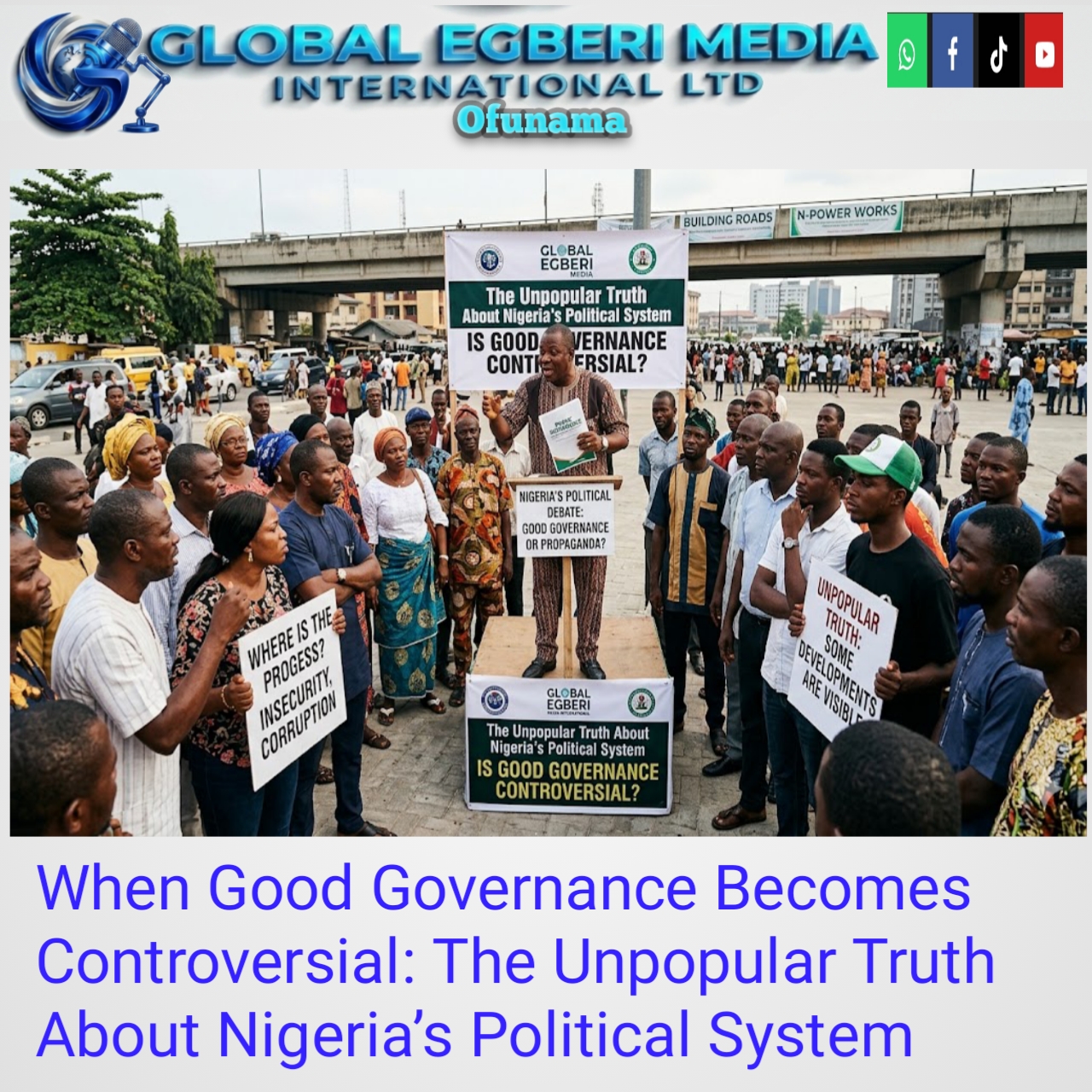
In today’s Nigeria, praising the government or political leaders often attracts immediate backlash. In many public spaces—especially on social media—any attempt to highlight positive efforts by politicians is quickly dismissed as propaganda or political loyalty. Yet, beneath the widespread anger and frustration of the masses lies a difficult and controversial question: Is it truly accurate to say that nothing good comes from Nigeria’s political system?
For years, the narrative surrounding governance in Nigeria has been overwhelmingly negative. Citizens frequently point to corruption, insecurity, unemployment, and economic hardship as proof that the political class has failed the nation. These grievances are real and deeply felt. However, the intensity of public distrust has created a climate where acknowledging any positive development within government is treated almost like a betrayal of public sentiment.
Ironically, this growing refusal to recognize positive outcomes may itself be distorting the national conversation.
Take infrastructure development for example. Across several states, governments continue to construct roads, bridges, schools, and healthcare facilities. Whether at the federal, state, or local level, projects are constantly being commissioned and implemented. Critics often argue that such projects are either insufficient or politically motivated, yet the reality remains that these developments still provide tangible benefits to communities.
Similarly, the Presidential Amnesty Programme, introduced during the administration of Umaru Musa Yar’Adua, remains one of the most significant peace-building initiatives in Nigeria’s modern history. The programme helped calm tensions in the Niger Delta and provided training and reintegration opportunities for thousands of former militants. While not perfect, many observers agree that it played a crucial role in reducing violent conflict in the region.
Another example often overlooked is the expansion of social intervention initiatives such as the N-Power Programme and other youth empowerment schemes under the National Social Investment Programme. These programs have provided temporary employment, training, and financial support to millions of young Nigerians. Critics question their sustainability, but beneficiaries argue that the assistance helped them survive difficult economic conditions.
Even within the political class itself, there are leaders who quietly pursue reforms, strengthen institutions, or advocate for regional development. Unfortunately, the broader public rarely celebrates these efforts, partly because trust in the political system has eroded so deeply.
The truth many Nigerians struggle to accept is that governance—especially in a country as complex as Nigeria—is rarely entirely good or entirely bad. Progress often occurs alongside failure, reforms alongside corruption, and development alongside hardship.
This reality creates the paradox currently confronting the nation: speaking positively about government actions has become controversial.
For some citizens, highlighting any achievement of politicians appears to undermine the fight against corruption and bad governance. Yet for others, refusing to acknowledge progress risks encouraging cynicism and hopelessness, where the belief that “nothing works” becomes a permanent national mindset.
Political analysts warn that such extreme pessimism can be dangerous for democracy. When citizens begin to believe that every leader is inherently corrupt and every institution is completely useless, public participation declines and accountability mechanisms weaken.
In other words, when society refuses to recognize progress—even when it occurs—it may unintentionally strengthen the very problems it seeks to fight.
None of this suggests that Nigeria’s political system is free from flaws. The challenges facing the country remain enormous, from economic instability to security threats and governance deficits. However, acknowledging these problems does not require ignoring every positive development.
Perhaps the most controversial statement in Nigeria today is simply this: some government policies and some politicians have actually made meaningful contributions to national development.
For a society accustomed to viewing politics only through the lens of disappointment, that claim alone is enough to spark debate.
And maybe, just maybe, that debate is exactly what Nigeria needs.
Source: Political Analysis / Public Affairs Commentary
Global Egberi Media International: https://globalegberi.com.ng/wp
About the Author