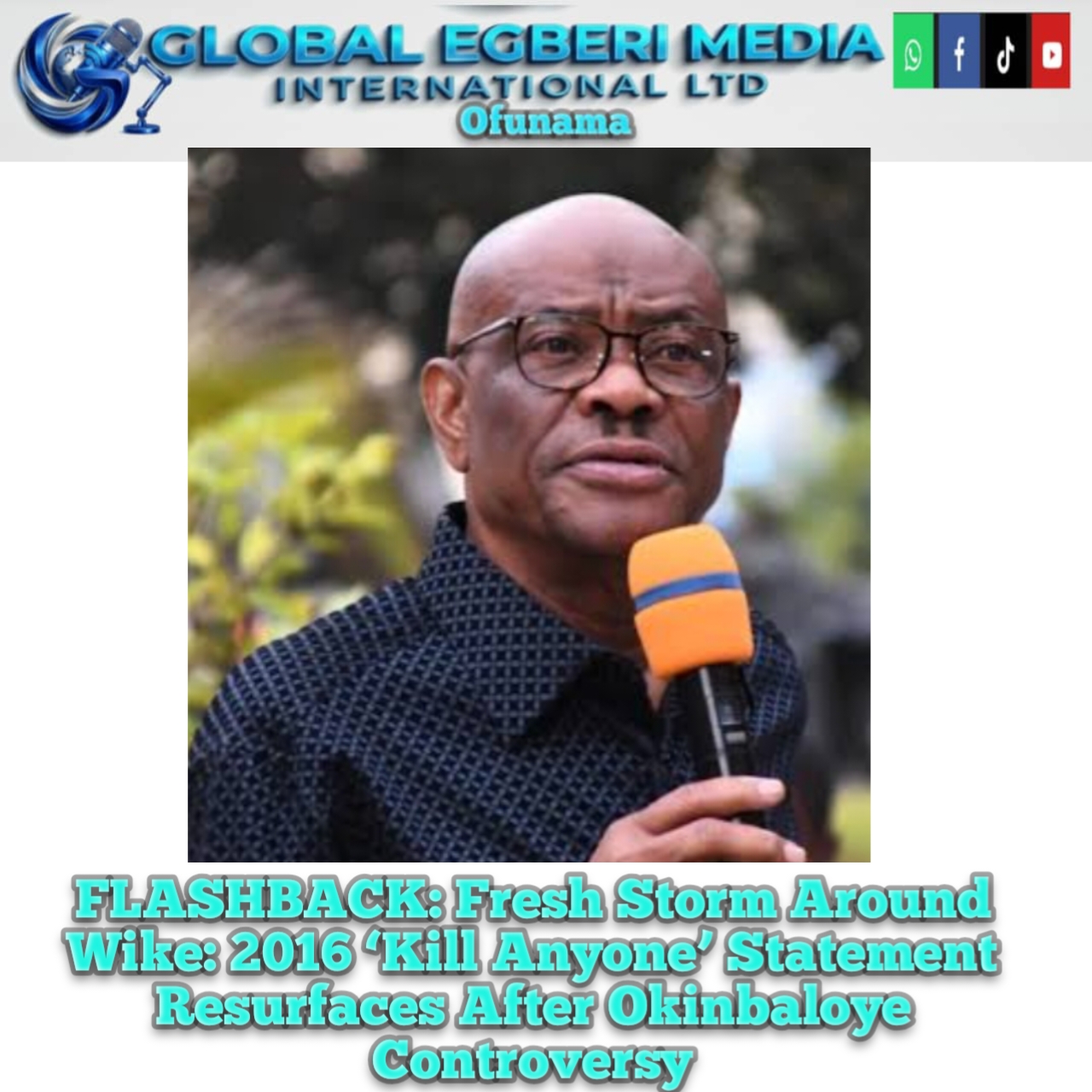
FLASHBACK: Fresh Storm Around Wike: 2016 ‘Kill Anyone’ Statement Resurfaces After Okinbaloye Controversy
By Dr. Odimientimi Agbedeyi
Introduction
A wave of controversy has erupted across Nigeria’s political and media landscape following recent remarks attributed to Nyesom Wike, Minister of the Federal Capital Territory (FCT), over an alleged threat directed at a television journalist. The development has reignited public scrutiny of the former Rivers State governor’s past statements, particularly a widely circulated 2016 comment in which he reportedly declared a willingness to “kill anyone” who interfered with electoral processes.
The resurfacing of these past remarks has sparked intense debate over political rhetoric, press freedom, and the boundaries of power in Nigeria’s democratic space.
Fresh Controversy: Alleged Threat to a Journalist
The latest uproar stems from comments allegedly made by Wike concerning Seun Okinbaloye, a prominent broadcaster with Channels Television. Reports indicate that Wike issued strong warnings following media coverage perceived as unfavorable, with critics interpreting the remarks as a threat against the journalist.
Although the full context of the statement remains subject to interpretation, the incident has drawn condemnation from media professionals, civil society groups, and political observers who view it as a potential affront to press freedom.
Media rights advocates argue that such rhetoric, especially when directed at journalists, could create a chilling effect within the industry, discouraging objective reporting and undermining democratic accountability.
Flashback to 2016: The ‘Kill Anyone’ Statement
The controversy has been amplified by the resurfacing of a 2016 statement made during Wike’s tenure as Governor of Rivers State. At the time, he was quoted as saying he would “kill anyone” who attempted to manipulate electoral processes involving the Independent National Electoral Commission (INEC).
The remark was reportedly made in the context of heightened political tensions and concerns over election integrity. Wike had positioned himself as a staunch defender of the electoral mandate, warning against interference by perceived political adversaries.
However, critics have long argued that the language used was extreme and potentially dangerous, even if intended as a rhetorical expression of resolve.
Connection to Fayose: A Pattern of Strong Language
Further fueling the debate is the recollection of Wike’s past interactions with Ayodele Fayose, a former governor known for his outspoken political style. During politically charged moments, both figures were associated with fiery rhetoric, reflecting the intense nature of Nigeria’s political discourse at the time.
Observers note that such language, while not uncommon in Nigeria’s political arena, raises concerns about the normalization of aggressive speech among public office holders.
Public Reaction and Media Outcry
The re-emergence of these past comments has triggered widespread reactions across social media and traditional platforms. Many Nigerians have expressed concern over what they perceive as a pattern of confrontational rhetoric by influential political figures.
Journalists and media organizations, in particular, have called for greater respect for press freedom, emphasizing the critical role of the media in holding power accountable.
Civil society organizations have also weighed in, urging political leaders to exercise restraint in their public statements and to uphold democratic values, including freedom of expression and the protection of journalists.
Press Freedom Under the Spotlight
The incident has once again brought attention to the state of press freedom in Nigeria. While the country operates under a democratic system with constitutional guarantees for free speech, journalists often face challenges ranging from intimidation to legal pressures.
Analysts warn that statements perceived as threats—whether explicit or implied—can undermine confidence in the safety and independence of the media.
The role of organizations like Channels Television remains crucial in providing balanced and investigative reporting, especially in a complex political environment.
Political Rhetoric and Democratic Responsibility
At the heart of the controversy lies a broader question about the nature of political communication in Nigeria. Strong language and dramatic expressions have often been used by politicians to convey determination or rally support.
However, experts argue that public officials must balance assertiveness with responsibility, ensuring that their words do not incite fear, violence, or misinterpretation.
The resurfacing of Wike’s past statements serves as a reminder that political rhetoric does not exist in isolation; it shapes public perception and can have lasting implications.
Calls for Accountability and Restraint
In light of the current situation, calls have intensified for greater accountability among political leaders. Stakeholders are urging public office holders to adopt more measured and constructive language, particularly when addressing sensitive issues involving the media.
There have also been demands for clarification from Wike regarding his recent comments, with many seeking reassurance that journalists can carry out their duties without fear of intimidation.
Conclusion
The renewed attention on Nyesom Wike’s past and present remarks underscores the enduring impact of political speech in Nigeria. As the controversy surrounding his alleged threat to Seun Okinbaloye continues to unfold, it highlights the delicate balance between authority, accountability, and freedom of expression.
For Nigeria’s democracy to thrive, both political leaders and media practitioners must operate within a framework of mutual respect and responsibility. The unfolding debate is not just about one individual—it is about the standards that define public discourse and the future of democratic engagement in the country.
About the Author