
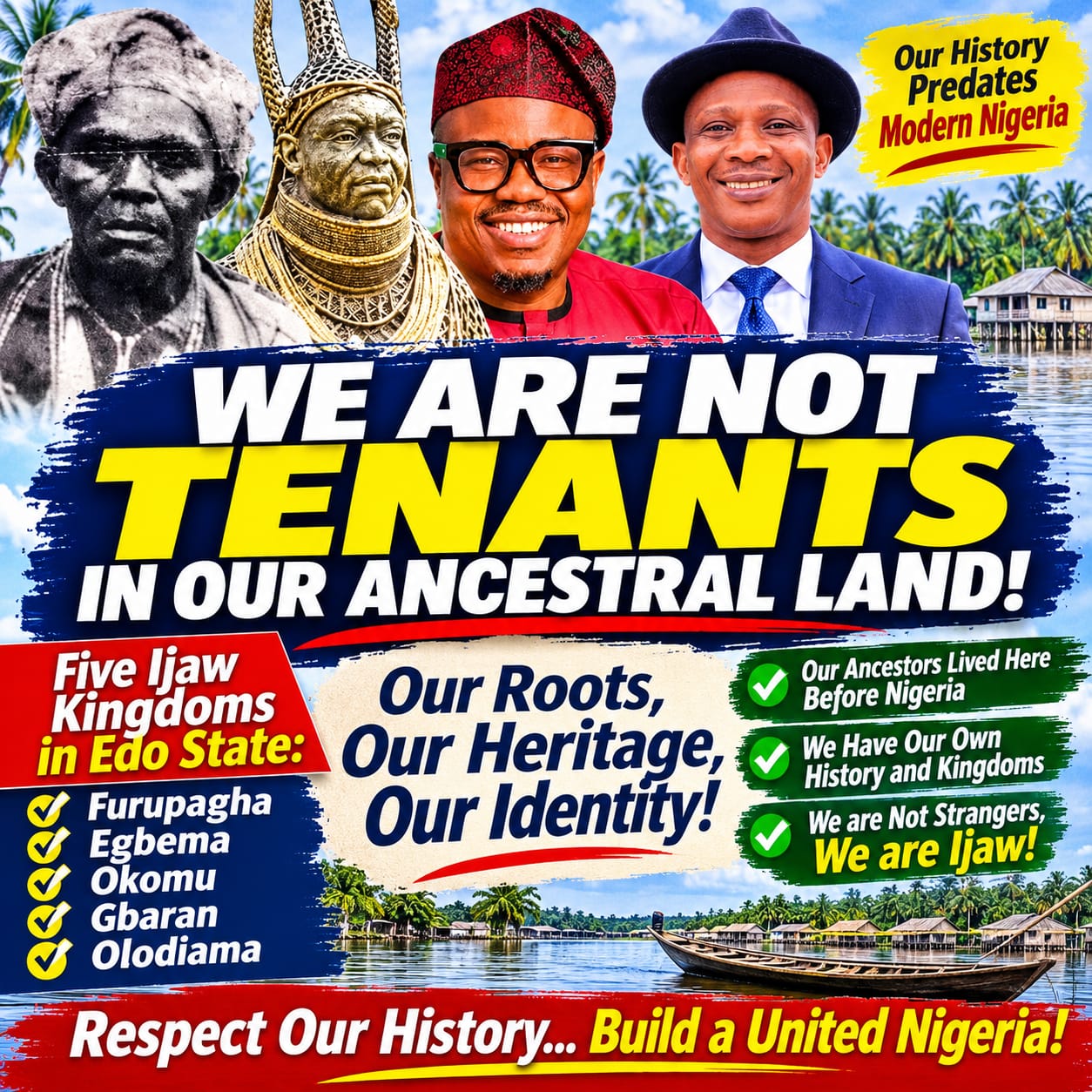
AN IJAW MAN’S RESPONSE TO CBSCO: OUR ANCESTORS WERE HERE BEFORE YOUR POLITICAL BOUNDARIES WERE DRAWN – WE ARE NOT TENANTS IN OUR ANCESTRAL HOMELAND
By Dr. Odimientimi Agbedeyi
I have carefully read the purported formal summons issued by the Coalition of Benin Socio-Cultural Organisations (CBSCO) to Hon. Charity Aguobarueghian over his reported statement concerning the historical identity of the Ijaw people.
Although the letter is not addressed to me, I consider it necessary to respond as an Ijaw man, a proud son of the Niger Delta and someone who believes that historical truth must never be sacrificed on the altar of ethnic superiority, political influence or territorial intimidation.
Let me make one thing abundantly clear: THE IJAW PEOPLE ARE NOT TENANTS IN THEIR ANCESTRAL HOMELAND, AND OUR EXISTENCE IN PRESENT-DAY EDO STATE DOES NOT REQUIRE THE PERMISSION OR VALIDATION OF ANY SOCIO-CULTURAL ORGANISATION.
The attempt to summon a serving member of the Edo State House of Assembly to account to a coalition of ethnic organisations for expressing a historical opinion raises fundamental questions about the meaning of cultural coexistence, freedom of expression and the rights of indigenous communities.
Who appointed CBSCO as the historical tribunal of the Ijaw people?
Who conferred upon the coalition the authority to determine the ancestral identity of another ethnic nationality?
And by what historical instrument does a contemporary socio-cultural organisation assume the power to question the indigenous status of communities whose ancestral existence predates the political boundaries of modern Nigeria?
These are questions worth answering.
1. FIVE IJAW KINGDOMS EXIST IN PRESENT-DAY EDO STATE
For the avoidance of doubt, the Ijaw presence in Edo State is not a recent development, nor is it an accidental settlement created by modern migration.
There are five recognised Ijaw kingdom groupings in the present-day Edo State:
- Furupagha Kingdom.
- Egbema Kingdom.
- Okomu Ijaw Kingdom.
- Gbaran Kingdom.
- Olodiama Kingdom.
These are not imaginary settlements. They are established Ijaw communities with their own ancestral histories, traditional institutions, cultural identities and territorial connections.
Interestingly, a report published by The Guardian Nigeria on September 29, 2026, titled “Ijaw in Edo demand recognition of kingdoms”, independently identifies these five kingdoms and reports their demand for recognition.
This is important because it demonstrates that the question of Ijaw identity and traditional recognition in Edo State is a real historical and contemporary issue, not an invention of any individual politician.
2. OUR ANCESTORS DID NOT WAIT FOR NIGERIA TO BE CREATED BEFORE INHABITING THEIR LAND.
Let CBSCO understand this historical distinction.
Nigeria became independent in 1960. The Mid-Western Region was created in 1963. Bendel State emerged in 1976, while Edo State was created in 1991.
But were the Ijaw people of these territories born in 1963, 1976 or 1991?
Absolutely not!
Our ancestors had established their settlements, fishing communities, family lineages, traditional institutions and ancestral territories long before these administrative arrangements came into existence.
The creation of a state does not create the people inhabiting it. Neither does the alteration of administrative boundaries transfer the ownership of ancestral history from one ethnic nationality to another.
Edo State is a modern administrative designation. The people and communities within its geographical boundaries have histories that extend far beyond the creation of that state.
You cannot use a modern political map to erase an ancient people’s historical existence.
3. OUR ANCESTORS ARE BURIED IN THE LAND WE INHABIT TODAY.
This is not merely an argument about political boundaries or contemporary ethnic identification.
It is about ancestral continuity.
Our forefathers lived, raised families, established communities and were buried in the territories our people continue to inhabit today.
Their graves, ancestral shrines, family histories, traditional institutions and inherited cultural practices are part of our historical connection to these territories.
Many of our communities possess oral genealogies and ancestral accounts that have been preserved across generations.
We did not arrive yesterday. We did not arrive because Edo State was created. We did not arrive because somebody gave us permission to occupy our ancestral settlements.
Our history is rooted in these communities.
If CBSCO wishes to challenge this assertion, the responsible approach is to undertake an independent historical investigation involving the traditional institutions, elders, historians and ancestral records of the affected Ijaw kingdoms.
Historical questions deserve historical investigation, not ethnic intimidation.
4. WE HAVE NEVER REGARDED OURSELVES AS TENANTS OR TRIBUTE-PAYING SUBJECTS.
Let me also address the persistent insinuations that the Ijaw people in present-day Edo State are tenants, strangers, settlers or subordinate populations of the Benin people.
Speaking from the historical accounts and inherited traditions of our communities, our ancestors maintained their own settlements, ancestral institutions and traditional identities.
Our communities have never understood their existence as a tenancy arrangement requiring perpetual rent or tribute to another ethnic nationality.
We do not accept the description of our ancestral communities as properties belonging to another people.
If anyone claims that our ancestors were tenants, captives, slaves or tribute-paying subjects, let such a person produce the specific historical evidence.
Which ancestors?
Which kingdom?
Under whose authority?
During what period?
What documented tribute arrangements existed?
Which historical records establish such a relationship?
These are legitimate historical questions. They should be answered with evidence rather than assumptions.
We are equally prepared to have our own historical traditions examined.
5. HISTORICAL CONTACT DOES NOT MEAN ETHNIC OWNERSHIP.
One of the greatest errors in ethnic historical arguments is the assumption that historical interaction automatically establishes ethnic origin or political ownership.
The Ijaw and Benin peoples have had historical interactions, trade relationships, cultural contacts and, in some cases, migration connections.
That history deserves honest examination.
Professor Ebiegberi Joe Alagoa’s scholarly work, Oral Tradition among the Ijo of the Niger Delta, published in the Journal of African History, examines Ijaw traditions of origin and the importance of ancestral institutions in reconstructing Ijaw history.
The work also acknowledges early contacts between Ijaw communities and Benin.
However, historical contact is not proof that an entire ethnic nationality originated from another.
The existence of historical relationships between two peoples does not erase their separate identities.
The Ijaw people have their own language, cultural institutions, ancestral traditions, kingdoms and historical experiences.
Our identity cannot be reduced to somebody else’s interpretation of our history.
6. THE QUESTION OF INDIGENEITY MUST NOT BE CONFUSED WITH MODERN ADMINISTRATIVE OWNERSHIP.
The Ijaw people are one of the ancient indigenous populations of the Niger Delta.
Our historical presence extends across the territories that are today divided among Bayelsa, Rivers, Delta, Ondo and Edo States.
These state boundaries are administrative creations. They do not define the beginning or end of Ijaw civilisation.
Indeed, the existence of Ijaw communities across several modern states demonstrates the geographical spread of our people.
The question CBSCO should be willing to address is this:
Why should an Ijaw community lose its historical identity simply because its ancestral territory falls within the administrative boundaries of a state predominantly associated with another ethnic nationality?
Does geographical inclusion automatically translate into ethnic ownership?
Does living within Edo State make an Ijaw man a Benin man?
Certainly not.
We can coexist as Nigerians, respect our neighbours and acknowledge the historical importance of the Benin Kingdom without surrendering our own ancestral identity.
7. OUR CHALLENGE TO CBSCO
Since CBSCO has chosen to issue a formal summons demanding historical accountability from an elected representative, I believe the same standard of accountability should apply to everyone making historical claims.
We therefore challenge CBSCO to make its historical position available for independent academic examination.
Let the coalition provide:
- Documentary evidence establishing the historical status it attributes to the five Ijaw kingdoms.
- Archival records supporting claims that these Ijaw communities were historically tenants, captives or subordinate populations.
- Historical evidence establishing the specific nature of any tribute obligations it claims existed.
- Recognised historical records showing when and how the ancestral territories of these communities became subject to the political authority CBSCO describes.
- Evidence demonstrating why the independent ancestral traditions of these Ijaw communities should be dismissed.
Historical accountability must be reciprocal.
If Hon. Charity Aguobarueghian is expected to provide historical evidence, those questioning him must also be prepared to provide evidence for their own assertions.
No ethnic organisation should assume that its interpretation of history is beyond examination.
8. OUR POSITION IS PEACEFUL COEXISTENCE, NOT ETHNIC CONFRONTATION.
Let me conclude by emphasising that this intervention is not an attack on the Benin people.
The Benin people have a remarkable history, a respected traditional institution and a rich cultural heritage. Their history deserves respect.
But the Ijaw people also have a history, a heritage and an ancestral identity that deserve equal respect.
Respecting Benin history must not require the erasure of Ijaw history.
Respecting Ijaw history must not require the denial of Benin history.
We can live together, trade together, participate in the same political institutions and pursue development together without one ethnic nationality claiming superiority over another.
I am proud to be an Ijaw man. I am proud of my ancestors, my heritage and the Niger Delta civilisation from which I come.
I do not need to diminish the history of the Benin people to establish the dignity of my own people.
And neither should anybody attempt to diminish the Ijaw people to elevate another ethnic nationality.
MY FINAL MESSAGE TO CBSCO IS SIMPLE: OUR ANCESTORS WERE HERE BEFORE YOUR MODERN POLITICAL BOUNDARIES. OUR HISTORY DID NOT BEGIN WITH EDO STATE, AND OUR IDENTITY WILL NOT BE DETERMINED BY A SUMMONS FROM ANY SOCIO-CULTURAL ORGANISATION.
We are Ijaw. We know our roots. We honour our ancestors. We respect our neighbours.
But we shall never surrender our ancestral identity.
WE ARE NOT TENANTS IN OUR HOMELAND. WE ARE NOT STRANGERS IN OUR ANCESTRAL TERRITORIES. WE ARE NOT A PEOPLE WITHOUT HISTORY.
Our history deserves to be documented, respected and preserved.
Signed,
Dr. Odimientimi Agbedeyi
A Proud Son of the Ijaw Nation
Niger Delta, Nigeria.
About the Author





Well said sir. Thank you so much