
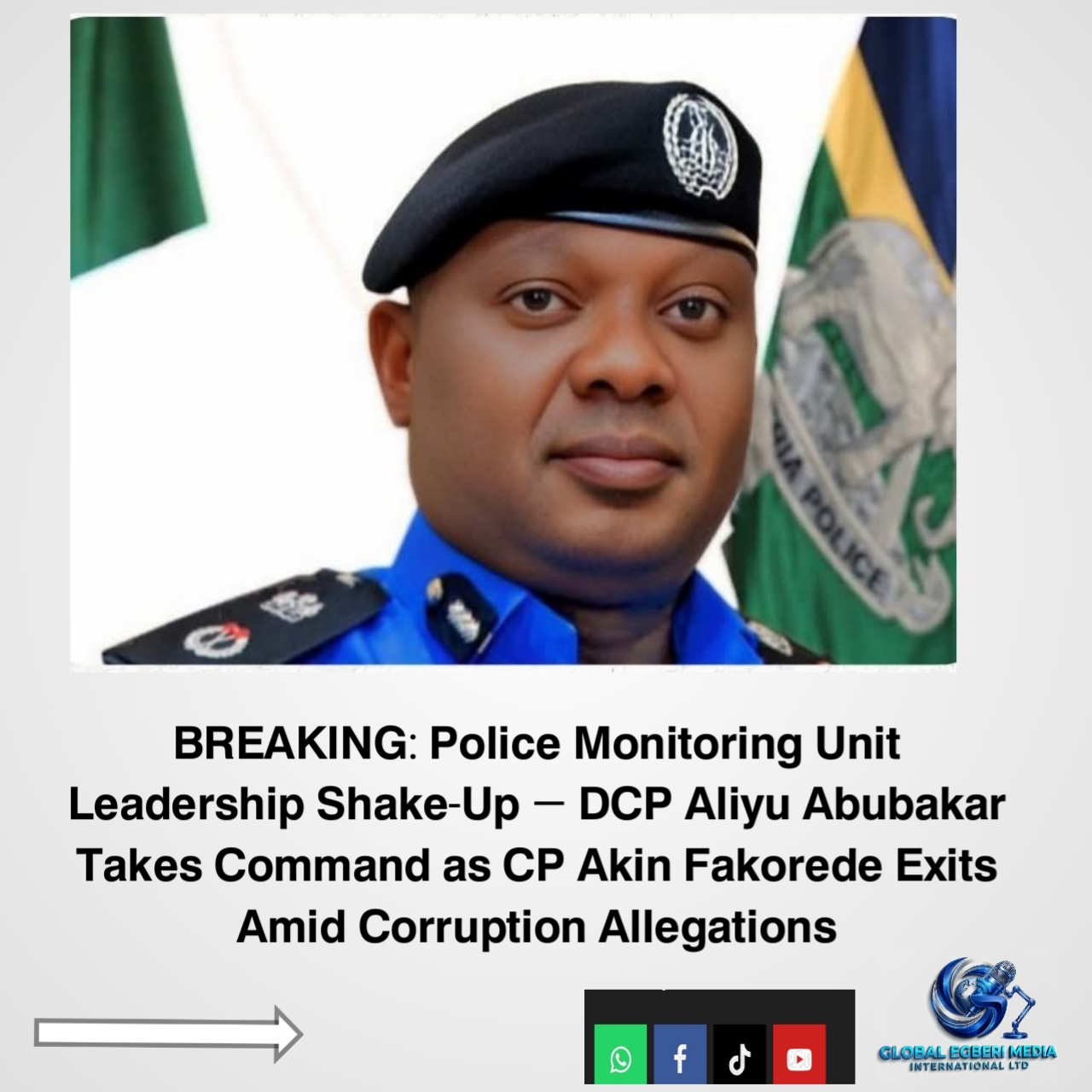
Nigeria’s policing architecture has once again witnessed a dramatic administrative metamorphosis as Deputy Commissioner of Police (DCP) Aliyu Abubakar formally assumes leadership of the Inspector General of Police Monitoring Unit, succeeding Commissioner of Police (CP) Akin Fakorede, whose controversial tenure ended amid a maelstrom of corruption allegations, human rights concerns, and institutional distrust.
The leadership recalibration, which has generated significant discourse within Nigeria’s security and governance ecosystem, is widely interpreted as a strategic attempt by the hierarchy of the Nigeria Police Force to reinforce internal accountability mechanisms and restore professional rectitude within the ranks.
A Strategic Transition in the Police Monitoring Architecture
Reliable security sources revealed that the newly appointed monitoring chief, Aliyu Abubakar, has been saddled with an expansive supervisory mandate. His responsibilities include ensuring meticulous surveillance of police officers’ conduct nationwide, overseeing rigorous investigations into allegations of professional misconduct, and executing special directives issued by the Inspector General of Police.
The monitoring unit, regarded as one of the most sensitive internal oversight bodies within the police establishment, plays a critical role in safeguarding ethical discipline across the force.
According to insiders familiar with the directive, Abubakar’s appointment represents an institutional recalibration designed to “reinvigorate operational transparency and eradicate systemic impropriety within the force.”
The Fall of Fakorede: A Tenure Enmeshed in Controversy
The departure of Akin Fakorede follows weeks of mounting controversy and internal review. Reports earlier indicated that Fakorede had been placed on compulsory leave for forty days and subsequently reassigned to head the Research Department of the force.
Prior to his removal, Fakorede served as the head of the IGP Monitoring Unit at the Force Headquarters in Abuja, a position he assumed in December 2024 under the leadership of former Inspector General of Police Kayode Egbetokun.
However, his appointment was greeted with vehement opposition from several human rights organisations that cited his past record as a commander of the now-defunct Special Anti-Robbery Squad.
These organisations accused him of involvement in incidents of brutality, extrajudicial actions, and operational excesses that allegedly undermined public confidence in the police institution.
Wike’s Scathing Rebuke
Adding to the already combustible narrative was the public condemnation from Nyesom Wike, the Minister of the Federal Capital Territory, who did not mince words while speaking during a televised interview on Channels Television.
Wike described Fakorede in blistering terms, referencing his previous activities while commanding SARS operations in Rivers State.
The minister asserted that he had earlier warned the police leadership about the potential reputational damage Fakorede’s appointment could inflict on the monitoring unit.
He also disclosed that the Independent National Electoral Commission had reportedly expressed reservations regarding Fakorede’s involvement in electoral processes due to past allegations of interference.
River Park Estate Controversy
Fakorede’s leadership period also became entangled in a contentious land dispute involving the River Park Estate, where his actions allegedly displayed bias against foreign investors.
The situation escalated in January 2026 when officers attached to the monitoring unit reportedly clashed with journalists and protesting workers at the estate.
The confrontation intensified public scrutiny of the unit and further amplified calls for accountability within the force.
The Afriq Arbitrage Scandal
Perhaps the most consequential controversy associated with Fakorede’s tenure involved allegations surrounding international fraud suspect Jesam Michael, the chief executive officer of Afriq Arbitrage System.
Investigative reports suggested that despite compelling evidence linking Michael to an alleged Ponzi operation that reportedly defrauded over 56,000 investors, Fakorede repeatedly dismissed allegations against the businessman.
Financial forensic analyses reportedly traced approximately $1.6 billion to digital wallets associated with the scheme, representing funds contributed by thousands of unsuspecting participants.
Insiders within law enforcement circles alleged that Michael enjoyed unusually cordial relationships with several officers, with some reportedly referring to him by the honorific nickname “Odogwu,” a term suggesting admiration or reverence.
A Test of Institutional Integrity
The appointment of Abubakar is therefore being interpreted not merely as a personnel change but as a litmus test for the institutional integrity of the Nigeria Police Force.
Observers argue that the success of the monitoring unit under its new leadership will depend on its ability to demonstrate operational independence, enforce ethical compliance, and restore public confidence in law enforcement oversight.
In a country where allegations of police misconduct frequently dominate civic discourse, the responsibility placed on Abubakar’s shoulders is both enormous and consequential.
For now, the nation watches attentively as the new monitoring chief navigates the labyrinthine complexities of reforming one of the most scrutinised units within Nigeria’s policing system.
Author:
Dr. Odimientimi Agbedeyi
CEO, Global Egberi Media International Ltd.
Source: Sahara Reporters
Homepage: https://globalegberi.com.ng/wp
About the Author