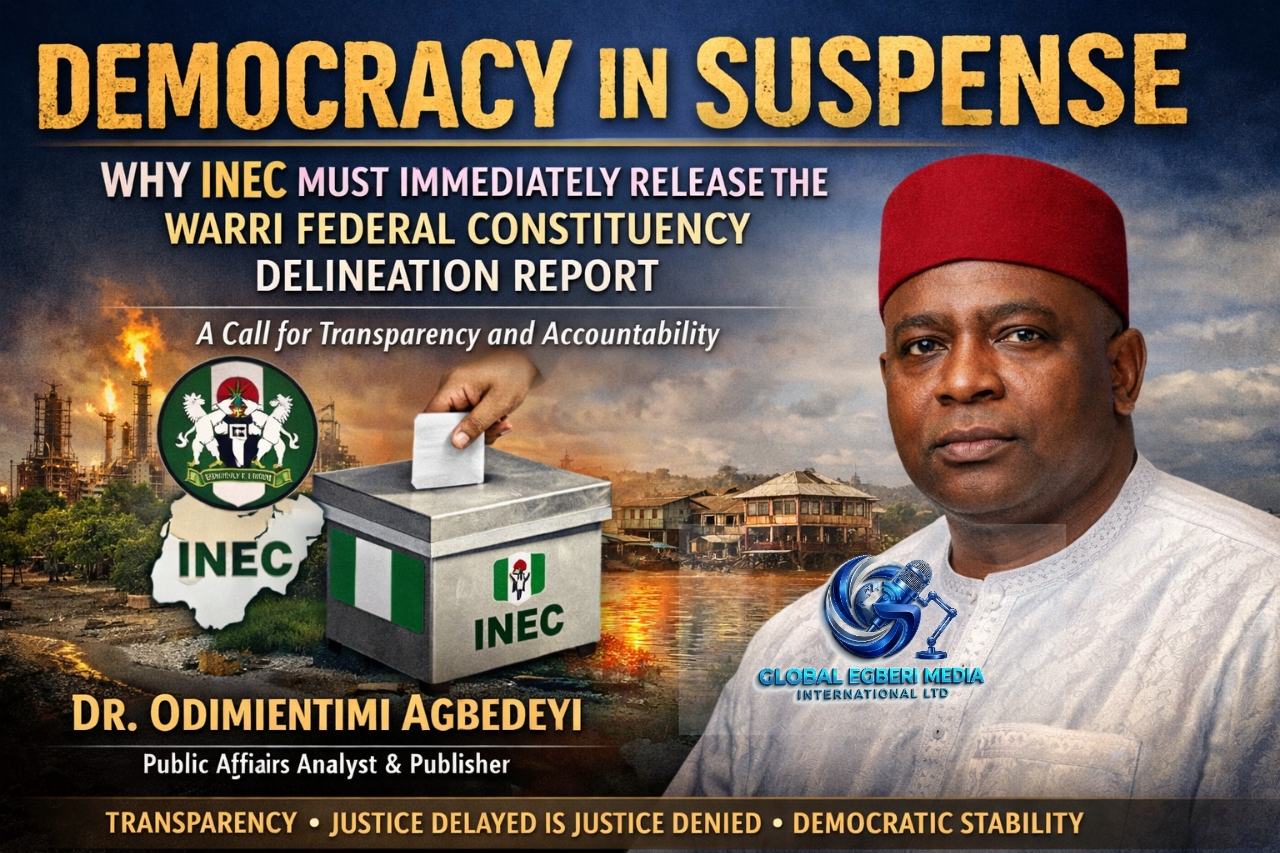
In the theatre of democracy, silence from an institution entrusted with constitutional authority is rarely benign. When that silence concerns a matter as historically delicate and politically combustible as the ward delineation of Warri Federal Constituency, it transcends administrative delay and enters the realm of democratic peril. The continued quietude of the Independent National Electoral Commission (INEC) on the final delineation results has become a troubling anomaly—one that now demands urgent national reflection.
Warri is not merely a geographical constituency; it is a mosaic of histories, identities, and deeply rooted narratives of belonging. For decades, the question of representation within this region has oscillated between historical claims, demographic realities, and political negotiations. Such a terrain requires not only administrative precision but also moral courage from institutions mandated to safeguard democratic equity.
Yet, the prolonged withholding of the final delineation outcome by INEC has begun to cast a long shadow over the Commission’s credibility. In democratic governance, opacity often breeds suspicion, and suspicion—if left unattended—metastasizes into mistrust. What should have remained a technical exercise in electoral administration is rapidly mutating into a crisis of institutional confidence.
The constitutional and legal dimensions of this matter are neither obscure nor ambiguous. The ruling of the Supreme Court in the celebrated case of Timinimi v. INEC underscored an unmistakable principle: electoral delineation is not an optional administrative indulgence but a binding constitutional obligation. The Commission is duty-bound to execute such directives with fidelity to the law and in accordance with transparent procedure.
Consequently, the lingering delay in publishing the final delineation results risks being interpreted not merely as bureaucratic lethargy but as a troubling deviation from judicial authority. In a constitutional democracy, the legitimacy of institutions rests heavily on their willingness to implement court pronouncements without equivocation or procrastination.
But beyond the jurisprudential argument lies an even more urgent concern: the fragile equilibrium of peace within Warri itself.
Warri has historically existed at the confluence of competing ethnic identities and political aspirations. Narratives of origin and territorial legitimacy are not abstract intellectual constructs in this region—they are living realities that influence representation, power distribution, and communal stability. Any process that touches these sensitivities must therefore be handled with utmost transparency and timeliness.
Silence, in such circumstances, is not neutral. Silence becomes an incubator for conjecture. It nourishes misinformation. It empowers opportunistic actors who thrive in the fog of uncertainty. Every day that passes without a clear statement from INEC widens the gulf between institutional authority and public trust.
For an electoral body whose constitutional mandate includes protecting the sanctity of representation, perception is almost as consequential as reality. Even if the Commission is diligently finalizing its technical processes, the absence of communication has inadvertently created a vacuum—a vacuum in which rumours flourish and political anxieties deepen.
INEC must therefore rise above the cacophony of competing narratives and demonstrate the impartiality that the Nigerian Constitution demands. Historical claims must be scrutinized with academic rigor, demographic statistics must be verified with empirical accuracy, and political pressures—however subtle—must be resisted with institutional resolve.
Fairness, however, is not merely a question of outcome; it is also a question of timing. Justice delayed is often perceived as justice denied, and in the sensitive ecosystem of Warri politics, delay may inadvertently trigger consequences far beyond administrative inconvenience.
Nigeria’s democratic journey has repeatedly illustrated how unresolved questions of identity and representation can evolve into combustible disputes. Preventing such escalation requires proactive transparency rather than reactive damage control.
INEC must therefore act decisively.
The final ward delineation report for Warri Federal Constituency must be released immediately—fully, transparently, and without obfuscation. Not in fragments. Not through unofficial channels. Not through carefully managed leaks. But through an open declaration that affirms the Commission’s commitment to constitutional duty and democratic accountability.
This is not merely a bureaucratic requirement; it is a moral imperative.
Institutions derive their legitimacy not only from the powers conferred upon them by law but also from the confidence they inspire among the people they serve. At this moment, the credibility of INEC stands at a delicate crossroads. A prompt and transparent publication of the delineation results would reinforce its reputation as an impartial guardian of Nigeria’s electoral system.
Conversely, continued silence risks allowing suspicion to calcify into disillusionment.
Warri is watching with cautious anticipation. Nigeria is observing with measured concern. And history, ever the impartial archivist of human conduct, will ultimately record whether this moment was met with courage or hesitation.
For in the annals of democracy, it is often not the complexity of challenges that defines institutions—but the timeliness and integrity with which they respond.
By Dr. Odimientimi Agbedeyi
Development Advocate, Public Affairs Analyst, and Media Publisher.
About the Author