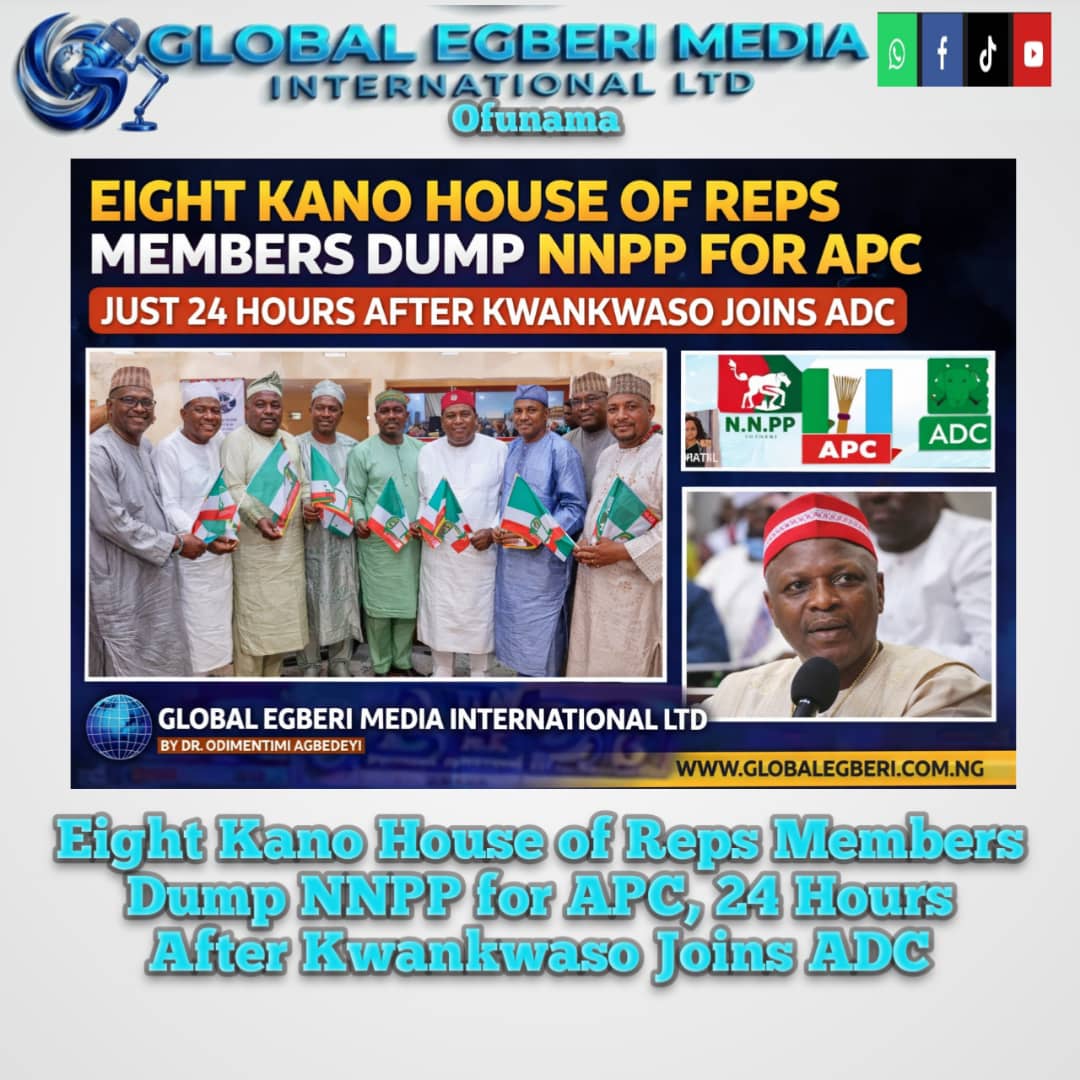
Eight Kano House of Reps Members Dump NNPP for APC, 24 Hours After Kwankwaso Joins ADC
Nigeria’s political landscape continues to experience rapid and dramatic realignments as the nation gradually approaches the 2027 general elections. In a development that has stirred widespread reactions across the political spectrum, eight members of the House of Representatives from Kano State have officially defected from the New Nigeria Peoples Party (NNPP) to the ruling All Progressives Congress (APC).
The defection, which occurred during plenary at the House of Representatives, was formally announced by the Speaker, Rt. Hon. Tajudeen Abbas, who read the letters submitted by the lawmakers explaining their decision to abandon the NNPP. The development came barely twenty-four hours after former Kano State Governor and political heavyweight, Senator Rabiu Musa Kwankwaso, reportedly joined the African Democratic Congress (ADC), triggering a new round of political realignments across Kano State and beyond. (Arise News)
Wave of Defections Rocks Kano Politics
The mass defection of the eight lawmakers represents a significant shift in Kano’s political balance. Kano State, one of Nigeria’s most politically influential states with a large voting population, has long been a battleground for major political parties.
According to reports from the National Assembly, the lawmakers cited the ongoing internal crisis within the NNPP as the primary reason for their defection. In their letters, they expressed concerns over unresolved leadership disputes and political uncertainty within the party, which they argued had made it increasingly difficult for them to effectively represent their constituents under the NNPP platform. (Punch Newspapers)
Political analysts note that defections in Nigeria’s political system are not unusual, especially as elections draw closer. However, the timing of this particular defection has drawn heightened attention due to its proximity to the reported defection of Kwankwaso, widely regarded as the national leader of the Kwankwasiyya political movement.
Kwankwaso’s Move to ADC Triggers Reactions
Just a day before the lawmakers announced their move to the APC, reports emerged that Senator Rabiu Musa Kwankwaso had formally joined the African Democratic Congress (ADC). The former governor, who was the presidential candidate of the NNPP during the 2023 general elections, reportedly made the move as part of broader political calculations ahead of the 2027 polls. (Arise News)
Kwankwaso remains one of the most influential political figures in northern Nigeria, particularly in Kano State where his Kwankwasiyya movement commands strong grassroots support. His departure from the NNPP has therefore created significant uncertainty within the party’s structure in the state.
Observers believe that the exit of such a prominent figure from the NNPP may have weakened the party’s cohesion, thereby prompting several politicians to reconsider their political affiliations.
APC Consolidates Its Strength
With the defection of the eight lawmakers, the APC appears to have further strengthened its numerical advantage in the House of Representatives. Political reports indicate that the APC has continued to gain new members as political realignments intensify nationwide. (The Nation Newspaper)
The APC leadership has welcomed the defecting lawmakers, describing their decision as a sign of confidence in the policies and leadership of the ruling party. Party officials also expressed optimism that the move would further strengthen the party’s influence in Kano State and across the northern region.
Some political stakeholders in Kano have interpreted the development as a strategic consolidation of political forces ahead of the 2027 elections. Kano’s political dynamics often influence national electoral outcomes, making the state a key battleground for major political parties.
Broader Political Realignments in the National Assembly
The defection of the eight Kano lawmakers was part of a broader wave of political movements within the National Assembly. Reports indicate that as many as 27 lawmakers across different political parties changed their affiliations during the same period. (Channels Television)
Such movements are often linked to shifting political alliances, ideological disagreements, and strategic positioning ahead of elections. In Nigeria’s political system, defections are frequently used by politicians as a means of aligning with parties perceived to have stronger chances of electoral victory.
The growing trend of defections has also sparked renewed debates about the ideological identity of political parties in Nigeria. Critics argue that frequent party switching undermines the development of strong party structures and ideological clarity.
Implications for the NNPP
For the NNPP, the loss of eight federal lawmakers from Kano State represents a significant setback. The party had gained national attention during the 2023 elections largely due to the popularity of Kwankwaso and the strength of the Kwankwasiyya movement in Kano.
However, the recent developments suggest that the party may now face internal challenges as political actors reconsider their positions within the evolving political landscape.
Political observers say the future of the NNPP in Kano will largely depend on how its remaining leadership responds to the current crisis and whether it can rebuild confidence among its members.
Kano’s Strategic Role in Nigerian Politics
Kano State remains one of the most politically significant states in Nigeria. With one of the largest voting populations in the country, the state has historically played a decisive role in determining electoral outcomes at the national level.
Major political figures such as former Governor Rabiu Musa Kwankwaso and former Governor Abdullahi Umar Ganduje have built powerful political networks within the state, shaping its political trajectory for decades.
Consequently, any political shift in Kano often has ripple effects across the broader Nigerian political landscape.
Analysts Predict Intense Political Competition Ahead
As the countdown to the 2027 general elections continues, analysts expect more defections and political realignments across various parties.
Political parties are currently repositioning themselves to attract influential figures and strengthen their grassroots structures. In states like Kano, where political loyalties can significantly influence election outcomes, the competition among parties is expected to intensify in the coming months.
For many observers, the defection of the eight lawmakers may only be the beginning of a broader political reshuffling that could reshape the balance of power in Nigeria’s National Assembly.
Conclusion
The defection of eight Kano House of Representatives members from the NNPP to the APC marks yet another chapter in Nigeria’s evolving political landscape. Coming just twenty-four hours after Senator Rabiu Musa Kwankwaso reportedly joined the ADC, the development underscores the fluid nature of political alliances as the nation moves closer to the 2027 elections.
Whether these realignments will ultimately reshape Kano’s political dominance or merely represent temporary shifts remains to be seen. What is clear, however, is that Nigeria’s political terrain is entering a new phase of strategic maneuvering, with major actors positioning themselves for the battles ahead.
Author: Dr. Odimientimi Agbedeyi
Source: Daily Post / The Punch / The Cable
Homepage: https://globalegberi.com.ng/wp
About the Author