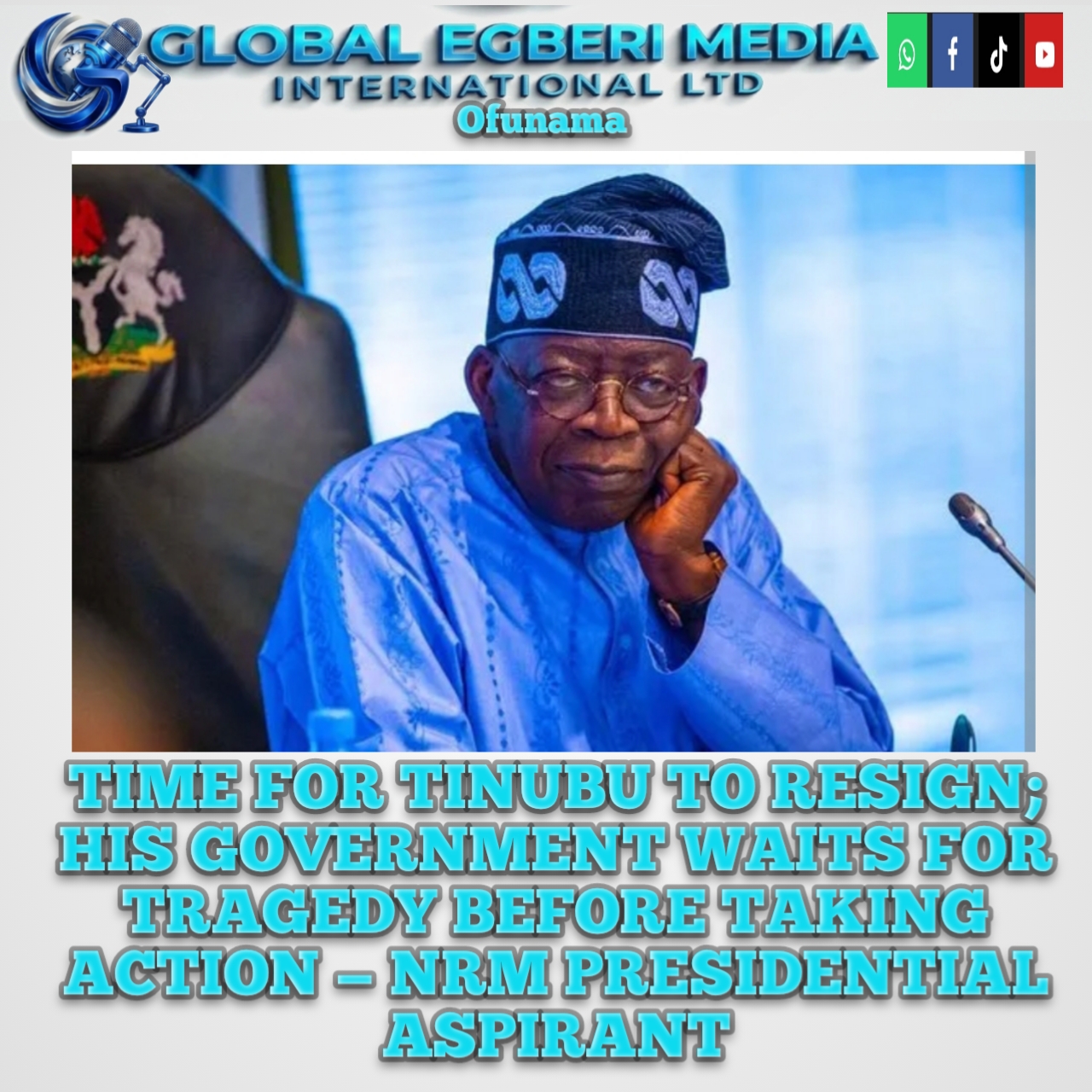
TIME FOR TINUBU TO RESIGN; HIS GOVERNMENT WAITS FOR TRAGEDY BEFORE TAKING ACTION — NRM PRESIDENTIAL ASPIRANT
Nigeria’s political atmosphere has once again been stirred by a strong statement from a presidential aspirant of the National Rescue Movement (NRM), who has openly called on Bola Ahmed Tinubu, the current President of Nigeria, to resign from office.
The aspirant accused the Tinubu administration of failing to respond proactively to critical national challenges, arguing that government action often comes only after avoidable tragedies occur. The statement has since sparked renewed debates across political and civil society circles regarding governance, accountability, and the direction of Nigeria’s democracy.
A Call for Presidential Resignation
According to the NRM presidential hopeful, the current administration has repeatedly demonstrated what he described as a “reactive style of governance,” where decisive government intervention is triggered only after major crises erupt.
He argued that this pattern has created a climate of uncertainty and fear among Nigerians who expect leadership that anticipates problems rather than merely responding to disasters after they occur.
The aspirant reportedly stated that Nigeria deserves leadership that prioritizes prevention, strategic planning, and timely action. In his view, the failure to anticipate national emergencies—whether in security, infrastructure, or economic management—has exposed the country to unnecessary hardship.
He maintained that the country cannot continue to operate under what he described as a governance system that waits for tragedy before implementing reforms.
Criticism of Government Response to National Challenges
The criticism directed at the Tinubu administration reflects a wider frustration among sections of the Nigerian political opposition and civil society groups.
Since assuming office on 29 May 2023, President Tinubu’s government has faced numerous complex challenges including economic reforms, rising living costs, and persistent security threats across different parts of the country. (Wikipedia)
Opposition voices argue that some of the administration’s responses to crises have been delayed or insufficient. They claim that preventive measures could have reduced the scale of certain tragedies experienced in recent years.
The NRM aspirant emphasized that leadership must be measured not only by policy announcements but also by the ability to foresee and mitigate risks before they escalate into national emergencies.
The Broader Political Context
The remarks come at a time when political activities across Nigeria are already beginning to take shape ahead of the 2027 general elections.
President Tinubu recently directed political appointees who intend to contest elective positions in the forthcoming elections to resign their appointments before the stipulated deadline, a move aimed at ensuring compliance with electoral regulations. (OSGF)
Political analysts say such developments indicate that Nigeria’s political landscape is gradually shifting toward the next electoral cycle, with parties and aspirants positioning themselves to challenge the ruling government.
For smaller parties like the National Rescue Movement, strong public criticism of the administration may also serve as a strategy to gain visibility in a political environment dominated by major parties.
Rising Public Debate on Governance
The call for Tinubu’s resignation has triggered discussions among Nigerians on social media and within political commentary platforms.
Supporters of the administration argue that the president inherited significant structural challenges and that reforms require time to produce results. They point to ongoing initiatives in economic restructuring, infrastructure development, and governance reforms as evidence that the administration is actively working to reposition the country.
Critics, however, maintain that the pace of reforms has not matched the urgency of Nigeria’s problems. According to them, leadership must demonstrate greater responsiveness to issues such as insecurity, inflation, and social welfare.
For many citizens, the debate ultimately revolves around the question of accountability—how governments should respond when policies fail or when crises expose systemic weaknesses.
The Role of Opposition Voices
In democratic systems, calls for resignation or leadership change are not unusual. Opposition figures often employ such rhetoric to challenge ruling governments and mobilize public support.
The NRM aspirant’s statement reflects a long-standing tradition within Nigeria’s political landscape where opposition parties seek to hold the government accountable while presenting themselves as alternative leadership options.
Political commentators note that such criticism, while sometimes controversial, can play an important role in strengthening democratic discourse by encouraging transparency and public engagement.
However, they also warn that political rhetoric must be balanced with constructive policy proposals that address the country’s challenges.
Tinubu’s Reform Agenda
Despite criticism from opposition voices, the Tinubu administration has continued to defend its policies under what it describes as the “Renewed Hope Agenda.”
The government has pursued several initiatives aimed at restructuring Nigeria’s economy and governance system. These include fiscal reforms, attempts to improve infrastructure development, and efforts to strengthen national security frameworks.
Supporters of the administration argue that such reforms are necessary to address long-standing structural problems that have accumulated over decades.
They contend that expecting immediate solutions to deeply entrenched issues may be unrealistic.
Nigeria’s Democratic Resilience
Nigeria’s democratic system has evolved significantly since the return to civilian rule in 1999. The country has witnessed multiple peaceful transitions of power and an increasingly vibrant political space where diverse opinions are openly expressed.
Statements such as the one made by the NRM aspirant demonstrate the growing assertiveness of opposition voices within Nigeria’s democracy.
Observers say the real test of democratic maturity lies not only in the ability of leaders to respond to criticism but also in the willingness of political actors to engage in constructive dialogue about national development.
Looking Ahead
As Nigeria continues to grapple with economic, social, and security challenges, the debate about leadership accountability is likely to remain a central theme in national discourse.
Whether the call for President Tinubu’s resignation gains wider political traction remains uncertain. However, the statement has once again highlighted the intense scrutiny faced by governments in a democratic society.
For many Nigerians, the ultimate expectation is simple: leadership that is proactive, responsive, and committed to safeguarding the welfare of citizens.
As political discussions intensify ahead of future elections, voices from both government and opposition will continue to shape the national conversation about Nigeria’s path forward.
Source: Sahara Reporters
Homepage: https://globalegberi.com.ng/wp
Author: Dr. Odimientimi Agbedeyi
About the Author