ZONING WARS AND POWER PLAYS: 10 STATES BRACE FOR POLITICAL SHOWDOWN AS GOVERNORS’ TERMS END IN 2027
By Dr. Odimientimi Agbedeyi
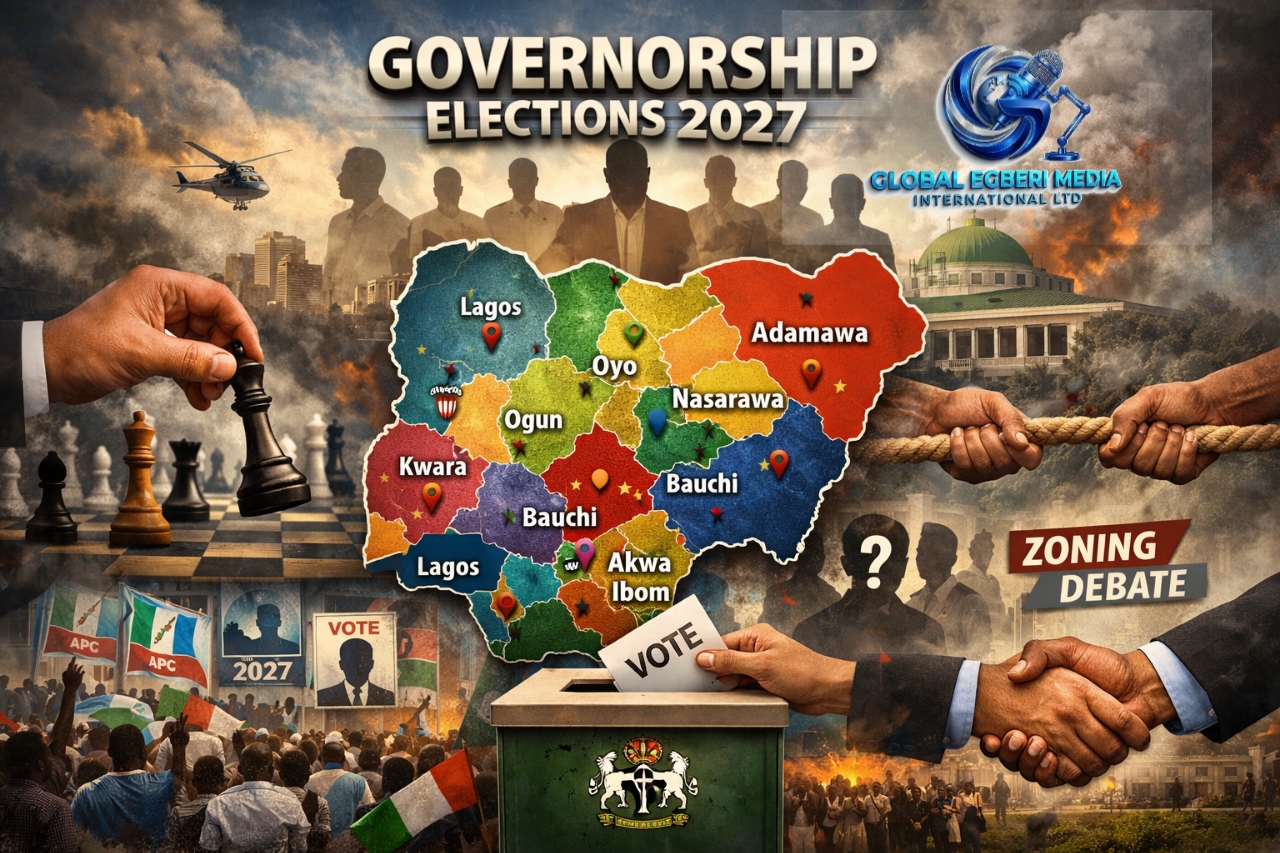
Nigeria’s political environment is gradually heating up as the nation inches closer to the 2027 general elections, with succession battles intensifying across several states where incumbent governors will complete their constitutionally allowed two terms. Across at least ten states—Lagos, Oyo, Ogun, Kwara, Nasarawa, Adamawa, Bauchi, Gombe, Bayelsa, and Akwa Ibom—political actors have begun positioning themselves for what analysts describe as a fierce contest defined by zoning controversies, political realignments, defections, and the influence of powerful political godfathers.
Political observers note that the emerging struggles are not merely about replacing outgoing governors but about determining the future direction of power structures within the states. In many of these states, aspirants ranging from seasoned politicians and technocrats to wealthy businessmen have quietly begun consultations, mobilizing political structures and grassroots networks ahead of the decisive party primaries.
Lagos: The Shadow of Tinubu Looms Large
In Lagos State, the political chessboard is already being set within the ruling All Progressives Congress (APC). The state remains the traditional political stronghold of Bola Ahmed Tinubu, whose influence is widely expected to shape the eventual choice of the party’s governorship candidate.
Several prominent figures have been linked with potential ambitions, including Deputy Governor Obafemi Hamzat, former governor Akinwunmi Ambode, Senator Tokunbo Abiru, the Chief of Staff to the President Femi Gbajabiamila, Lagos State House of Assembly Speaker Mudashiru Obasa, and businessman Seyi Tinubu.
While none of these figures have formally declared their intentions, political watchers believe that consultations and strategic alignments are already underway behind closed doors.
Interestingly, analysts suggest that the incumbent governor Babajide Sanwo-Olu may not wield decisive influence over the choice of his successor, reinforcing the belief that Lagos politics remains largely shaped by the broader APC leadership structure.
Nasarawa: A Crowded Battlefield
In Nasarawa State, the governorship race is already shaping up to be one of the most crowded contests in the country. Political investigations indicate that no fewer than 30 aspirants from multiple political parties are preparing to contest the state’s top seat.
The aspirants are reportedly drawn from parties including the APC, the Peoples Democratic Party (PDP), Social Democratic Party (SDP), African Democratic Congress (ADC), New Nigeria Peoples Party (NNPP), the Labour Party (LP), and the Action Alliance (AA).
This unusually large pool of aspirants highlights the high political stakes involved in the state’s next leadership transition.
Adamawa: Defections Redraw the Political Map
The political configuration in Adamawa State has also experienced significant changes due to recent defections that could reshape the 2027 governorship race.
Former Vice President Atiku Abubakar is reported to have moved to the ADC, while the state governor Ahmadu Umaru Fintiri has reportedly aligned with the APC. These developments are expected to significantly alter the balance of power and alliances ahead of the election cycle.
Political analysts say such realignments may trigger further defections across the state’s political landscape.
Kwara: The Zoning Debate Returns
In Kwara State, the governorship contest is already being shaped by renewed debates over zoning.
The state chapter chairman of the APC, Prince Sunday Fagbemi, stated in late 2025 that the party had not yet made a decision on whether the governorship ticket would be zoned.
This declaration has reignited agitation from political stakeholders in Kwara North Senatorial District, the only zone in the state that has not produced a civilian governor since the return of democracy in 1999. Advocates of zoning argue that fairness and political equity demand that the district should be allowed to produce the next governor.
Ogun: Familiar Faces Return
The political terrain in Ogun State is also witnessing renewed activity from seasoned political actors.
One of the prominent figures linked to the race is Gboyega Isiaka, who currently represents Imeko-Afon/Yewa North Federal Constituency in the House of Representatives.
Isiaka has previously contested the governorship seat three times—under the Peoples Party of Nigeria in 2011, the PDP in 2015, and the ADC in 2019—and political watchers believe he may again enter the contest in 2027.
Early Campaign Signals Across States
Across several states, campaign posters have already begun appearing in strategic locations, signaling the early mobilization of political structures even before formal declarations.
However, many outgoing governors are keeping their succession plans closely guarded. This has left deputy governors and other loyal political allies uncertain about their prospects, despite years of political loyalty.
Analysts say this pattern reflects a broader trend in Nigerian politics where succession decisions are often determined by powerful political networks rather than institutional processes.
Bayelsa and Akwa Ibom: Strategic Calculations Underway
In the South-South region, Bayelsa State and Akwa Ibom State are also expected to witness intense political maneuvering as political stakeholders begin calculating possible succession formulas that could balance ethnic, senatorial, and party interests.
These calculations are particularly significant given the historical role of zoning arrangements in maintaining political stability in many states.
A Prelude to 2027
Political analysts believe the developments currently unfolding across these ten states represent only the early stages of what will likely become one of Nigeria’s most competitive subnational electoral cycles.
As 2027 approaches, alliances will shift, political ambitions will crystallize, and party primaries will eventually determine which aspirants emerge as candidates.
For now, however, the political atmosphere remains one of careful maneuvering, quiet consultations, and strategic positioning as Nigeria’s political class prepares for another defining electoral contest.
Source: Punch Newspaper
About the Author