
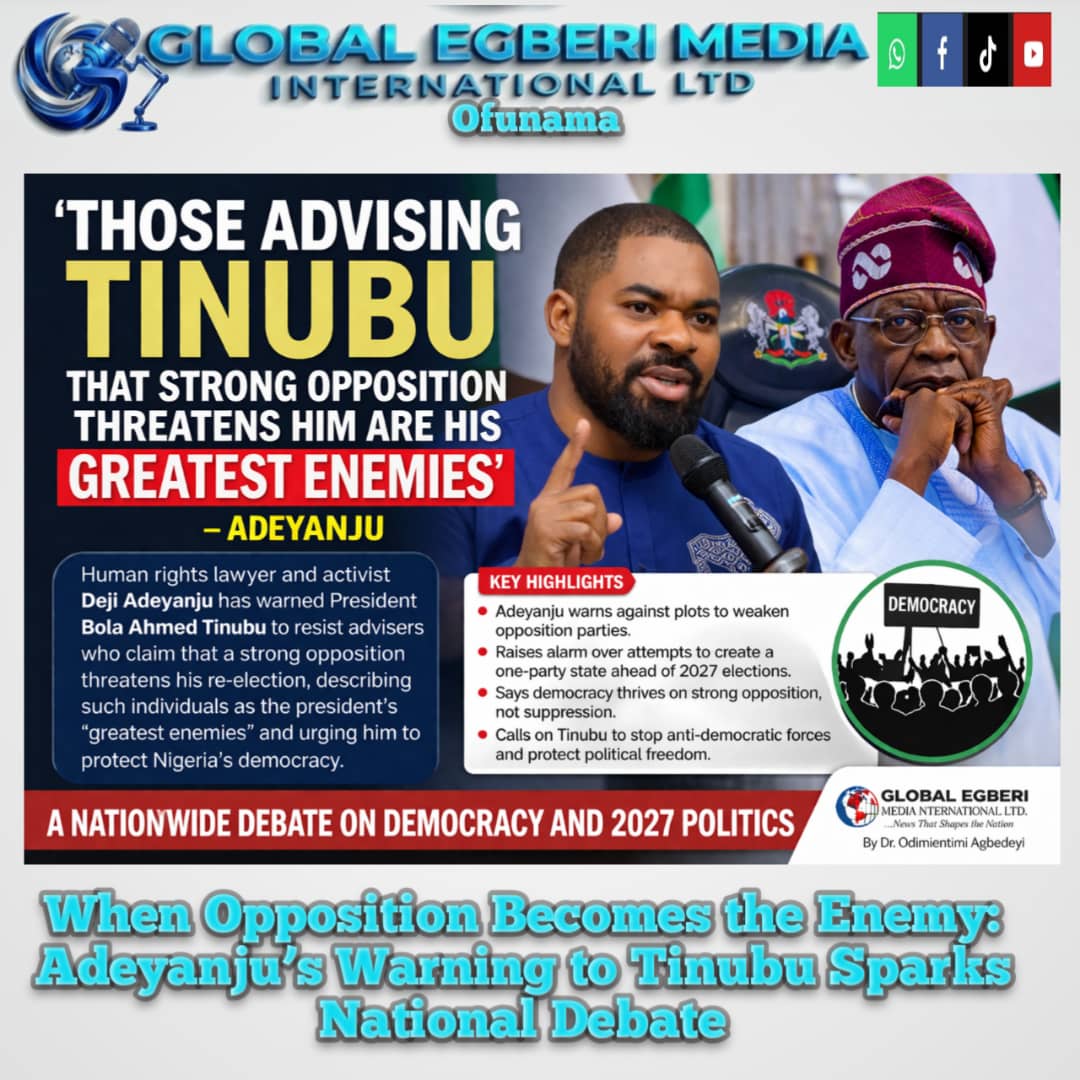
When Opposition Becomes the Enemy: Adeyanju’s Warning to Tinubu Sparks National Debate
Nigeria’s political landscape has once again been stirred by a bold statement from outspoken activist and lawyer Deji Adeyanju, who has warned that those advising President Bola Ahmed Tinubu to fear or suppress a strong opposition may actually be working against the long-term stability of his administration.
The remark, which has generated widespread discussion across political circles, comes amid growing concerns about the health of Nigeria’s democratic space as the nation gradually moves toward the 2027 general elections.
Adeyanju’s Strong Message to the Presidency
In a statement that has since attracted national attention, Adeyanju urged President Tinubu to restrain individuals and forces within his government whom he believes are undermining opposition parties in Nigeria. According to him, the president must resist attempts by advisers who portray political opposition as a threat to his political survival.
Adeyanju warned that such advice is not only misleading but dangerous to the future of democracy.
“The President must recognise that those advising him that a strong opposition threatens his chances of re-election are, in fact, his greatest enemies,” the activist declared. (Daily Post)
His statement reflects growing anxiety among political observers who fear that weakening opposition parties could create an unhealthy democratic environment in Africa’s most populous nation.
Fear of an Emerging One-Party State
Adeyanju did not stop at simply criticizing the narrative around opposition politics. He went further to raise alarm about what he described as a gradual attempt to weaken major opposition platforms in Nigeria.
According to him, recent political developments suggest deliberate efforts to destabilize opposition parties ahead of the next electoral cycle.
He specifically pointed to what he described as sustained attempts to weaken the Peoples Democratic Party (PDP) and the African Democratic Congress (ADC), warning that such actions could gradually push Nigeria toward a dangerous one-party political structure. (Daily Post)
For Adeyanju, the emergence of a dominant political party without effective competition would undermine democratic pluralism and reduce the accountability that healthy opposition provides.
The Role of Opposition in Democracy
Political analysts say Adeyanju’s remarks highlight a fundamental principle of democratic governance: opposition is not an enemy but a necessary component of democracy.
Opposition parties perform several critical functions, including:
- holding the government accountable
- offering alternative policies and ideas
- representing diverse political interests
- strengthening transparency and public debate
Without a functioning opposition, critics argue that democratic systems risk sliding into authoritarian tendencies, even when elections continue to take place.
Adeyanju emphasized that Nigeria’s democracy was built through the sacrifices of many activists, journalists, and politicians who resisted military dictatorship.
Ironically, the president himself once played a role in that democratic struggle. During the military era of General Sani Abacha, Tinubu was part of the pro-democracy movement that fought for the restoration of democratic rule in Nigeria. (Wikipedia)
For Adeyanju and other civil society voices, this historical background makes it even more important for the current administration to protect democratic freedoms.
Courts and Political Battles
Another issue raised by Adeyanju relates to the use of institutions, particularly the judiciary, in political conflicts.
He warned that using legal processes to frustrate opposition parties from fielding candidates in elections could undermine public confidence in Nigeria’s democratic system.
According to him, political competition should be decided by voters through elections, not through legal manoeuvres designed to weaken rivals before the contest begins.
His call reflects a broader debate within Nigerian politics about the increasing number of court cases that shape the internal leadership of political parties.
Calls for National Leaders to Speak Up
Adeyanju also appealed to former presidents, elder statesmen, and influential national figures to speak out against any attempt to undermine democratic pluralism.
He described the current period as a defining moment for Nigeria’s political future, urging respected leaders across the country to defend democratic values.
“This is a defining time for our democracy,” he said, calling on well-meaning Nigerians to resist any attempt to reduce political competition. (Gistmania)
Such calls highlight the belief among many activists that safeguarding democracy requires collective vigilance from both citizens and political leaders.
Political Realignments Ahead of 2027
Adeyanju’s remarks also come at a time when Nigeria’s political environment is witnessing major shifts.
Observers have noted increasing political defections, coalition talks, and strategic alignments among parties as politicians begin positioning themselves for the next national elections.
Historically, Nigeria has experienced intense political realignments in the years leading up to major elections. Similar developments occurred before the 2015 election, when multiple opposition parties merged to form the All Progressives Congress (APC), the party that eventually defeated the long-ruling PDP government.
Today, some analysts believe that opposition forces may again attempt to form strategic alliances to challenge the ruling party in the coming years.
Public Reactions to Adeyanju’s Statement
Adeyanju’s warning has triggered mixed reactions across Nigeria’s political spectrum.
Supporters of his position argue that his statement reflects legitimate concerns about preserving democratic competition. They believe a strong opposition helps strengthen governance by ensuring that leaders remain accountable to the people.
However, some critics argue that political rhetoric surrounding opposition suppression is exaggerated and that Nigeria’s political system remains vibrant with multiple parties actively participating in governance.
Despite the differing views, the debate itself underscores the importance Nigerians attach to democratic freedoms and political competition.
Democracy at a Crossroads
Nigeria’s democracy, which returned in 1999 after decades of military rule, remains one of the most significant political systems on the African continent.
However, maintaining democratic stability requires constant vigilance from both leaders and citizens.
Adeyanju’s warning serves as a reminder that the strength of democracy is not measured only by elections but also by the freedom of opposition voices to challenge those in power.
Whether one agrees with his views or not, the activist’s statement has reignited an important national conversation about the balance between political power and democratic accountability.
A Message Beyond Politics
Ultimately, the core message of Adeyanju’s warning goes beyond the fortunes of any single political party or leader.
It is a call to remember that democracy thrives when multiple voices compete freely within a framework of fairness and respect for the rule of law.
For Nigeria, a nation whose democratic journey has been shaped by sacrifice, struggle, and resilience, the challenge remains clear: protect political diversity, encourage debate, and ensure that power never becomes insulated from accountability.
As the political clock gradually ticks toward the next election cycle, Adeyanju’s words will likely continue to echo across the nation’s political discourse.
Source: Daily Post / NigerianEye
🌐 https://globalegberi.com.ng/wp
Author: Dr. Odimientimi Agbedeyi
About the Author