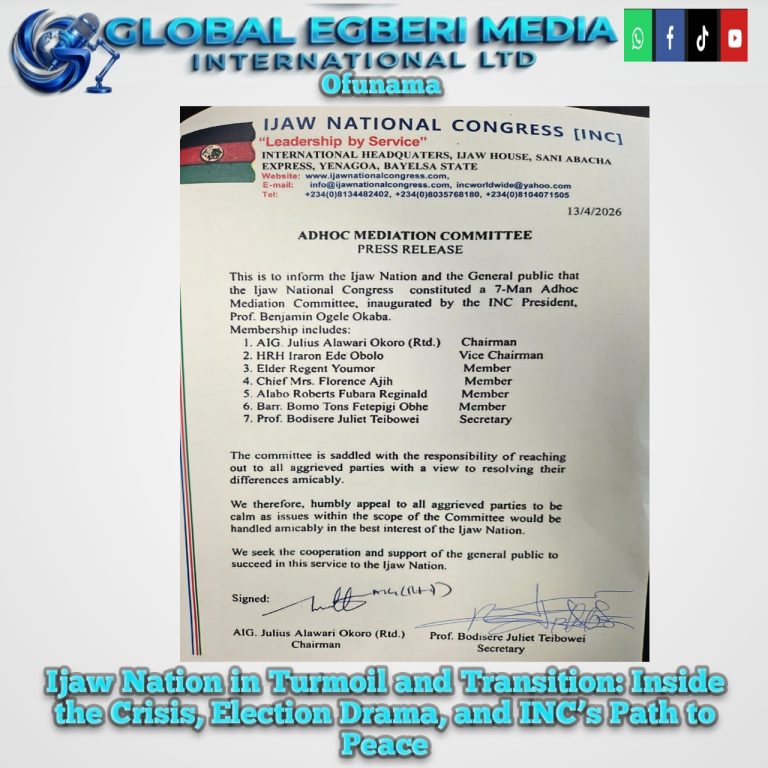
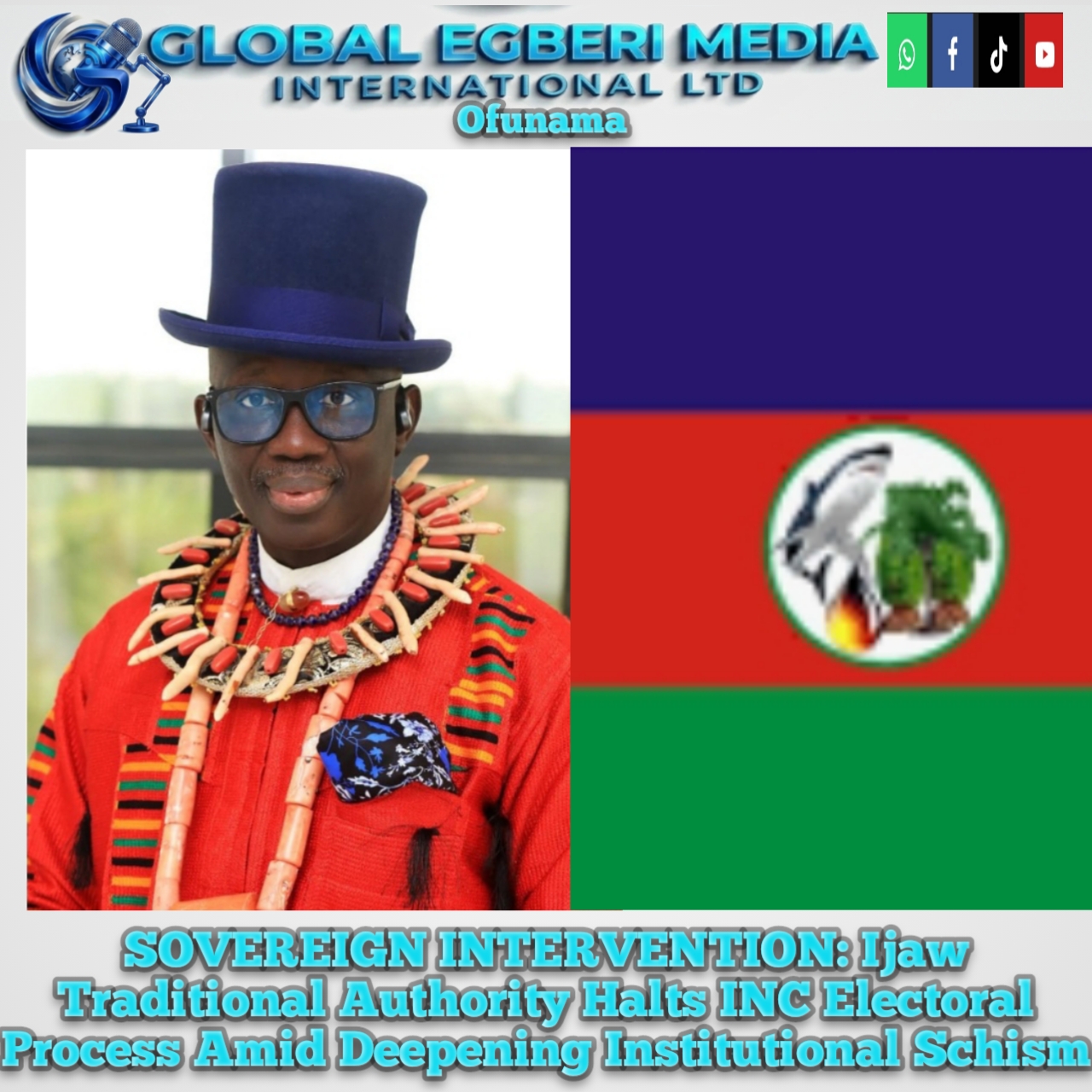
SOVEREIGN INTERVENTION: Ijaw Traditional Authority Halts INC Electoral Process Amid Deepening Institutional Schism
In a moment of profound institutional recalibration and socio-political introspection within the Ijaw nation, the Ijaw National Congress (INC) has been thrust into an unprecedented suspension of its electoral processes by the authoritative intervention of the National Conference of Ijaw Traditional Rulers and Elders (N-CITRE-INC). This decisive action, announced following an exhaustive deliberative conclave in Yenagoa, underscores the gravity of the internal dissonance that has beleaguered the apex socio-cultural organization of the Ijaw people.
The suspension, which effectively halts the previously rescheduled National Executive Council (NEC) elections slated for April 13, 2026, is not merely procedural but emblematic of a deeper quest for institutional sanctity, jurisprudential clarity, and ethical rectitude. The N-CITRE-INC, invoking its constitutional prerogatives as the apex adjudicatory and appointive authority within the INC framework, has directed the National Electoral Committee of the Ijaw National Congress (N-ELECO-INC) to cease all electoral undertakings with immediate effect.
This development emerges against the backdrop of a labyrinthine web of petitions, allegations, and contestations that have cast a pall of uncertainty over the credibility and legitimacy of the impending electoral exercise. The elders and traditional rulers, acting as custodians of Ijaw heritage and arbiters of communal equilibrium, undertook what can be described as a forensic examination of the multifaceted grievances presented before them. Their resolution to suspend the elections is thus a manifestation of prudential foresight rather than administrative caprice.
Central to this intervention is the constitution of a septenary Dispute Resolution Committee (DRC), an assemblage of eminent personalities endowed with both moral gravitas and experiential profundity. The committee is chaired by King Bubaraye Dakolo Agada IV, the Ibenanaowei of Ekpetiama Kingdom and Chairman of the Bayelsa State Traditional Rulers Council, whose reputation for sagacity and impartiality renders him a fitting helmsman for such a sensitive assignment.
Other distinguished members of the committee include King Bright Ateke Fiboinumama, a retired Brigadier General and revered traditional ruler; Chief Dr. Silas Eneyo, representing the Eastern Zone; Dr. Loveth Ige, representing the Central Zone; Pere Luke Kalanama III; and Ekiomi Oweigbe John, representing the Western Zone. This geographically and intellectually diverse composition reflects an intentional inclusivity aimed at engendering holistic and equitable adjudication.
The DRC has been vested with a sweeping mandate to interrogate all extant petitions, including those specifically targeting the conduct and integrity of the N-ELECO-INC itself. This investigative purview is indicative of a systemic approach to conflict resolution, one that seeks not merely to address superficial manifestations but to excavate and rectify foundational anomalies.
The lexicon employed in the official communiqué—replete with references to “honesty,” “peace,” and “cooperation”—is emblematic of a normative framework that prioritizes communal cohesion over factional triumphalism. It is a clarion call to all stakeholders within the Ijaw polity to subordinate parochial interests to the overarching imperative of unity and collective progress.
From a jurisprudential standpoint, the intervention of the N-CITRE-INC can be construed as an exercise in constitutional guardianship. By suspending the electoral process pending the resolution of disputes, the body has effectively forestalled the potential crystallization of illegitimacy that could arise from a contested electoral outcome. Such preemptive action is not only legally defensible but also politically sagacious, as it mitigates the risk of protracted factionalism and institutional fragmentation.
Moreover, this episode serves as a microcosm of the broader challenges confronting indigenous governance structures in contemporary Nigeria. The tension between traditional authority and modern organizational frameworks is palpably evident, yet the N-CITRE-INC’s intervention demonstrates that these paradigms need not be mutually exclusive. Rather, when harmonized judiciously, they can engender a resilient and adaptive governance architecture.
The implications of this suspension are manifold. In the immediate term, it introduces a temporal hiatus in the leadership succession process within the INC. However, in the longue durée, it may well catalyze a paradigmatic shift towards more transparent, accountable, and participatory electoral mechanisms. The success of the DRC’s mandate will thus be pivotal in determining whether this episode is remembered as a moment of crisis or a catalyst for renaissance.
It is also pertinent to consider the socio-cultural ramifications of this development. The Ijaw nation, with its rich tapestry of traditions, values, and communal bonds, has historically placed a premium on consensus-building and elder mediation. The activation of these traditional conflict-resolution mechanisms in the context of a modern organizational dispute is both a reaffirmation of cultural continuity and an adaptive response to contemporary exigencies.
In conclusion, the suspension of the INC elections by the N-CITRE-INC represents a confluence of authority, responsibility, and foresight. It is a testament to the enduring relevance of traditional institutions in navigating the complexities of modern governance. As the Dispute Resolution Committee embarks on its onerous task, the hopes of the Ijaw nation are inextricably intertwined with its ability to deliver a verdict that is not only just but also perceived as such.
The path forward will undoubtedly be fraught with challenges, but it also presents an opportunity for introspection, reform, and renewal. In the final analysis, the true measure of this intervention will lie not in the suspension itself, but in the integrity and inclusivity of the processes that follow.
Report by Dr. Odimientimi Agbedeyi
Global Egberi Media International
🌐 https://globalegberi.com.ng
Source: Daily News Hub
🌐 https://globalegberi.com.ng
About the Author