
INEC Revives Suppressed Constituencies, Reshapes Political Landscape Ahead of 2027 Polls
By Dr. Odimientimi Agbedeyi
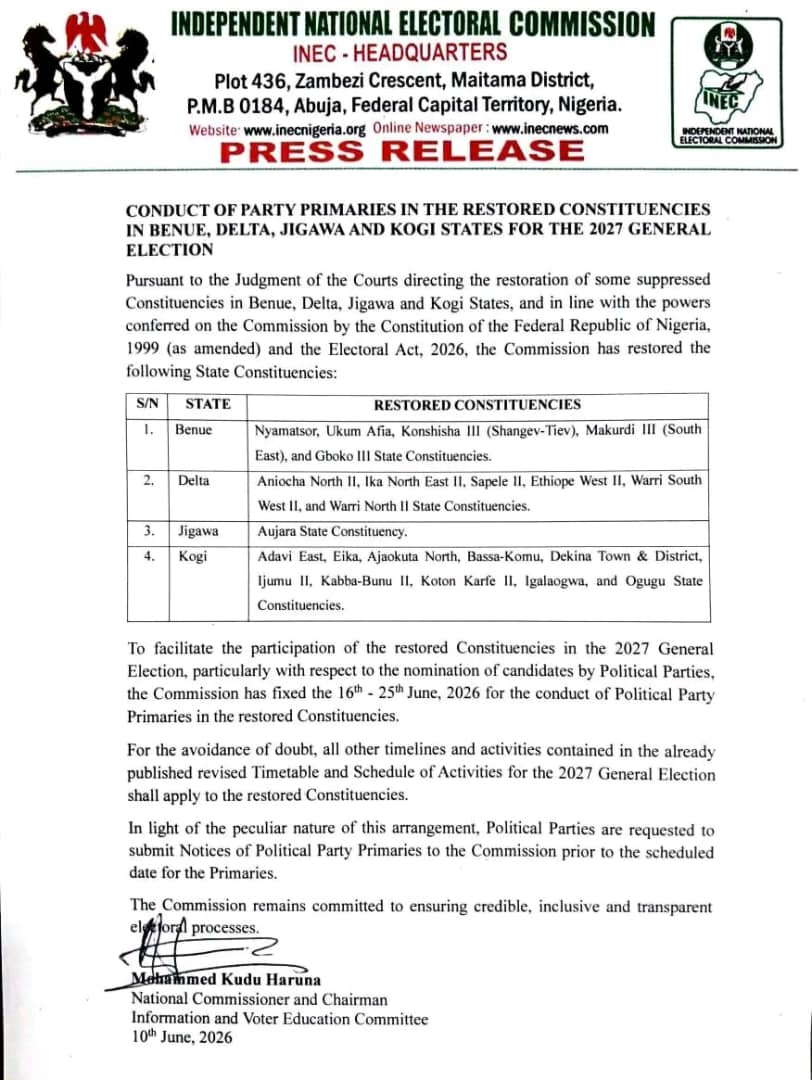
In a development that has reverberated across Nigeria’s political firmament and ignited renewed discourse on electoral representation, the Independent National Electoral Commission (INEC) has officially announced the restoration of several previously suppressed constituencies in Benue, Delta, Jigawa, and Kogi States ahead of the 2027 General Election.
The announcement, contained in a press release issued by the electoral umpire on June 10, 2026, followed judicial pronouncements directing the reinstatement of constituencies that had been excluded from the nation’s democratic architecture. The Commission stated that the restoration was undertaken pursuant to constitutional provisions and powers vested in it by the Electoral Act, 2026.
The decision has been described by political analysts as a monumental recalibration of Nigeria’s electoral cartography and a profound affirmation of democratic inclusivity.
A Triumph of Constitutional Jurisprudence
According to INEC, the restoration exercise was necessitated by court judgments which ordered the reactivation of constituencies that had hitherto been suppressed within the country’s representative framework.
The Commission emphasized that its actions were guided by constitutional imperatives and a commitment to ensuring equitable political participation for all affected communities.
Observers have noted that the decision reinforces the supremacy of the judiciary while simultaneously reaffirming the sanctity of democratic representation in Nigeria’s evolving political ecosystem.
Delta State Emerges Major Beneficiary
Of particular significance is Delta State, where six constituencies have been restored. These include:
- Aniocha North II
- Ika North East II
- Sapele II
- Ethiope West II
- Warri South West II
- Warri North II
Political stakeholders believe the restoration of Warri South West II and Warri North II could profoundly alter existing political calculations within the Niger Delta region, especially considering the historical complexities surrounding representation, resource control, and ethnic interests.
Many analysts predict that the development could trigger intensified political mobilization, strategic realignments, and heightened competition among aspirants seeking elective positions in the restored constituencies.
Other Restored Constituencies Across Nigeria
In Benue State, INEC restored the following constituencies:
- Nyamatsor
- Ukum Afia
- Konshisha III (Shangev-Tiev)
- Makurdi III (South East)
- Gboko III
Jigawa State witnessed the restoration of:
- Aujara State Constituency
Meanwhile, Kogi State recorded the highest number of restored constituencies, namely:
- Adavi East
- Eika
- Ajaokuta North
- Bassa-Komu
- Dekina Town and District
- Ijumu II
- Kabba-Bunu II
- Koton Karfe II
- Igalogwa
- Ogugu
The restoration of these constituencies is expected to broaden democratic participation and ensure that previously marginalized communities enjoy effective legislative representation.
INEC Fixes Dates for Party Primaries
To facilitate the seamless integration of the restored constituencies into the electoral timetable, INEC has scheduled political party primaries for June 16 to June 25, 2026.
The Commission directed political parties intending to field candidates in the affected constituencies to submit notices of their primaries before the stipulated dates.
INEC further clarified that all other activities and timelines already outlined in the revised schedule for the 2027 General Election remain applicable to the restored constituencies.
Political Parties Face Strategic Challenges
The compressed timeframe for conducting primaries presents a labyrinthine challenge for political parties, aspirants, and electoral strategists.
Potential candidates must rapidly consolidate support bases, cultivate alliances, and navigate the intricate dynamics of party politics within a relatively short period.
Political observers warn that failure to adhere strictly to established procedures could precipitate intra-party disputes and legal contests capable of undermining the integrity of candidate selection processes.
A New Chapter in Democratic Inclusion
Beyond the administrative dimensions of the announcement lies a broader democratic significance.
The restoration of the constituencies symbolizes the reintegration of communities that had been relegated to the periphery of political representation. It constitutes a reaffirmation of the principle that every segment of society deserves an authentic voice within the nation’s legislative institutions.
For many affected communities, the development represents not merely a political adjustment but a restoration of democratic dignity and civic visibility.
Implications for the 2027 General Election
As preparations intensify for the 2027 General Election, the restored constituencies are expected to become focal points of political activity and electoral contestation.
The development may influence party strategies, alter voting demographics, and redefine legislative competition across the affected states.
More importantly, it underscores the dynamic nature of Nigeria’s democratic journey, where constitutional remedies and judicial interventions continue to shape the contours of political representation.
With the restoration now officially effected, attention shifts to political parties, aspirants, and voters who must navigate the opportunities and responsibilities that accompany this historic electoral reconfiguration.
Source
Independent National Electoral Commission (INEC) Press Release, June 10, 2026.
Author: Dr. Odimientimi Agbedeyi
About the Author