

PAP: Ogidigba Kicks Against Amnesty Monthly Stipend Increment, Backs Otuaro Reforms
By Dr. Odimientimi Agbedeyi
For Global Egberi Media International Ltd
Gen. Godstime Ogidigba Ogidigba has kicked against the proposed increase in the monthly stipend under the Presidential Amnesty Programme (PAP), arguing that the programme’s fundamental challenges must first be addressed before additional funds are committed.

Gen. Ogidigba, while expressing his position on the development, alleged that beneficiaries and delegates from the Niger Delta captured under Phases 1 to 3 of the Amnesty Programme constitute less than 50 percent of the approximately 30,000 delegates associated with the programme.
According to him, the alleged presence of more than 50 percent non-Niger Delta beneficiaries raises fundamental questions about the original objectives, implementation and impact of the programme.
He argued that increasing the monthly stipend without first addressing what he described as structural problems within the programme would make the increment largely ineffective, particularly if a significant portion of the additional funds does not ultimately benefit people from the Niger Delta region.
Questions Over The Original Foundation Of PAP
Gen. Ogidigba further alleged that the major challenge confronting the Amnesty Programme goes beyond the issue of monthly stipends, stressing that attention must be paid to what he described as the foundation upon which the programme was established.
He alleged that corruption and compromise had affected the implementation of the programme from its early stages, resulting in what he described as the creation of questionable camps and allocation of slots to individuals who, according to him, were not genuine Niger Delta beneficiaries.
He specifically alleged that some Nollywood actors and actresses, top politicians and civil servants from outside the Niger Delta had benefited from slots allegedly meant for genuine participants from the region.
These allegations, however, remain claims by Gen. Ogidigba and would require independent verification and appropriate documentary evidence before being established as facts.
PAP Should Serve Its Original Purpose
Gen. Ogidigba maintained that the Presidential Amnesty Programme was established primarily to develop, train, educate and empower people from the Niger Delta, rather than operate as what he described as a general charity organisation.
He therefore called for a renewed focus on the programme’s original objectives, particularly human-capital development, education, vocational training, entrepreneurship and sustainable empowerment.
According to him, simply increasing monthly stipends without fundamentally strengthening the educational and empowerment components of the programme may provide temporary relief without adequately addressing the long-term challenges facing young people in the Niger Delta.
Otuaro’s Education Initiative Receives Support
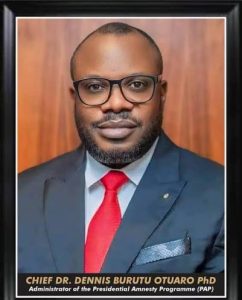
Gen. Ogidigba also expressed support for what he described as the education revolution under the administration of Chief Dennis Otuaro, describing education as a critical pathway to producing a new generation of intellectually equipped leaders capable of taking the Niger Delta to the global stage.
He argued that investment in education and human capital should remain central to the development agenda of the region.
According to him, a sustainable Niger Delta cannot be built solely around monthly stipends. Rather, the region requires a generation of educated, skilled and empowered young people who can compete nationally and internationally while contributing meaningfully to the development of their communities.
He therefore encouraged Niger Deltans to pay greater attention to policies that create long-term opportunities instead of focusing exclusively on immediate financial benefits.
Call For Support And Regional Stability
Gen. Ogidigba appealed to Niger Deltans to set aside grievances, personal interests and sentiments and support the administration of Chief Dennis Otuaro in its efforts to sustain what he described as the fragile peace, stability and security currently existing in the region.
He stressed that the peace and stability of the Niger Delta should remain a collective responsibility, noting that disagreements over policies and programmes should not undermine the broader interests of the region.
He urged stakeholders, youths, traditional leaders, political actors and other concerned Niger Deltans to engage constructively and demand transparency, accountability and programmes that genuinely improve the lives of the people.
The Way Forward
The position expressed by Gen. Ogidigba brings renewed attention to an important question: Should the priority be an increase in monthly stipends, or should the Amnesty Programme first undergo deeper reforms to ensure that its resources reach the intended beneficiaries?
While financial support may provide immediate assistance to beneficiaries, sustainable development requires investment in education, skills acquisition, entrepreneurship, employment and institutional accountability.
For the Niger Delta, the ultimate measure of the success of the Amnesty Programme should therefore not only be the amount paid as monthly stipends, but also the number of young people who acquire quality education, develop sustainable careers, establish businesses and become productive contributors to society.
Gen. Ogidigba’s call is ultimately for a return to the developmental objectives of the programme and for greater emphasis on human-capital development as a foundation for a stronger and more prosperous Niger Delta.
Signed:
Gen. Godstime Ogidigba Ogidigba
Reported by:
Dr. Odimientimi Agbedeyi
Global Egberi Media International Ltd
Source: Statement attributed to Gen. Godstime Ogidigba Ogidigba.
About the Author