
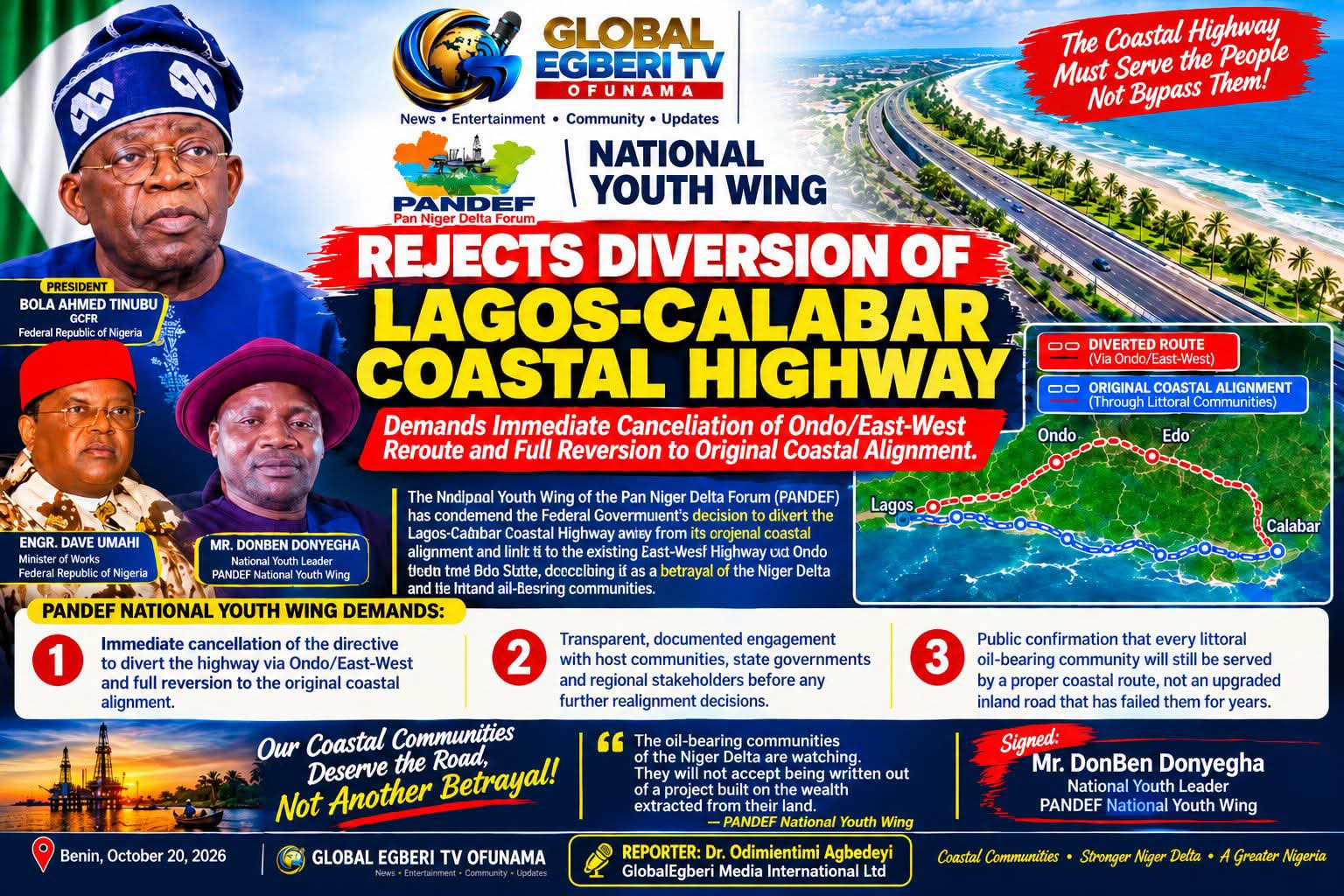
PANDEF Youth Wing Rejects Lagos-Calabar Coastal Highway Diversion, Demands Return to Original Route
Group Warns Against Marginalisation of Niger Delta Littoral Communities, Calls on Tinubu to Intervene
By Dr. Odimientimi Agbedeyi
GlobalEgberi Media International Ltd
BENIN CITY, EDO STATE — October 20, 2026
The National Youth Wing of the Pan Niger Delta Forum (PANDEF) has rejected the reported diversion of sections of the Lagos-Calabar Coastal Highway from their original coastal alignment, calling on President Bola Ahmed Tinubu to intervene and ensure that the project retains its intended developmental purpose.
The group expressed concern that routing affected sections through the existing East-West Road via Ondo and Edo states could leave some coastal and oil-producing communities across the Niger Delta without the direct infrastructure benefits originally anticipated.
In a press statement issued in Benin City, PANDEF National Youth Leader, Chief Hon. Engr. DonBen Donyegha, urged the Federal Government to reconsider the proposed realignment and return to the original coastal route.
According to the youth wing, the highway was conceived as a strategic national infrastructure project designed to connect coastal communities, improve transportation, stimulate investment and expand economic opportunities across the southern part of Nigeria.
The organisation warned that significant changes to the route could undermine those objectives and deepen concerns about unequal access to federal infrastructure among communities that have contributed substantially to Nigeria’s economy.
PANDEF Questions Rationale Behind Proposed Route Change
PANDEF’s reaction follows remarks attributed to the Minister of Works, Engr. Dave Umahi, concerning a proposed redesign of sections of the Lagos-Calabar Coastal Highway.
According to the account referenced by the youth wing, President Tinubu had reportedly directed that the project avoid certain new alignments and utilise the existing East-West Road.
The reported justification included difficult terrain, deep pits and construction costs affecting sections of the proposed route in parts of Ogun and Ondo states.
Although reports indicated that the approximately 750-kilometre highway project had not been abandoned and that surveying activities were continuing in other sections, PANDEF maintained that concerns remained about communities that might be excluded from the revised alignment.
The group called on the Federal Government to provide comprehensive public information detailing the affected sections, the communities expected to benefit from the proposed changes and the measures being considered to preserve the highway’s original coastal development objectives.
PANDEF acknowledged that engineering challenges and financial constraints are legitimate considerations in major infrastructure projects. However, it argued that such challenges should be addressed through transparent technical assessments and consultations rather than decisions that could undermine the long-term interests of intended beneficiaries.
The youth wing also called for an inclusive review process involving host communities, state governments and other relevant stakeholders before further major decisions are implemented.
Niger Delta Communities Deserve Inclusive Development
PANDEF emphasised that the Niger Delta remains strategically important to Nigeria because of its contribution to national oil production and revenue generation.
Despite this contribution, the organisation noted that many oil-bearing and riverine communities continue to face challenges associated with environmental pollution, gas flaring, inadequate road networks, limited economic opportunities and insufficient public infrastructure.
The group said the coastal highway had generated considerable expectations because of its potential to improve connectivity, facilitate trade, attract private investment and reduce the isolation of communities that remain difficult to access.
It warned that a route change that leaves these communities outside the highway’s direct reach could reinforce longstanding perceptions of marginalisation and weaken confidence in the Federal Government’s commitment to balanced development.
According to PANDEF, the project should be viewed as more than a road construction initiative. It should also serve as an opportunity to connect underserved populations with markets, public services and emerging economic activities.
The organisation maintained that communities whose lands and natural resources contribute significantly to the national economy should have meaningful opportunities to benefit from strategic infrastructure investments.
PANDEF Recalls South-South Development Commission Debate
The youth wing also referenced the advocacy surrounding the establishment of the South-South Development Commission (SSDC), arguing that the experience highlighted the persistent need for regional stakeholders to press for institutions and infrastructure they consider essential to development.
According to PANDEF, the region should not have to repeatedly mobilise public pressure before its developmental concerns receive adequate attention.
The group urged President Tinubu to ensure that decisions concerning the coastal highway do not reinforce perceptions of unequal treatment between the Niger Delta and other parts of the country.
It also cautioned against any policy direction that could undermine the project’s original coastal development objectives.
PANDEF stressed that the implementation of the highway should remain consistent with its intended purpose of improving transportation and creating economic opportunities for communities along the coast.
PANDEF Presents Three Major Demands to Tinubu
To address its concerns, the National Youth Wing outlined three principal demands to the Federal Government.
1. Immediate reversal of the proposed diversion
PANDEF called for the cancellation of the reported plan to route affected sections through the East-West Road and demanded a return to the original coastal alignment.
The organisation argued that engineering challenges should be addressed through appropriate technical solutions while preserving the project’s core purpose of connecting coastal communities.
2. Transparent engagement with stakeholders
The group demanded documented consultations involving host communities, state governments and relevant regional stakeholders before further major decisions are taken regarding the highway’s route.
It said such consultations would allow affected communities to understand the technical considerations behind the proposed changes and express their concerns about the project’s long-term implications.
3. A public guarantee for affected coastal communities
PANDEF requested an explicit commitment from the Federal Government that communities originally intended to benefit from the highway would continue to receive meaningful access under the final construction plan.
The group argued that upgrading portions of the existing East-West Road would not necessarily provide the same benefits as a coastal highway, particularly for settlements located far from the existing road network.
It therefore called for clear details showing how the interests of the project’s intended beneficiaries would be protected.
East-West Road Upgrade Should Complement, Not Replace, Coastal Highway
While acknowledging the importance of improving the East-West Road, PANDEF maintained that its rehabilitation should complement rather than replace the Lagos-Calabar Coastal Highway.
The youth wing noted that the existing road serves important transportation needs across parts of the Niger Delta, but argued that the coastal highway could open up additional communities that have historically experienced limited access to modern road infrastructure.
According to the group, both projects could contribute to regional economic growth if they were properly planned, funded and implemented.
PANDEF consequently urged the Federal Government to pursue an integrated transportation strategy that recognises the distinct roles of inland and coastal routes.
It warned that treating the two corridors as interchangeable could undermine the original rationale for developing a dedicated coastal highway.
Group Warns of Possible Community Reactions
PANDEF expressed concern that failure to address the reported diversion could generate dissatisfaction among young people, host communities and other stakeholders across the Niger Delta.
The organisation warned that renewed perceptions of exclusion could place additional pressure on the relative peace and security achieved in parts of the region.
It also highlighted the potential political implications ahead of the 2027 general elections, arguing that the Federal Government’s handling of the controversy could influence public perceptions of its commitment to the Niger Delta.
However, the youth wing said it remained open to constructive dialogue and advocated a peaceful, transparent and mutually acceptable resolution.
The organisation called on the authorities to address the concerns through meaningful engagement and clear communication before the dispute escalates into a broader regional controversy.
It maintained that inclusive decision-making and a demonstrable commitment to equitable development would be essential to sustaining public confidence in the project.
PANDEF Appeals for Presidential Intervention
Concluding its position, PANDEF’s National Youth Wing appealed directly to President Tinubu to review the reported realignment and ensure that the original coastal objectives of the Lagos-Calabar Coastal Highway are preserved.
DonBen Donyegha reiterated that oil-bearing and littoral communities across the Niger Delta should not be excluded from a major infrastructure project expected to have significant implications for the region’s connectivity and economic future.
The group described the highway as an opportunity to improve transportation, expand commercial activities and strengthen the relationship between the Federal Government and communities that have long called for greater developmental attention.
It urged the President to initiate engagement with relevant stakeholders and provide a clear public commitment that the interests of affected coastal communities would remain central to the project.
As discussions over the proposed route continue, questions remain about the engineering and financial considerations behind the reported realignment and how the Federal Government intends to ensure that the highway achieves its original objectives.
For PANDEF’s National Youth Wing, the central issue is whether the project will fulfil its promise of connecting coastal communities or whether changes to its alignment will leave some intended beneficiaries outside its direct reach.
The organisation insists that the Lagos-Calabar Coastal Highway should serve as an instrument of national integration and balanced development rather than become another source of grievance among communities seeking improved infrastructure and greater economic opportunities.
SIGNED:
Chief Hon. Engr. DonBen Donyegha
National Youth Leader
PANDEF National Youth Wing
GlobalEgberi Media International Ltd will continue to monitor developments concerning the Lagos-Calabar Coastal Highway and their implications for the Niger Delta and Nigeria’s infrastructure development agenda.
About the Author