
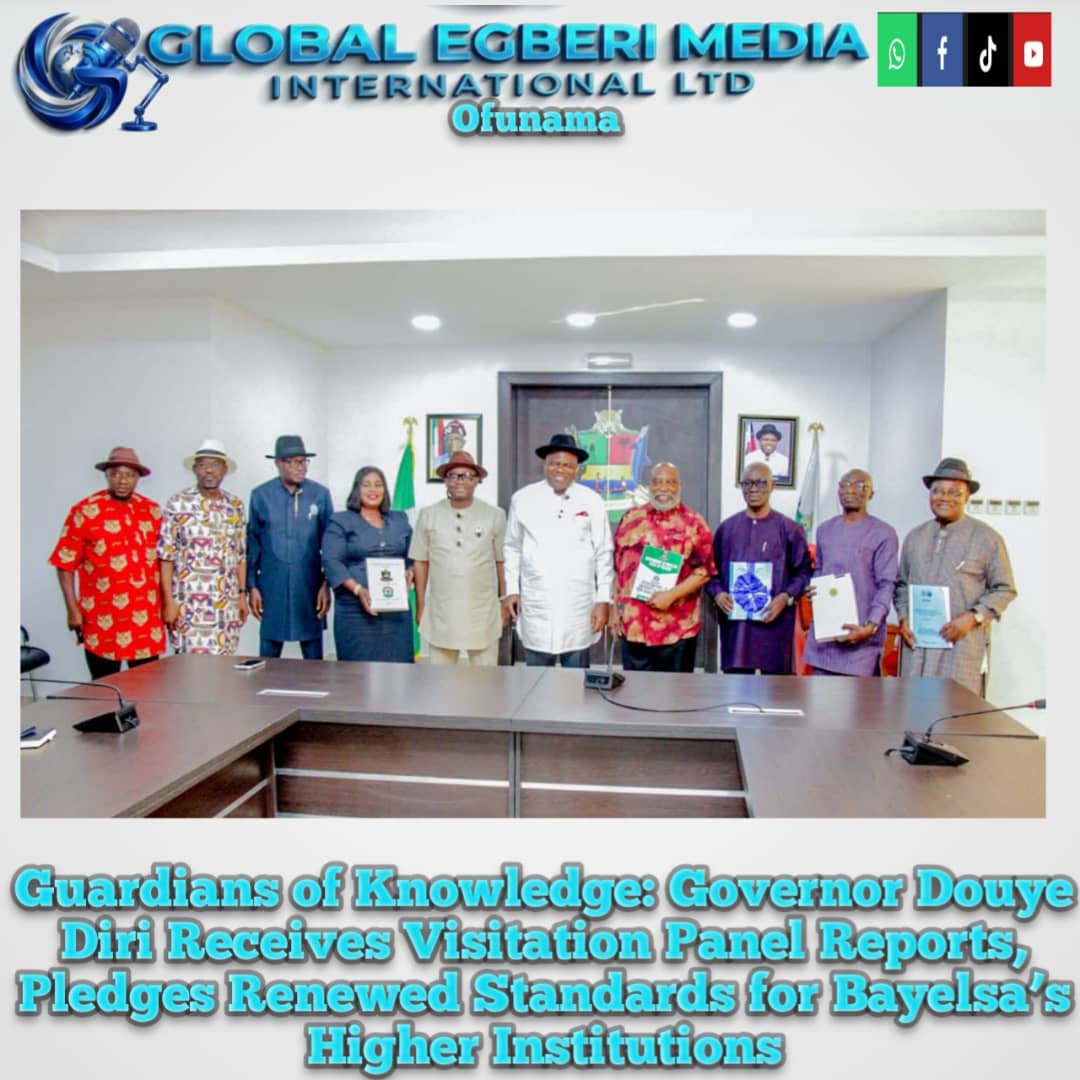
Guardians of Knowledge: Governor Douye Diri Receives Visitation Panel Reports, Pledges Renewed Standards for Bayelsa’s Higher Institutions
In what observers describe as a significant milestone in the ongoing efforts to strengthen the educational system of Bayelsa State, the Governor of the state, Douye Diri, on Wednesday formally received the reports of various Visitation Panels set up to review the operations, structures, and developmental progress of higher institutions owned by the state government.
The presentation ceremony, which brought together top academics, policymakers, and government officials, marked the culmination of months of investigative and administrative work undertaken by respected scholars and administrators who were appointed to assess the performance and challenges of the state’s tertiary institutions.
At the event, the chairmen of the respective visitation panels formally handed over their reports to the governor. These panels were constituted to examine the administrative structures, financial management, academic performance, infrastructure, and overall governance of the institutions with a view to recommending reforms that will enhance quality education and institutional efficiency.
The institutions covered by the visitation exercise include the University of Africa Toru-Orua, the Bayelsa Medical University, the Niger Delta University, the Bayelsa State Polytechnic Aleibiri, and the Isaac Jasper Boro College of Education.
Leading the delegation of panel chairmen was Dr. O.O. Osusu, who chaired the panel for the University of Africa, Toru-Orua. Also present was Dr. Martina A. Ebikake Nwanyanwu, who led the panel for Bayelsa Medical University. The panel for Niger Delta University was chaired by Prof. Steven Odiowei, while Prof. Kingsley D. Alagoa headed the panel that examined Bayelsa State Polytechnic, Aleibiri. The panel for Isaac Jasper Boro College of Education was chaired by Prof. Steve Azaiki, who was represented at the presentation by Prof. Don Donbebe.
Each panel conducted a detailed review of their assigned institution, engaging with management teams, academic staff, students, and administrative personnel in order to produce a comprehensive evaluation of the institutions’ strengths, weaknesses, and future prospects.
Receiving the reports, Governor Douye Diri expressed deep appreciation to the distinguished academics and professionals who served on the panels, commending them for their dedication and timely completion of the assignment entrusted to them by the state government.
According to the governor, the exercise forms a crucial part of the broader education reform agenda of the Prosperity Administration, which seeks to position Bayelsa State as a center of academic excellence and innovation in Nigeria.
“I thank you for the time and effort you all have put into this to ensure that we raise the standard of our higher education in the state,” Governor Diri said during the ceremony.
The governor emphasized that education remains a cornerstone of his administration’s development strategy, stressing that providing the necessary environment for quality learning and research is one of the top priorities of the Prosperity Government.
He noted that the state government established the visitation panels not merely as a routine administrative procedure but as a strategic intervention aimed at identifying systemic challenges and implementing reforms that will strengthen the institutions for the benefit of students and the broader society.
Governor Diri assured the panel members that their reports would not be left on the shelves but would undergo careful and thorough evaluation by the relevant authorities in the state government.
“I will ensure that your reports are thoroughly reviewed and implemented where necessary so that we can raise the standard of the educational system in the state,” he added.
Educational analysts believe the visitation panels represent a critical instrument for institutional accountability. In Nigeria’s university system, visitation panels are periodically set up by governments or governing councils to examine the operations of tertiary institutions and recommend improvements in governance, academic quality, financial management, and infrastructure development.
Such exercises often help uncover administrative lapses, financial irregularities, infrastructural gaps, and policy weaknesses while also highlighting areas where institutions have recorded notable achievements.
In the case of Bayelsa State, the visitation exercise is widely viewed as part of a broader effort by the state government to consolidate investments already made in higher education over the years.
Institutions like the University of Africa, Toru-Orua, have been positioned as centers for specialized academic programs designed to drive economic development and entrepreneurship. Similarly, Bayelsa Medical University has been tasked with addressing the shortage of medical professionals in the region by producing highly trained healthcare practitioners.
Niger Delta University, the state’s flagship university located in Amassoma, remains one of the most prominent higher institutions in the Niger Delta region, playing a vital role in research, professional training, and intellectual development.
Meanwhile, Bayelsa State Polytechnic, Aleibiri, and Isaac Jasper Boro College of Education continue to contribute to technical education and teacher training, both of which are considered essential for sustainable development in the state.
By commissioning visitation panels for these institutions, the Bayelsa State Government has demonstrated its intention to periodically assess performance and introduce reforms aimed at strengthening academic standards and institutional governance.
Observers say the implementation phase will be the most critical stage of the process, as the recommendations contained in the reports could lead to policy adjustments, structural reforms, improved funding strategies, and enhanced accountability mechanisms within the institutions.
For the panel members, the submission of the reports represents the completion of a significant intellectual and administrative undertaking. For the government, however, it marks the beginning of a new phase in the journey toward educational excellence.
Stakeholders in the education sector have expressed optimism that the findings and recommendations from the visitation panels will help reposition Bayelsa’s higher institutions to meet both national and global standards.
As the Prosperity Administration continues to emphasize human capital development, many believe that strengthening tertiary education will play a crucial role in shaping the future of the state, equipping young people with the knowledge, skills, and innovation required to drive economic growth and social transformation.
With the reports now officially in the hands of the governor, attention will shift to how swiftly and effectively the government acts on the recommendations—an outcome that could significantly determine the trajectory of higher education in Bayelsa State in the years ahead.
Source: Bayelsa State Government Media
Homepage: https://globalegberi.com.ng/wp
Author: Dr. Odimientimi Agbedeyi
About the Author