
APC Aspirant Rejects Consensus Claim, Warns of Internal Crisis in Warri North Politics
By Dr. Odimientimi Agbedeyi
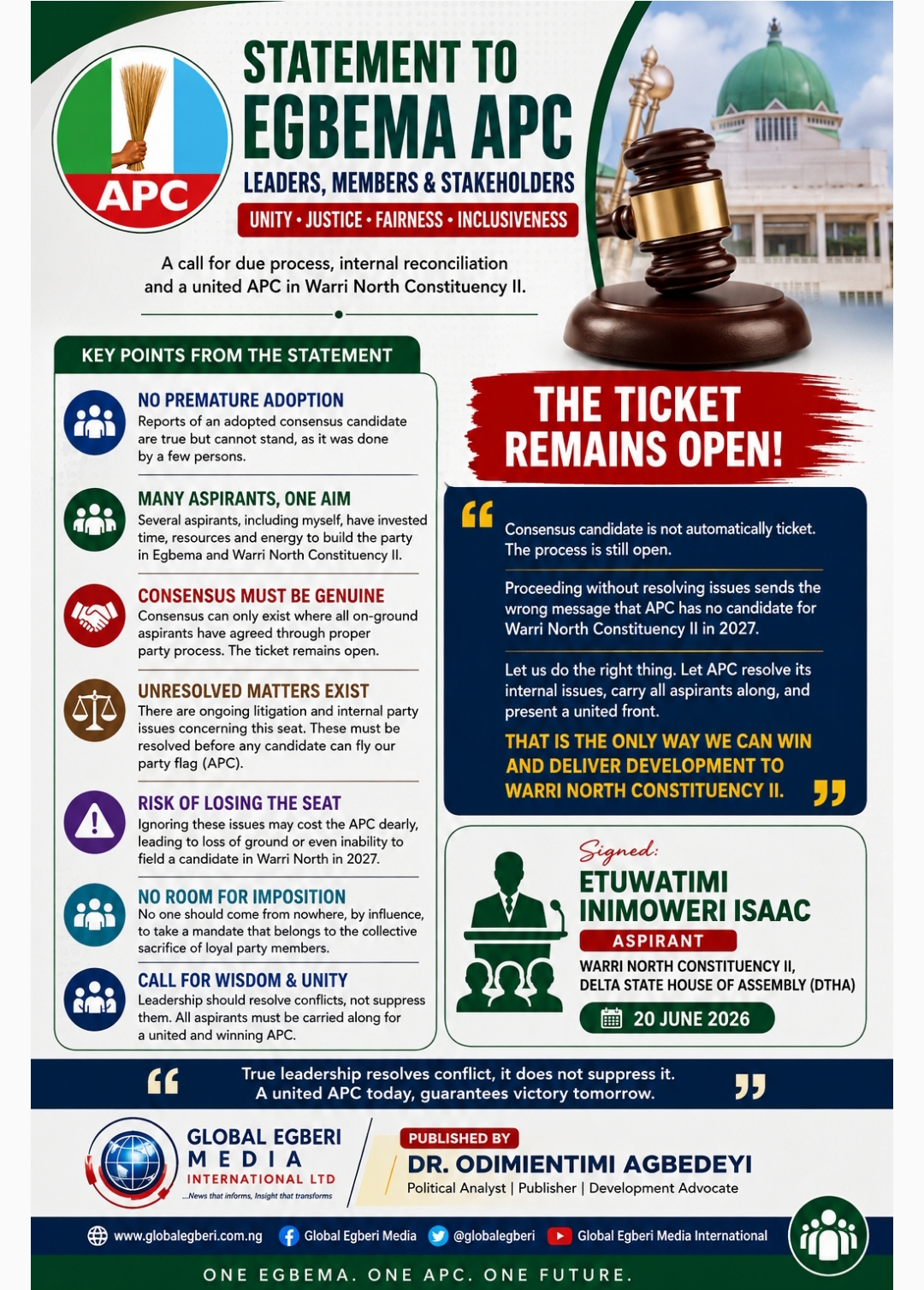
The political atmosphere in Warri North Local Government Area of Delta State appears to be heating up as an aspirant for the Warri North Constituency II seat in the Delta State House of Assembly under the All Progressives Congress (APC), Mr. Etuwatimi Inimoweri Isaac, has openly challenged reports that the party has already adopted a consensus candidate for the 2027 election.
In a strongly-worded statement addressed to APC leaders, stakeholders, and members across Egbema and Warri North, the aspirant expressed concern over what he described as premature celebrations and public announcements suggesting that the race for the party’s ticket had already been concluded.
According to him, while reports of an adopted consensus candidate may be circulating within political circles, such an arrangement cannot stand as a valid party decision because it allegedly did not emerge from a process involving all interested aspirants.
Isaac argued that several party faithful have spent years building the APC structure in Egbema and Warri North Constituency II. He noted that many aspirants, including himself, invested substantial time, resources, political capital, and personal sacrifices to strengthen the party’s presence in the constituency.
He maintained that genuine consensus can only be achieved when all aspirants willingly agree to a common candidate through an acceptable internal process. Anything short of that, he suggested, risks creating disaffection and division among party members.
The aspirant further revealed that unresolved litigation and internal party matters relating to the constituency remain outstanding and should be addressed before any final decision is reached regarding the party’s candidate for the 2027 Delta State House of Assembly election.
He cautioned that proceeding with a consensus arrangement without resolving these underlying disputes could have significant consequences for the APC in Warri North. According to him, such an approach could weaken party cohesion, discourage loyal members, and potentially jeopardize the party’s electoral prospects in the constituency.
Isaac emphasized that no individual should emerge through influence or political maneuvering at the expense of party members who have contributed to the growth and survival of the APC in the area over the years.
Calling for wisdom and restraint, he urged APC leaders in Egbema to embrace dialogue, reconciliation, and inclusiveness rather than actions that may be perceived as exclusionary.
The aspirant also appealed to his supporters to remain calm and avoid actions capable of escalating tensions within the party. He reminded them that an announcement of consensus does not automatically translate into the issuance of the party’s official ticket, especially where unresolved issues still exist.
In what many political observers may interpret as a warning to party leaders, Isaac stated that failure to properly manage the situation could create the impression that the APC lacks a legitimate candidate for the constituency, thereby creating opportunities for opposition parties to capitalize on internal divisions.
He concluded by urging party leaders to carry all aspirants along, resolve pending disputes, and present a united front ahead of the 2027 elections.
Editorial Insight
The controversy surrounding the reported adoption of a consensus candidate in Warri North Constituency II once again highlights one of the recurring challenges facing political parties in Nigeria: balancing political expediency with internal democracy.
Consensus arrangements are not inherently undemocratic. In fact, they have often been used by political parties to reduce internal conflicts, conserve resources, and strengthen unity ahead of elections. However, consensus only succeeds when it is genuinely inclusive, transparent, and accepted by major stakeholders.
Where aspirants feel excluded from the process, what is intended as a unifying mechanism can quickly become a source of division. Political history across Nigeria has repeatedly shown that unresolved grievances arising from candidate selection processes frequently result in litigation, defections, anti-party activities, or weakened electoral performance.
For the APC in Warri North, the emerging disagreement should not necessarily be viewed as a crisis but as an opportunity for constructive engagement. Party leaders must demonstrate fairness, transparency, and political maturity in managing competing interests within the party.
Ultimately, the strength of any political party lies not merely in selecting candidates but in ensuring that the process leading to their emergence commands legitimacy in the eyes of members. A candidate imposed without broad acceptance may win a nomination but struggle to unite the party. Conversely, a process perceived as fair often strengthens loyalty and collective commitment, even among those who do not emerge victorious.
As political activities gradually gather momentum ahead of the 2027 elections, all eyes will remain on the APC leadership in Warri North and how it navigates the delicate balance between party unity, internal democracy, and electoral strategy.
Source: Statement by Etuwatimi Inimoweri Isaac, Aspirant, Warri North Constituency II, Delta State House of Assembly, dated June 20, 2026.
Global Egberi Media International Homepage: https://globalegberi.com.ng
Author: Dr. Odimientimi Agbedeyi
About the Author