Historic Jos Court Verdict Redefines Indigeneity, Sparks National Conversation on Citizenship
Dr. Odimientimi Agbedeyi Says Judgment Strengthens Constitutional Rights and National Unity
By Dr. Odimientimi Agbedeyi
A landmark judgment delivered by Plateau State High Court 17 in Jos has ignited nationwide discussions on the meaning of indigeneity, citizenship, and belonging within Nigeria’s federal structure.
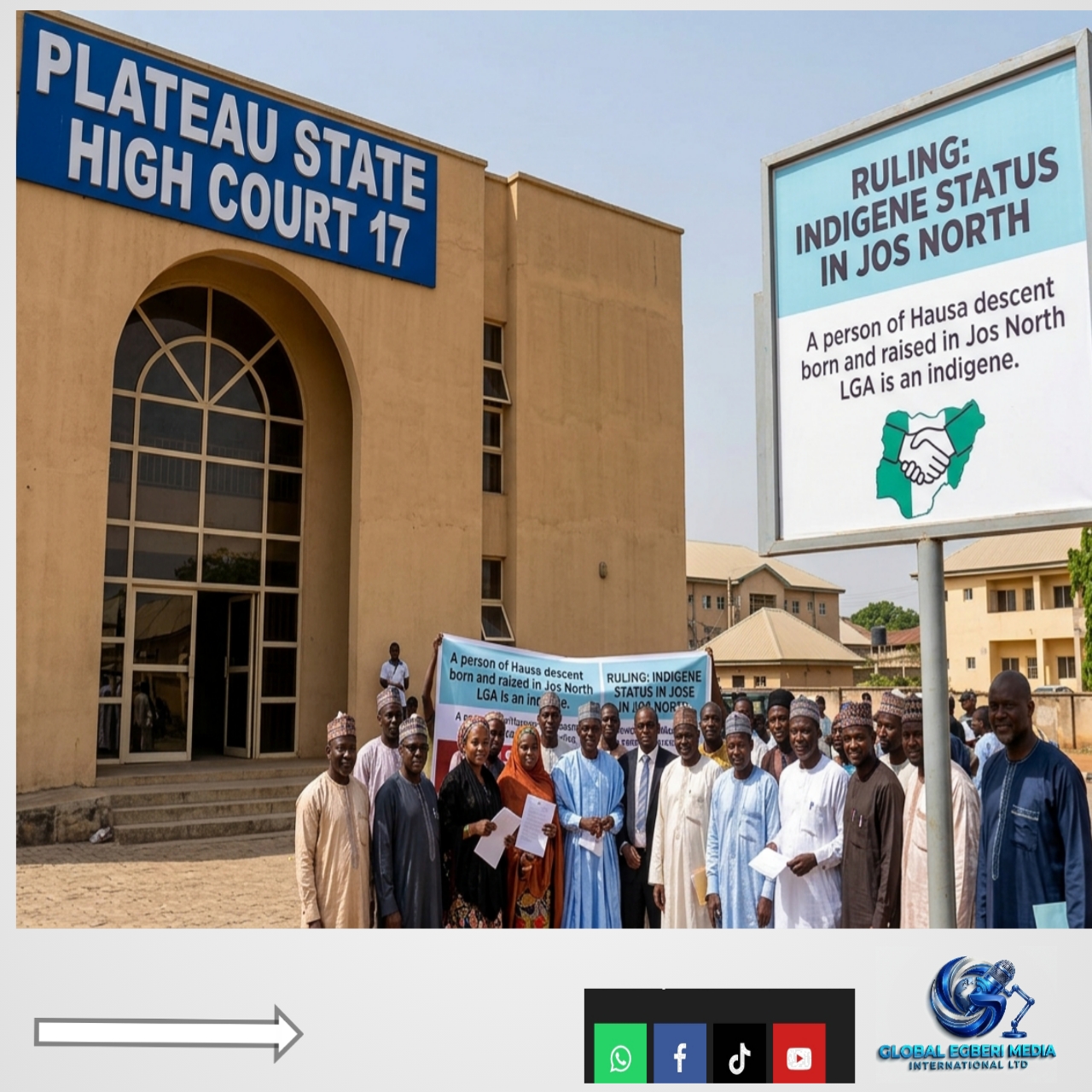
The court reportedly ruled that a Hausa man who was born and raised in Jos North Local Government Area of Plateau State is an indigene of the locality, a decision that many legal observers are already describing as one of the most consequential judicial pronouncements on citizenship rights in contemporary Nigeria. (Daily Trust)
The ruling, which emerged from a legal challenge against the denial of indigene status, touches upon a sensitive and longstanding national debate concerning the distinction between “indigenes” and “settlers” in various parts of the country. For decades, questions surrounding indigene certificates, political participation, employment opportunities, educational admissions, and access to social benefits have generated controversy in several states of the federation.
Reacting to the development, renowned academic, development advocate, and public affairs commentator, Dr. Odimientimi Agbedeyi, described the judgment as a significant contribution to the evolving jurisprudence of citizenship and constitutional equality in Nigeria.
According to Dr. Agbedeyi, the decision has the potential to deepen national integration by affirming the principle that individuals born and nurtured within a community should not be perpetually subjected to social exclusion on account of ancestral origins.
“The Nigerian Constitution recognizes citizenship and guarantees fundamental rights to all citizens. Any legal development that promotes inclusion, equality, and national cohesion deserves careful consideration and scholarly examination,” he stated.
The development advocate observed that Nigeria’s complex ethnic and cultural diversity has historically produced competing interpretations of identity and belonging. While communities understandably seek to preserve their cultural heritage, he argued that democratic societies must continually balance cultural preservation with constitutional guarantees of equality and non-discrimination.
According to him, the Plateau judgment represents more than a local legal dispute; it raises profound questions concerning the future of nation-building in a multi-ethnic state.
For many years, Jos has remained one of Nigeria’s most culturally diverse urban centres, accommodating people from numerous ethnic and religious backgrounds. The city has also witnessed periodic debates regarding indigene rights, political representation, and community identity.
Dr. Agbedeyi noted that the court’s decision may encourage broader national conversations on how citizenship rights should be interpreted in an increasingly interconnected society.
He emphasized that modern democratic governance should be anchored on justice, fairness, and equal opportunity for all citizens irrespective of ethnic origin, language, or religious affiliation.
“The strength of any nation lies not merely in its diversity but in its ability to transform diversity into a source of collective progress. When citizens feel included and protected under the law, national unity becomes stronger,” he remarked.
The academic further stressed that courts play a critical role in safeguarding constitutional values and resolving contentious societal questions through lawful and peaceful means.
According to him, judicial institutions remain indispensable pillars of democracy because they provide citizens with an avenue to seek redress without resorting to violence or social unrest.
He therefore called on Nigerians to approach the judgment with maturity, respect for the rule of law, and commitment to peaceful coexistence.
Dr. Agbedeyi also urged policymakers, constitutional scholars, civil society organizations, and community leaders to engage constructively with the broader issues raised by the ruling.
He argued that as Nigeria continues to evolve politically and socially, questions surrounding citizenship, residency, identity, and inclusion will increasingly require thoughtful legal and policy responses capable of promoting both justice and national stability.
The development advocate maintained that irrespective of differing opinions on the judgment, the ruling has succeeded in bringing renewed attention to the constitutional ideals of equality, citizenship, and human dignity.
“As a nation, we must continue to build bridges rather than walls. The future of Nigeria depends on our ability to create a society where every citizen can contribute meaningfully to national development without facing unnecessary barriers rooted in identity or origin,” he concluded.
The judgment is expected to generate extensive legal, political, and academic discussions in the coming weeks as stakeholders across the country evaluate its implications for governance, citizenship rights, and national integration. (Daily Trust)
About the Author
Dr. Odimientimi Agbedeyi is an academic, development advocate, public affairs commentator, and politician. He is widely known for his contributions to educational advancement, democratic discourse, youth development, community advocacy, and nation-building initiatives. He is associated with Delta State Polytechnic, Ogwashi-Uku, and remains actively involved in public policy conversations affecting the Niger Delta and Nigeria at large.
Source: Daily Trust.
Homepage: https://globalegberi.com.ng
Author: Dr. Odimientimi Agbedeyi
About the Author