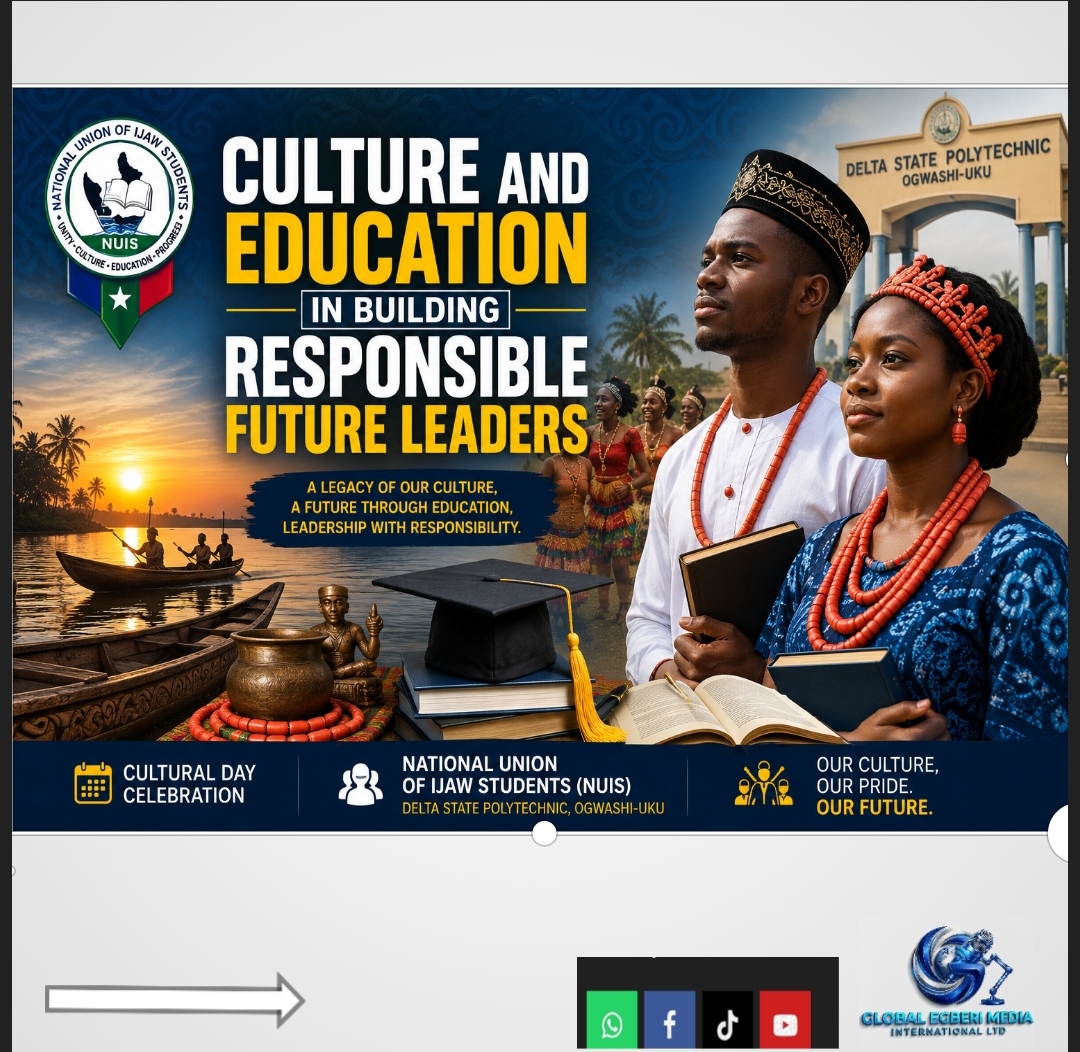
CULTURE AND EDUCATION IN BUILDING RESPONSIBLE FUTURE LEADERS
A Lecture Delivered at the Cultural Day Celebration of the National Union of Ijaw Students (NUIS), Delta State Polytechnic, Ogwashi-Uku
By
Dr. Odimientimi Agbedeyi
Dean, School of Applied Sciences
Delta State Polytechnic, Ogwashi-Uku
Protocols
The National President and Executives of the National Union of Ijaw Students, distinguished guests, members of staff, fellow academics, student leaders, ladies and gentlemen, I am honoured to be part of this year’s Cultural Day celebration.
Today’s theme, “Culture and Education in Building Responsible Future Leaders,” is timely because every society rises or falls on the quality of its leaders. The leaders of tomorrow are the students of today. Therefore, the values we learn and the culture we preserve will determine the kind of future we build.
Understanding Culture
Culture is the total way of life of a people. It includes our language, dressing, beliefs, customs, values, music, dances, respect for elders, hospitality, and our way of solving problems.
For the Ijaw people, culture teaches courage, honesty, unity, hard work, respect for elders, love for community, and peaceful coexistence. These values have sustained our people for generations and must not be allowed to disappear.
However, culture should not only be celebrated through traditional attire, music, and dance. It should also be reflected in our character, integrity, discipline, and respect for humanity.
The Place of Education
Education is more than acquiring certificates. It is the process of developing knowledge, skills, wisdom, and good character.
A truly educated person is not known only by academic excellence but by honesty, responsibility, humility, and the ability to solve societal problems.
Education broadens our thinking, exposes us to innovation, teaches critical reasoning, and prepares us to compete globally while remaining proud of our cultural identity.
The Relationship Between Culture and Education
Culture and education are partners in nation-building.
Culture provides our identity and moral values, while education provides knowledge, innovation, and practical skills.
When culture is separated from education, society may produce intelligent people without character. Likewise, culture without education may struggle to compete in a rapidly changing world.
Responsible leaders are therefore produced when education is built upon sound cultural values.
Characteristics of Responsible Future Leaders
Every responsible leader should possess:
- Integrity and honesty.
- Respect for elders and constituted authority.
- Hard work and discipline.
- Accountability and transparency.
- Service above self.
- Courage to stand for what is right.
- Respect for diversity and peaceful coexistence.
- Commitment to continuous learning.
Leadership is not about occupying positions. Leadership is about influence, responsibility, sacrifice, and positive impact.
Challenges Facing Young People Today
Many young people face serious challenges, including:
- Drug abuse.
- Internet fraud.
- Cultism.
- Violence.
- Moral decadence.
- Abuse of social media.
- Loss of cultural identity.
These social vices cannot build great leaders. Instead, they destroy promising futures.
Young people must reject shortcuts to success and embrace hard work, integrity, discipline, and excellence.
The Role of Students
Every student has a responsibility to become an ambassador of positive change.
Students should:
- Study diligently.
- Respect lecturers and constituted authorities.
- Preserve and promote Ijaw culture.
- Encourage peace and unity.
- Develop leadership qualities.
- Acquire entrepreneurial and digital skills.
- Use education to solve societal and community problems.
The future of the Niger Delta, the Ijaw nation, and Nigeria depends on the quality of leaders we nurture today.
The Role of the National Union of Ijaw Students
The National Union of Ijaw Students has an important responsibility to:
- Promote academic excellence.
- Preserve the Ijaw language and cultural heritage.
- Foster unity among Ijaw students.
- Organise leadership development programmes.
- Discourage cultism, drug abuse, and other social vices.
- Build partnerships that empower students academically and economically.
A vibrant student union today will produce visionary leaders for tomorrow.
The Responsibility of Educational Institutions
Educational institutions must continue to create an environment that promotes learning, innovation, discipline, and ethical leadership.
Lecturers should serve not only as teachers but also as mentors and role models. Parents, community leaders, and traditional institutions should equally support the moral development of young people.
Leadership development is a shared responsibility.
Conclusion
Culture gives us our identity.
Education gives us our knowledge and competence.
Character gives us our credibility.
When these three work together, they produce responsible leaders capable of transforming communities, institutions, and nations.
As young Ijaw students, never forget your roots. Be proud of your culture, pursue academic excellence, embrace innovation, and let integrity become your trademark.
The future belongs to those who prepare themselves today.
I challenge every one of you to become leaders who serve with honesty, lead with humility, defend justice, promote unity, and leave behind a legacy of excellence.
Vote of Thanks
Thank you for your kind attention.
May God bless the National Union of Ijaw Students.
May God bless Delta State Polytechnic, Ogwashi-Uku.
May God bless the Ijaw Nation.
May God bless Delta State.
And may God bless the Federal Republic of Nigeria.
About the Author