
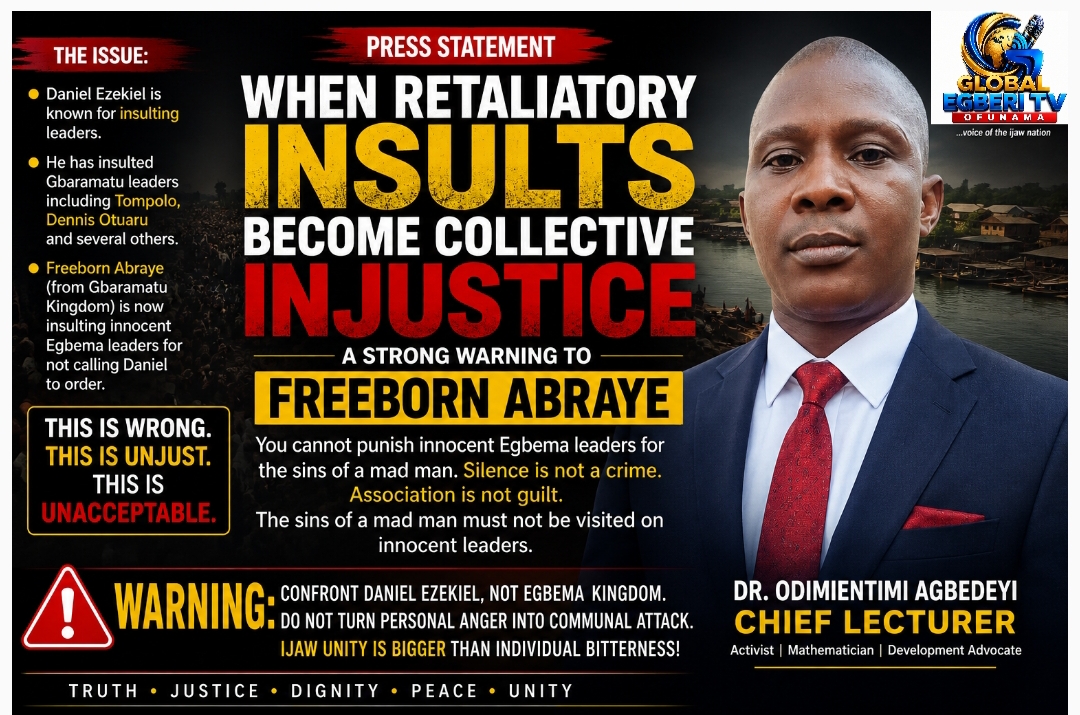
WHEN RETALIATORY INSULTS BECOME COLLECTIVE INJUSTICE: A STRONG WARNING TO FREEBORN ABRAYE
By Dr. Odimientimi Agbedeyi
There is a dangerous pathology in public discourse when the misconduct of one individual becomes the pretext for vilifying an entire community and its leadership.
I have previously used very strong language in describing Daniel Ezekiel because of his persistent pattern of attacking and insulting people in public discourse. In recent times, his reported attacks have extended to respected leaders of Gbaramatu Kingdom, including High Chief Government Ekpemupolo (Tompolo), Dr. Dennis Otuaru, and others.
Those who know the history of the controversy understand that Freeborn Abraye hails from Gbaramatu Kingdom. It is therefore understandable that he may feel aggrieved when individuals from his community are subjected to disparagement.
But there is a fundamental principle that every reasonable person must understand:
You cannot justifiably answer the alleged insult of one man by insulting innocent people who neither committed the offence nor authorised it.
If Daniel Ezekiel has insulted Gbaramatu leaders, let Daniel answer for Daniel’s words.
If Daniel has crossed the boundaries of decency, let him be confronted directly.
If he has made allegations, let him substantiate them.
If he has defamed anyone, let the appropriate person pursue lawful remedies.
But why should innocent Egbema leaders become the victims of a retaliatory campaign merely because they have not publicly condemned Daniel Ezekiel?
That is the precise question Freeborn Abraye must answer.
THIS IS NOT JUST RETALIATION; IT IS COLLECTIVE ATTRIBUTION
Freeborn Abraye appears to have committed a serious logical and moral error: transferring responsibility from the alleged offender to people who have not been shown to be parties to the alleged offence.
That is collective attribution.
It is intellectually indefensible to reason that because Egbema leaders did not publicly call Daniel Ezekiel to order, they therefore deserve to be insulted.
Since when did silence become authorship?
Since when did failure to issue a public reprimand constitute participation in another man’s alleged misconduct?
Since when did an individual become the alter ego of an entire Kingdom merely because he identifies with that Kingdom?
If Daniel Ezekiel is a freeborn Egbema son, that does not mean every Egbema leader is his spokesman, guardian, sponsor or moral custodian.
Daniel is responsible for Daniel.
Egbema leaders are responsible for their own conduct.
Freeborn must not deliberately collapse that distinction.
FREEBORN, YOUR ANGER MUST HAVE A TARGET
There is a profound difference between retaliation and justice.
Retaliation asks:
“Who can I hurt because I have been hurt?”
Justice asks:
“Who is actually responsible, and what is the appropriate response?”
The former is emotional.
The latter is rational.
The former is vindictive.
The latter is jurisprudential.
If your grievance is Daniel Ezekiel, then Daniel should be the object of your criticism.
If your grievance is a particular Egbema leader, identify that person and state the specific offence.
But to descend upon innocent Egbema leaders with insults because you believe they failed to discipline Daniel is to embrace a fallacious syllogism.
You are effectively saying:
Daniel insulted Gbaramatu leaders.
Egbema leaders did not condemn Daniel.
Therefore Egbema leaders deserve to be insulted.
That conclusion does not logically follow.
It is a non sequitur.
And intellectual sophistication demands that we say so.
EGBEMA LEADERS ARE NOT DANIEL EZEKIEL
This point deserves emphasis.
Egbema is not Daniel Ezekiel.
The traditional rulers and leaders of Egbema Kingdom are not Daniel Ezekiel.
The communities of Egbema are not Daniel Ezekiel.
The elders of Egbema are not Daniel Ezekiel.
The ordinary sons and daughters of Egbema are not Daniel Ezekiel.
Therefore, if Daniel’s utterances have offended Gbaramatu leaders, the appropriate course is to address Daniel’s conduct, not manufacture a communal indictment.
Freeborn cannot make every Egbema leader a defendant in a case in which they have not been shown to be a party.
That is not accountability.
That is vicarious condemnation.
THE SILENCE OF A LEADER IS NOT AUTOMATICALLY AN ENDORSEMENT
Perhaps Freeborn’s argument is that Egbema leaders should have called Daniel to order.
If that is his position, he is entitled to make that argument.
He can say:
“I believe Egbema leaders should publicly condemn Daniel Ezekiel’s conduct.”
That would be a legitimate opinion.
He can appeal to Egbema traditional institutions to intervene.
He can ask community leaders to caution their son.
He can even express disappointment that they have remained silent.
But there is an enormous difference between saying:
“I am disappointed that Egbema leaders have not condemned Daniel.”
and saying:
“Because they did not condemn Daniel, I will insult them.”
The first is criticism.
The second is retaliatory vilification.
And that is precisely where the line must be drawn.
DO NOT TURN THE IJAW FAMILY INTO A THEATRE OF RECIPROCAL INSULT
The Ijaw nation already has enough challenges.
Our communities face developmental deficits, political marginalisation, infrastructural shortcomings, environmental concerns and internal divisions.
The last thing we need is a culture in which one person’s provocation produces another person’s retaliation, which produces another person’s counter-retaliation, until brothers begin treating brothers as enemies.
That cycle is intellectually bankrupt and socially destructive.
Today it may be Daniel and Egbema.
Tomorrow it may be another Gbaramatu son.
The next day another community.
Eventually, the entire Ijaw family becomes trapped in an endless retributive spiral.
Who benefits?
Certainly not Egbema.
Certainly not Gbaramatu.
Certainly not the Ijaw nation.
FREEBORN ABRAYE MUST KNOW THE DIFFERENCE BETWEEN DISSENT AND CONTUMELY
There is nothing wrong with robust criticism.
There is nothing wrong with disagreeing with traditional rulers.
There is nothing wrong with demanding accountability from community leaders.
But criticism must not degenerate into contumely.
A sophisticated public commentator should know that vituperation is not evidence, invective is not argument, and insult is not accountability.
One can be ferocious without being reckless.
One can be courageous without becoming contemptuous.
One can be uncompromising without becoming uncivil.
One can defend one’s people without becoming unjust to another people.
That is the maturity expected from anyone who voluntarily enters public discourse.
A MESSAGE TO FREEBORN
Freeborn Abraye, if Daniel Ezekiel offended your people, confront Daniel Ezekiel.
If he insulted Tompolo, let Tompolo decide how to respond.
If he insulted Dennis Otuaru, let Dennis Otuaru decide how to respond.
If he insulted another Gbaramatu leader, let that individual determine the appropriate response.
Do not appoint yourself the executioner of innocent Egbema leaders simply because you believe they should have disciplined Daniel.
You are entitled to your anger. You are not entitled to manufacture guilt.
You are entitled to your opinion. You are not entitled to convert assumption into fact.
You are entitled to criticise. You are not entitled to condemn people by association.
And you are certainly not entitled to drag an entire Kingdom into a quarrel generated by the conduct of an individual.
THIS IS A WARNING, NOT A THREAT
Let this be absolutely clear.
This is a warning in the interest of peace, dignity and responsible public discourse—not a threat of violence or retaliation.
Nobody should threaten Freeborn Abraye.
Nobody should harass him.
Nobody should physically confront him.
But neither should anyone expect the people of Egbema to remain permanently silent when their respected leaders are subjected to what they regard as unjustified insults.
The appropriate response is truth, evidence, dialogue and lawful action.
If Freeborn has evidence against any Egbema leader, let him present it.
If he believes a particular leader acted wrongly, let him identify the person and the alleged wrongdoing.
If he believes Egbema leaders should have condemned Daniel, let him make that case.
But let the argument be built on facts rather than fury.
DO NOT CONFUSE COMMUNITY IDENTITY WITH COLLECTIVE LIABILITY
One of the most dangerous tendencies in communal politics is the assumption that the actions of one person automatically become the responsibility of everyone who shares his ethnic, community or ancestral identity.
That principle is untenable.
If one Gbaramatu son commits an offence, does every Gbaramatu leader become guilty?
If one Egbema son makes an offensive statement, should every Egbema traditional ruler be condemned?
If the answer is no—and it must be no—then the principle must apply equally.
There cannot be one standard for Gbaramatu and another for Egbema.
Justice must be symmetrical.
Dignity must be reciprocal.
Accountability must be universal.
EGBEMA DESERVES RESPECT
Let nobody misunderstand this position.
Egbema leaders are not above criticism.
They are human beings.
They can make mistakes.
They can be questioned.
They can be challenged.
They can even be condemned when there is credible evidence of wrongdoing.
But they should not be insulted merely because they failed to publicly discipline another adult.
That standard is unreasonable.
If Freeborn believes Egbema leaders have failed in their leadership responsibilities, then let him articulate precisely what they should have done.
That is a legitimate conversation.
But transforming disappointment into rancorous invective is neither courageous nor constructive.
THE DANGER OF RHETORICAL PYROTECHNICS
There comes a point when language ceases to illuminate and begins to incinerate bridges.
When every disagreement becomes an occasion for ridicule, when every opponent becomes an object of derision, and when every grievance is amplified into a personal assault, public discourse loses its teleology—its constructive purpose.
Words then become weapons rather than instruments of understanding.
Freeborn is too intellectually capable to allow himself to become imprisoned by such a pattern.
The Niger Delta does not need more professional antagonists.
It needs bridge-builders, truth-seekers, intellectuals, mediators and courageous voices capable of confronting injustice without manufacturing new injustice.
FINAL WARNING
Freeborn Abraye should therefore reconsider this trajectory before it hardens into a permanent culture of reciprocal denigration.
If you believe Daniel Ezekiel is wrong, confront Daniel.
If you believe Gbaramatu leaders were insulted, defend them with facts and dignity.
If you believe Egbema leaders should have intervened, make that argument.
But do not punish innocent Egbema leaders for the alleged sins of Daniel Ezekiel.
That is neither justice nor intellectual consistency.
And let it be remembered:
The sins of a son do not become the sins of his elders merely because the elders failed to publicly rebuke him.
Likewise:
The silence of an institution is not proof of complicity, and disagreement with one individual is not a licence to insult an entire Kingdom.
Freeborn, draw the line before the line disappears.
Do not allow animus to become ideology, indignation to become obsession, and retaliation to masquerade as justice.
Egbema and Gbaramatu are not destined to become permanent theatres of reciprocal insult because of the utterances of individuals.
We are better than that.
The Ijaw family deserves better than that.
And every genuine advocate of Ijaw unity must understand that you cannot build fraternity with the bricks of contempt.
If Daniel is wrong, condemn Daniel.
If an Egbema leader is wrong, condemn that leader.
If a Gbaramatu leader is wrong, condemn that leader.
But never condemn the innocent merely because they share a community with the person you are angry with.
That is the minimum standard of fairness.
That is the minimum standard of intellectual integrity.
And that is the minimum standard expected from anyone who claims to speak for justice.
Dr. Odimientimi Agbedeyi
For Truth, Justice, Dignity, Egbema–Gbaramatu Understanding and Responsible Leadership
About the Author