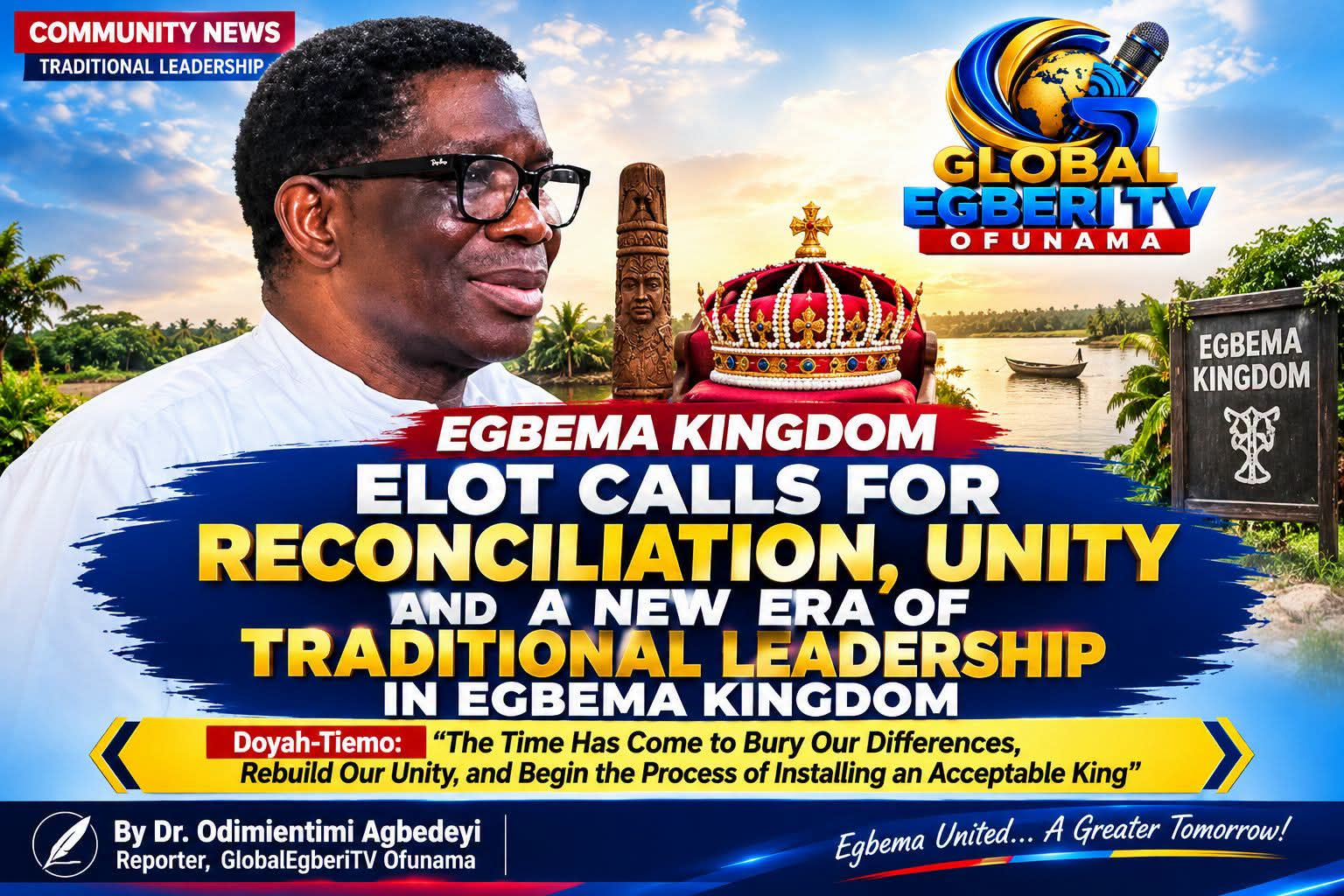
ELOT Calls for Reconciliation, Unity and New Era of Traditional Leadership in Egbema Kingdom
Elder Doyah-Tiemo: “The Time Has Come to Bury Our Differences, Rebuild Our Unity and Begin the Process of Installing an Acceptable King”
By Dr. Odimientimi Agbedeyi
GlobalEgberiTV Ofunama
WARRI, DELTA STATE — The Egbema Leaders of Thought (ELOT) has called for reconciliation, unity and renewed cooperation among traditional rulers, chiefs, elders, community leaders and youths of Egbema Kingdom, urging stakeholders to put aside past disagreements and work collectively towards restoring peace and strengthening the kingdom’s traditional institution.
The call was made by ELOT Chairman, Elder Edmund Eyekomieghan Doyah-Tiemo, during his opening address at the Egbema Kingdom Leadership Meeting held on Friday, October 23, 2026, at Park Royale Hotel, Airport Road, Warri, Delta State.
The meeting brought together key stakeholders to discuss ways of overcoming divisions that have affected relationships within the kingdom over the past four years and to establish a common path towards lasting peace, unity, development and the restoration of traditional leadership.
Elder Doyah-Tiemo described the gathering as an opportunity to begin a new chapter in the kingdom’s history through dialogue, forgiveness, mutual understanding and renewed commitment to their shared heritage.
“The time has come for us to move forward as one people with one purpose: the greatness and prosperity of Egbema Kingdom,” he declared.
ELOT Chairman Urges Peace and Reconciliation
Addressing the gathering, Elder Doyah-Tiemo acknowledged that disagreements and disputes over the past four years had strained relationships among some stakeholders and presented challenges to the kingdom’s collective progress.
He expressed optimism that the meeting would mark the beginning of a new era characterised by peace, understanding, forgiveness and renewed brotherhood.
Drawing inspiration from the biblical message in Ecclesiastes that there is a time and season for everything under heaven, he maintained that the period of disagreements should give way to healing, reconciliation and peaceful coexistence.
He stressed that unity does not require everyone to hold identical opinions but demands respect for differing views, constructive engagement and a willingness to pursue solutions that serve the common good.
The ELOT chairman warned that prolonged internal conflicts could weaken traditional institutions, undermine collective aspirations and create opportunities for external interests to exploit divisions within the kingdom.
He therefore urged all stakeholders to avoid actions and statements capable of reopening old wounds and instead embrace dialogue as a means of resolving outstanding differences.
Tompolo, Barr. Fedude Zimughan, SAN, Commended
Doyah-Tiemo expressed gratitude to Almighty God and acknowledged the contributions of individuals whose interventions, according to him, had helped create an opportunity for reconciliation among stakeholders.
He particularly commended High Chief Government Oweizide Ekpemupolo, popularly known as Tompolo, for his sacrifices, intervention and commitment towards resolving disputes that had divided stakeholders in Egbema Kingdom.
According to the ELOT chairman, the withdrawal of court cases arising from the disagreements had created room for leaders to come together and discuss a common way forward.
He prayed for continued wisdom, strength and divine guidance for Tompolo, expressing hope that his contributions would continue to support peace, unity and development across the Ijaw Nation.
Doyah-Tiemo also commended Barr. Fedude Zimughan, SAN, for his engagement with stakeholders and efforts towards advancing the reconciliation process.
He appreciated everyone who contributed directly or indirectly to bringing the leaders together, emphasising that lasting reconciliation would depend on the collective willingness of all parties to move beyond past disagreements.
ELOT Seeks Acceptable King for Egbema Kingdom
One of the major issues highlighted at the meeting was the need to commence a process towards installing a king who would enjoy broad acceptance among the people and provide unifying leadership for Egbema Kingdom.
Doyah-Tiemo stressed that reconciliation must go beyond bringing leaders together for discussions. It must also establish a foundation for restoring public confidence in the traditional institution and strengthening its capacity to promote peace, stability and development.
He explained that the institution of the king represents more than an individual position of authority, describing it as a symbol of the history, cultural identity, heritage and collective aspirations of the Egbema people.
He therefore urged stakeholders to approach the process of installing a monarch with wisdom, fairness, mutual respect and adherence to established traditions and applicable procedures.
According to him, the objective should not merely be to install a king but to establish a traditional leadership institution that commands respect, enjoys broad acceptance and serves as a rallying point for the people.
He maintained that an acceptable monarch should promote unity across communities, encourage cooperation among stakeholders and place the welfare of the people above personal interests.
The chairman further stressed that the restoration of traditional leadership must be guided by the collective interest of the kingdom rather than rivalry, division or narrow individual considerations.
Three-Point Action Plan to Strengthen Reconciliation
To translate the renewed commitment to unity into practical results, Doyah-Tiemo proposed a three-point action plan aimed at deepening reconciliation across Egbema Kingdom and preparing the ground for the next phase of the traditional leadership process.
1. Tour of Egbema Communities
The first proposal is to embark on a tour of communities across Egbema Kingdom to communicate the message of reconciliation and explain the leaders’ renewed commitment to peace, unity and collective progress.
The proposed visits would provide opportunities for direct engagement with community representatives, traditional stakeholders, elders and youths.
The initiative is also expected to extend the reconciliation process beyond the leadership meeting by encouraging grassroots participation and ensuring that communities have a role in rebuilding trust and restoring peaceful relationships.
2. Restoration of the Egbema Spirit
The second objective is to restore the spirit of brotherhood, belonging and collective responsibility among the Egbema people.
Doyah-Tiemo maintained that past divisions must not be allowed to determine the kingdom’s future, stressing that every community and stakeholder has an important place in the shared heritage of Egbema.
He called for renewed respect, cooperation and understanding, noting that a strong sense of belonging would help rebuild confidence and encourage collective action.
According to him, the restoration of the Egbema spirit must be reflected in peaceful relationships, practical cooperation and a common commitment to the advancement of the kingdom.
3. Commencement of the King’s Installation Process
The third proposal is for stakeholders to reconvene after the community tour and announce their readiness to commence the process of installing a king for Egbema Kingdom.
Doyah-Tiemo emphasised that the process must comply with established traditions and applicable procedures, with the objective of strengthening the traditional institution and promoting lasting peace.
He urged stakeholders to approach the process responsibly, transparently and cooperatively, noting that the credibility of traditional leadership depends significantly on the fairness and acceptance of the process.
He described the proposed action plan as the beginning of a renewed journey that would require sustained engagement and commitment from all concerned parties.
Unity as a Foundation for Development
Beyond the question of traditional leadership, the ELOT chairman highlighted unity as a prerequisite for addressing development challenges confronting communities across Egbema Kingdom.
He observed that the kingdom could not achieve its full potential if its leaders remained divided over issues requiring collective attention and coordinated action.
He drew attention to infrastructure challenges, including roads and other essential amenities needed to improve the living conditions of residents.
Doyah-Tiemo urged traditional rulers, community leaders, elders and youths to rise above personal interests and work together to advance the welfare of their communities.
He stressed that reconciliation should produce tangible benefits, including stronger community relationships, improved cooperation and a coordinated approach to development priorities.
He also called for a collective commitment to preserving Egbema’s cultural heritage and ensuring that its institutions remain respected, relevant and responsive to the needs of the people.
Leadership Must Be Measured by Service
Doyah-Tiemo reminded stakeholders that leadership should not be measured solely by titles, positions or influence but by the positive impact leaders make on the lives of the people.
He described leadership as a responsibility entrusted to individuals for the advancement of their communities rather than an instrument for pursuing personal interests.
He challenged participants to reflect on the legacy they intended to leave behind and whether future generations would remember them for allowing divisions to weaken the kingdom or for demonstrating the courage to reconcile and rebuild.
The chairman called for an Egbema Kingdom where children could grow with pride in their heritage, communities could enjoy peace and development, and traditional institutions could command respect through fairness, wisdom and service.
Using the analogy of a gardener nurturing and protecting different plants within a garden, he explained that differences among people should not automatically become grounds for division.
Instead, he said, differences should provide opportunities to demonstrate patience, tolerance, understanding and mature leadership.
He maintained that the kingdom’s collective identity must remain stronger than individual disagreements, political affiliations and personal interests capable of undermining its aspirations.
ELOT Calls on Stakeholders to Sustain Peace
As the meeting concluded, Doyah-Tiemo urged participants to approach their deliberations with sincerity, maturity and a genuine willingness to find practical solutions to the challenges facing Egbema Kingdom.
He encouraged stakeholders to speak honestly but respectfully, listen to opposing views and remain open to constructive dialogue.
He stressed that the success of the reconciliation process would depend on the willingness of leaders to translate public declarations into measurable actions.
The proposed community tour, restoration of brotherhood and commencement of the traditional leadership process were identified as important steps towards consolidating the progress made through dialogue.
He called on every stakeholder to take responsibility for protecting the kingdom’s heritage, strengthening its institutions and promoting the collective interests of the Egbema people.
“The greatness of Egbema Kingdom is our collective pride and responsibility. Its progress is our shared responsibility, and its future depends on the decisions we make and the actions we take together,” he stated.
The chairman concluded by praying for divine wisdom and guidance for the leaders, lasting peace across Egbema communities and sustained progress for the kingdom.
The Way Forward: From Reconciliation to Lasting Unity
The Egbema Kingdom Leadership Meeting represents an opportunity for stakeholders to consolidate reconciliation, rebuild relationships and establish a shared direction for the future.
For the initiative to achieve lasting results, the spirit of the meeting must be sustained through continued dialogue, meaningful community engagement and respect for the traditions and procedures governing the kingdom’s traditional institution.
The proposed community outreach could help extend the message of peace to the grassroots, while sustained cooperation among leaders would be essential in addressing longstanding disagreements and development concerns.
Similarly, the proposed process of installing an acceptable king will require responsible engagement and a collective commitment to ensuring that traditional leadership serves as a unifying force for the people.
Ultimately, the future of Egbema Kingdom will depend not only on the decisions reached by its leaders but also on their willingness to work together in the interests of peace, cultural preservation, development and the welfare of future generations.
Reconciliation must become more than a declaration made at a meeting. It must be reflected in the conduct of leaders, the relationships among communities and the decisions that shape the kingdom’s future.
For Egbema, the task ahead is clear: rebuild trust, strengthen brotherhood, protect the kingdom’s heritage and pursue a traditional leadership process capable of inspiring confidence and promoting unity.
Peace, unity and collective progress must remain the common priorities of Egbema Kingdom.
REPORTER: Dr. Odimientimi Agbedeyi
MEDIA ORGANISATION: GlobalEgberiTV Ofunama
About the Author