
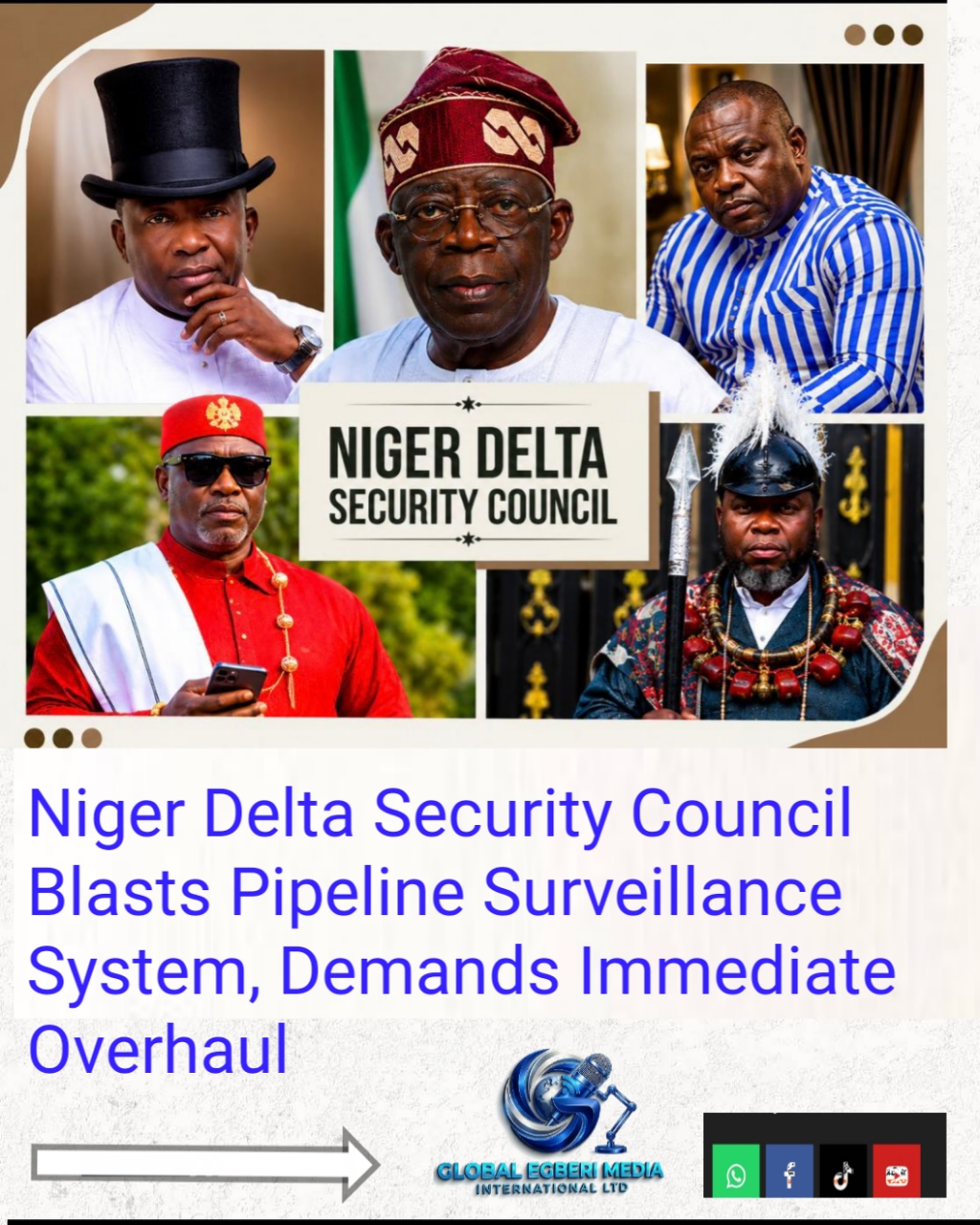
Niger Delta Security Council Blasts Pipeline Surveillance System, Demands Immediate Overhaul
The Niger Delta Security Council (NDSC) has launched a scathing attack on the current pipeline surveillance structure in the Niger Delta, accusing its defenders of “endorsing failure and calling it success” despite Nigeria’s worsening crude oil production crisis.
In a strongly worded communiqué issued on Sunday, May 25, 2026, and signed by Ebi Smart on behalf of the Council, the group faulted the recent endorsement of the existing surveillance arrangement by the Niger Delta Ethnic Nationalities Youth Leaders Forum (NDENYLF), led by Sir Jonathan Lokpobiri.
The Council described the endorsement as a dangerous attempt to justify a collapsing system that has allegedly cost Nigeria billions of dollars in lost oil revenue.
According to the statement, Nigeria’s crude oil production for April 2026 stood at only 1.488 million barrels per day, far below the Federal Government’s projected benchmark of 1.84 million barrels per day contained in the 2026 national budget.
The Council further noted that Nigeria has consistently failed to meet its 1.5 million barrels daily quota approved by OPEC for nine consecutive months.
Using prevailing Brent crude prices of approximately 103 dollars per barrel, the NDSC estimated that Nigeria is currently losing nearly 93 million dollars daily in unrealised revenue due to production shortfalls.
The statement recalled that before May 2015, when surveillance operations were allegedly more decentralised and coordinated on a state-by-state basis, Nigeria reportedly maintained production levels between 2.4 and 2.5 million barrels per day.
According to the Council, the difference represents an annual economic loss exceeding 33 billion dollars.
The NDSC accused supporters of the current surveillance arrangement of attempting to manipulate public perception through media campaigns and political endorsements while the country’s oil sector continues to suffer.
“Real Security Versus Stage-Managed Shows”
In one of the most controversial portions of the communiqué, the Council drew a distinction between what it described as “genuine pipeline security” and “the performance of pipeline security.”
The group praised the Nigerian Armed Forces, including the Navy, Army, and Joint Task Forces, for carrying out what it called verifiable anti-oil theft operations across the Niger Delta.
According to the Council, security agencies have consistently recorded arrests, seizures, and documented operations against crude oil thieves without excessive publicity.
However, the NDSC questioned the effectiveness of the dominant private surveillance contractor currently operating in the region.
The Council referenced a 2024 incident in which four individuals allegedly linked to the contractor were reportedly arrested by the Nigerian Navy in Lagos over suspected involvement in oil theft activities.
“This is what passes for pipeline security under the current centralised arrangement,” the communiqué declared.
Council Accuses NDENYLF Of Contradictions
The NDSC further argued that the NDENYLF communiqué itself exposed weaknesses in the present surveillance framework.
According to the Council, the youth forum simultaneously endorsed the current arrangement while also demanding greater inclusion of Niger Delta youths in oil, gas, and security activities.
The group insisted that such demands amount to an indirect admission that the present structure has failed to provide adequate employment and development opportunities for local communities.
To address the situation, the NDSC proposed a fully decentralised surveillance system coordinated by the Nigerian Armed Forces.
Under the proposed framework, each of the nine Niger Delta states would reportedly engage a minimum of 5,000 youths directly in surveillance and protection operations.
The Council argued that such a system would create at least 45,000 jobs while ensuring broader accountability and preventing any single non-state actor from dominating regional security operations.
Criticism Of Legislative Oversight Opposition
The Council also reacted strongly to comments reportedly made by Sir Jonathan Lokpobiri during an appearance on Arise Television, where he allegedly warned that National Assembly scrutiny of pipeline surveillance contracts could destabilise the fragile peace in the region.
Describing the comments as disturbing, the NDSC insisted that all surveillance contracts funded with public resources must remain subject to legislative oversight.
“A pipeline surveillance arrangement funded through public resources and operating in Nigeria’s most sensitive security terrain cannot be above scrutiny,” the communiqué stated.
The group questioned whose interests were being protected by attempts to discourage parliamentary investigation into the contracts.
2016 Niger Delta Crisis Leaders Remembered
The Council also criticised the NDENYLF for allegedly failing to acknowledge several Niger Delta leaders who, according to the communiqué, played key roles in stabilising the region during the 2016 Niger Delta Avengers crisis.
Among those mentioned were Senior High Chief Bibopere Ajube, King Michael Ateke Tom, King Dokubo Asari, Chief Victor Ben Ebikabowei, and Chief Michael Jonny of Gbaramatu.
The NDSC claimed these figures made significant sacrifices to prevent the region from descending into chaos at a critical period in Nigeria’s oil production history.
Amnesty Programme Under Fire
In another major revelation, the Council called for an immediate investigation into the Presidential Amnesty Programme.
The group urged the Economic and Financial Crimes Commission (EFCC) and the Independent Corrupt Practices Commission (ICPC) to probe the utilisation of funds under the administration of Dr. Denis Otuaro.
The communiqué alleged that ordinary beneficiaries of the programme have continued receiving a monthly stipend of N65,000 since 2010 despite rising inflation and the programme’s reportedly massive budget allocations.
The Council also alleged that certain influential camps within the region had allegedly enjoyed payment increases exceeding 500 percent while ordinary beneficiaries remained neglected.
NDSC Demands Immediate Reforms
At the conclusion of the statement, the Niger Delta Security Council demanded the immediate decentralisation of pipeline surveillance operations across the Niger Delta.
The group insisted that all surveillance contracts should be subjected to public scrutiny and coordinated solely through the Nigerian Armed Forces.
The Council further demanded the immediate review of the N65,000 Amnesty Programme stipend and broader inclusion of Niger Delta communities in oil security operations.
The statement warned that continued centralisation of surveillance contracts without accountability could further deepen distrust, unemployment, and instability in the oil-rich region.
Source: Niger Delta Security Council (NDSC) Communiqué
Author: Dr. Odimientimi Agbedeyi
About the Author