
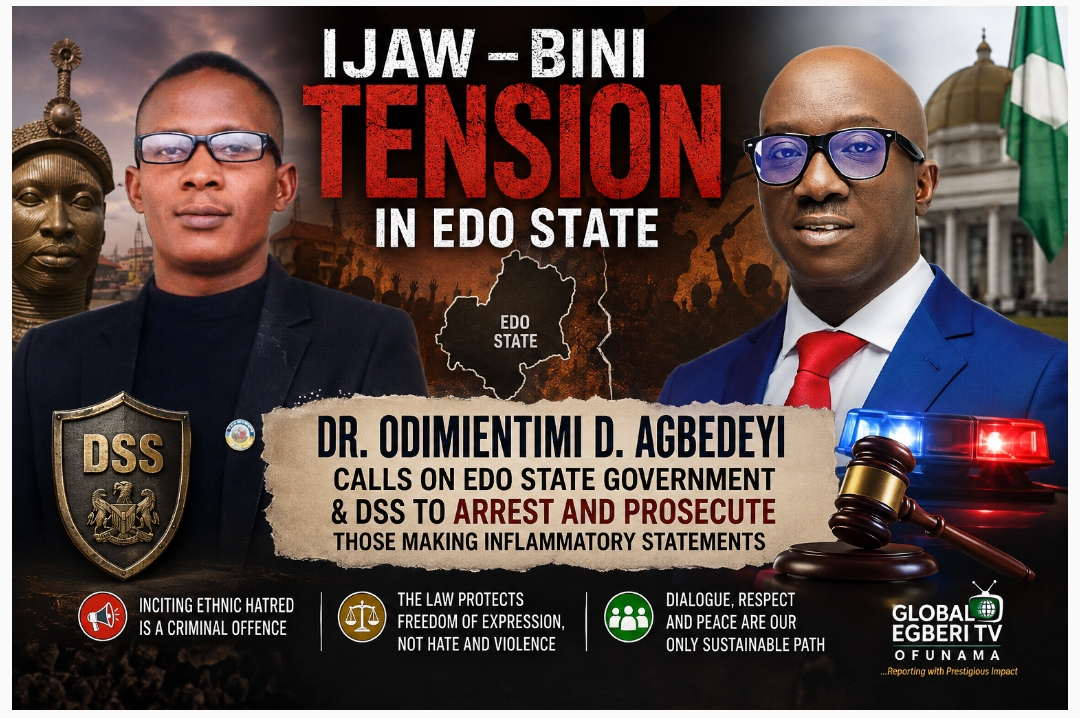
Edo Ijaw–Bini Tension: Agbedeyi Urges DSS, Edo Government to Prosecute Incendiary Voices Before Rhetoric Becomes Conflict
By GlobalEgberiTV Ofunama
BENIN CITY, EDO STATE — A Chief Lecturer at Delta State Polytechnic, Ogwashi-Uku, Dr. Odimientimi Desmond Agbedeyi, has called on the Edo State Government and the Department of State Services (DSS) to urgently investigate and, where the evidence establishes criminal culpability, prosecute persons allegedly disseminating inflammatory, ethnically provocative and violence-inducing statements capable of destabilising the fragile relationship between the Ijaws and Binis in Edo State.
Agbedeyi’s intervention comes amid a growing wave of contentious commentary in the digital space concerning the status, identity and rights of indigenous Ijaw people in Edo State.
According to him, the situation has assumed a dimension that should no longer be treated as mere social-media banter or political rhetoric, particularly where statements allegedly encourage ethnic exclusion, stigmatise an entire ethnic community or advocate the use of arms against fellow Nigerians.
He expressed particular concern over alleged online assertions that Ijaws are “tenants” in Edo State and reports of persons purportedly urging Binis not to rent their apartments to Ijaws.
Agbedeyi argued that such rhetoric, if established and viewed in its proper factual and legal context, could become a dangerous instrument for ethnic polarisation.
“The government and the security agencies must not wait until inflammatory rhetoric metamorphoses into physical violence before they act. Where individuals are making statements capable of inciting ethnic hatred or violence, the appropriate agencies should investigate the statements, identify the authors and determine whether the threshold for criminal prosecution has been crossed.”
He further alleged that some individuals on social-media platforms have gone beyond controversial historical or political arguments to make statements allegedly calling for armed confrontation against Ijaws.
According to him, such utterances should be treated with particular gravity because the transition from inflammatory speech to organised violence can sometimes occur with alarming speed.
Constitutional Rights Are Not a Licence for Incitement
Agbedeyi acknowledged that citizens possess constitutionally protected rights to freedom of expression.
Section 39(1) of the 1999 Constitution guarantees freedom of expression, including the right to hold opinions and impart ideas and information. However, that constitutional protection does not place every form of communication beyond the reach of legitimate criminal law enforcement. (Nigeria Rights)
More importantly, Section 15(3) of the Constitution imposes a constitutional policy obligation to promote national integration, including encouraging the free movement of people and securing full residence rights for every citizen in all parts of Nigeria. Section 15(2) also provides that national integration shall be actively encouraged while discrimination on grounds including ethnic or linguistic association is prohibited. (PlacNG)
Section 41 further guarantees every Nigerian citizen the right to move freely throughout Nigeria and to reside in any part thereof, subject to constitutionally permissible restrictions. Section 42 protects citizens against discrimination on grounds including community, ethnic group and place of origin. (PlacNG)
Consequently, Agbedeyi maintained that ethnic identity cannot legitimately be converted into a juridical basis for denying Nigerian citizens their constitutional entitlement to reside peacefully in another part of the country.
“Tenants” Rhetoric Requires Responsible Scrutiny
The controversy over the description of Edo Ijaws as “tenants” has recently become a recurring feature of online discourse. Current social-media material shows that the expression continues to be used in the context of the broader argument over the place of Ijaws in Edo State. (Facebook)
Agbedeyi said historical, territorial and political disagreements should be subjected to scholarly debate, documentary evidence and lawful dispute-resolution mechanisms rather than transformed into ethnic antagonism.
He warned that reducing a complex historical question to derogatory ethnic labels could deepen resentment and create a combustible environment, especially when amplified through social-media platforms.
The call also comes against the background of recent public warnings that inflammatory statements surrounding the Ijaw–Benin question could generate resentment and unnecessary tension between the two tribes. (Vanguard News)
Where Speech Crosses Into Criminality
The legal position, however, requires precision.
Not every offensive or provocative statement automatically constitutes a criminal offence. The relevant question for law-enforcement authorities is whether the particular statement satisfies the ingredients of an offence recognised by applicable law, including whether it was intended, or was objectively capable in the circumstances, of producing consequences prohibited by law.
Nigeria’s criminal-law framework contains provisions dealing with conduct capable of exciting hatred between classes of persons where public peace is endangered. For example, the relevant provisions reproduced in the Nigerian legal materials include an offence concerning the excitation of hatred against a class of persons in a manner capable of endangering public peace, as well as provisions dealing with false publications capable of causing public alarm and inducing offences against public peace. (Laws of Nigeria)
The Criminal Code also contains provisions dealing with assemblies and conduct calculated to promote animosity between groups. (Laws of Nigeria)
Accordingly, Agbedeyi’s position is not necessarily a demand for indiscriminate censorship. Rather, he is urging the competent authorities to undertake forensic investigation, evidentiary assessment and lawful prosecution wherever the facts disclose an actual criminal offence.
DSS Should Not Wait for the First Spark
Agbedeyi appealed to the DSS and other relevant security institutions to monitor the situation proactively and identify persons allegedly using digital platforms to circulate threats, incitement or messages capable of escalating ethnic hostility.
He said intelligence-led intervention is preferable to a reactive security response after violence has already erupted.
“Security agencies should not remain at the fence while the digital space is being weaponised to deepen ethnic suspicion. The prudent course is preventive intelligence gathering, proper investigation and lawful intervention before inflammatory rhetoric acquires a physical manifestation.”
He equally urged the Edo State Government to deploy its constitutional and administrative machinery toward confidence-building, dialogue and conflict prevention.
According to him, government must demonstrate that Edo State belongs to all Nigerians who lawfully reside within it, while simultaneously protecting the legitimate cultural and historical interests of indigenous communities.
A Warning Against Collective Retaliation
The Chief Lecturer also cautioned Ijaw youths against retaliatory rhetoric, emphasising that an alleged provocation by an individual must never be transformed into collective hostility against an entire ethnic population.
He urged Ijaw and Benin traditional rulers, community leaders, youth organisations, religious leaders and civil-society actors to establish channels of communication capable of defusing tension before it degenerates.
He further called on social-media users to exercise restraint and refrain from reproducing threatening or inflammatory material merely because it is sensational.
“Edo Must Not Become a Theatre of Ethnic Confrontation”
Agbedeyi said the historical relationship between the five Ijaw Kingdoms in Edo State and the Benin Kingdom should not be reduced to an adversarial contest for political supremacy.
He argued that disagreement over history, land, identity, representation or political participation can be legitimately contested through scholarship, dialogue, constitutional processes and the courts.
What must be rejected, he said, is the transformation of such disagreements into an ideological justification for exclusion, intimidation or violence.
“Edo State cannot afford an ethnic conflagration generated by reckless words on the Internet. Once violence begins, nobody can predict where it will terminate. The government must therefore act within the law, security agencies must do their intelligence work, and community leaders must restrain their followers.”
He concluded by calling for an immediate stakeholder peace initiative involving the Edo State Government, security agencies, Benin traditional institutions, Ijaw traditional institutions, youth leaders, civil-society organisations and relevant political stakeholders.
According to Agbedeyi, the objective should not be to suppress legitimate historical discourse, but to establish a clear red line against ethnic vilification, threats of violence, discriminatory mobilisation and incitement capable of imperilling public order.
He maintained that prevention is infinitely preferable to post-conflict investigation, and that the preservation of peace in Edo State should remain a collective responsibility.
GlobalEgberiTV Ofunama will continue to monitor developments surrounding the Ijaw–Benin discourse and report verified developments responsibly.
Reporter: GlobalEgberiTV Ofunama
About the Author