
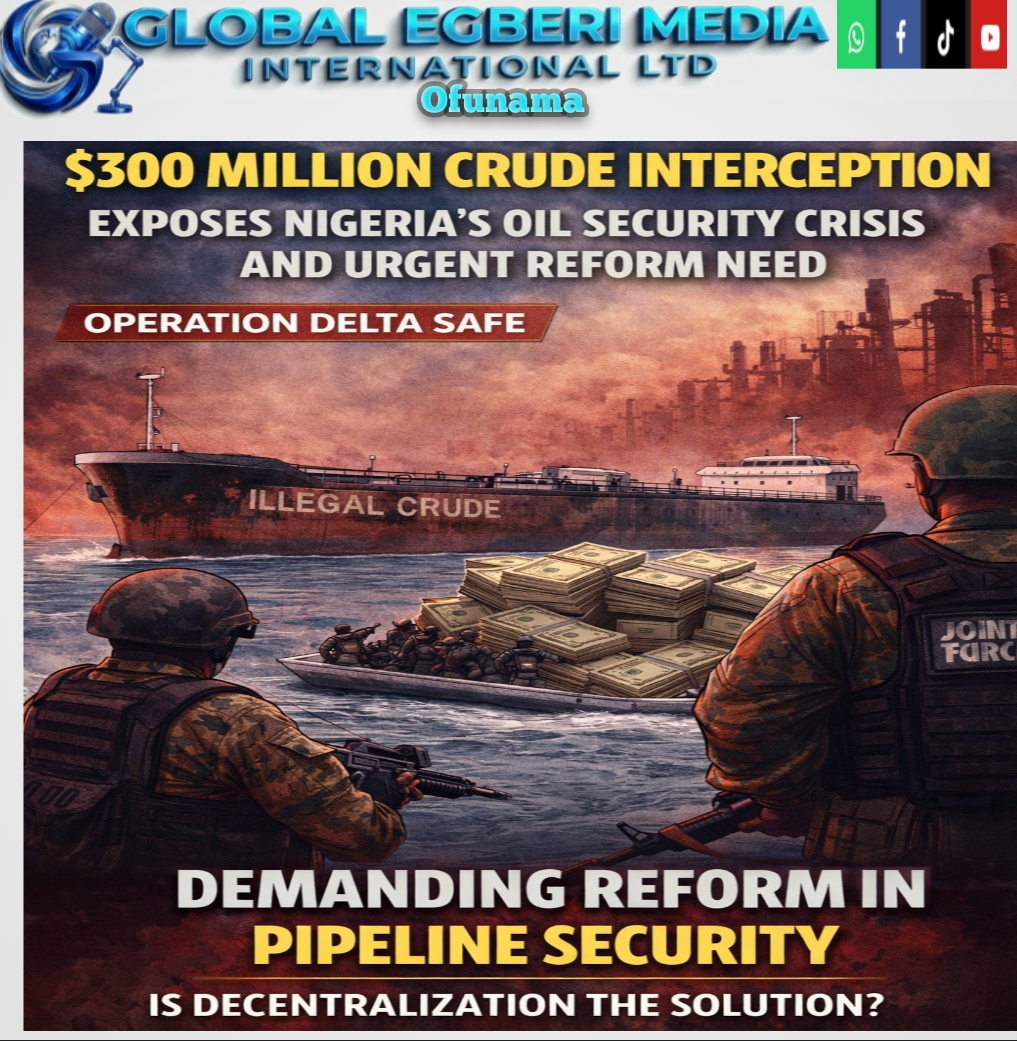
$300 Million Crude Interception Exposes Nigeria’s Oil Security Crisis and Urgent Reform Need
Nigeria stands at a defining moment in its long and complicated battle against crude oil theft, as the confirmed interception of illegal crude valued at $300 million (approximately ₦450 billion) exposes deep-rooted vulnerabilities in the nation’s oil security architecture.
Reports from NTA Network News, corroborated by Daily Times Nigeria, confirm that the Joint Task Force (JTF) under Operation Delta Safe intercepted vessels suspected to be transporting illegally refined crude oil across key waterways in the Niger Delta.
While the operation has been widely praised as a major success, it simultaneously raises uncomfortable and unavoidable questions about how such a massive volume of crude could move within the system undetected until the point of interception.
A Success That Reveals a Bigger Problem
There is no doubt that the interception represents a significant operational achievement for Nigeria’s security forces. It demonstrates capacity, coordination, and a renewed determination to combat economic sabotage.
However, beyond the applause lies a deeper concern.
At an estimated ₦450 billion, the scale of the intercepted crude is staggering. This is not the work of small-scale operators or opportunistic vandals. It reflects a highly organized network with access to pipelines, transportation infrastructure, and distribution channels.
Such a network does not operate in isolation. It thrives within gaps—gaps in surveillance, enforcement, and accountability.
The real issue, therefore, is not just the interception, but the system that allowed the operation to exist in the first place.
Historical Context: Nigeria’s Long Struggle with Oil Theft
Crude oil theft is not a new phenomenon in Nigeria. For decades, the Niger Delta has been at the center of illegal bunkering activities, pipeline vandalism, and unauthorized refining.
Successive governments have launched initiatives, deployed military task forces, and awarded surveillance contracts worth trillions of naira. Yet, the problem persists.
Estimates over the years suggest that Nigeria has lost billions of dollars annually to oil theft—funds that could have been invested in infrastructure, healthcare, education, and economic development.
The interception of $300 million worth of crude is therefore not just an isolated incident—it is a snapshot of a much larger, ongoing crisis.
Economic Implications: A Nation Bleeding Revenue
The financial implications of crude oil theft are profound.
Nigeria’s economy is heavily dependent on oil revenues. When large volumes of crude are stolen, the consequences ripple across multiple sectors:
- Reduced government revenue, affecting budget implementation
- Pressure on foreign exchange reserves, weakening the naira
- Decline in investor confidence, discouraging foreign investment
- Increased national debt, as the government borrows to fill revenue gaps
In simple terms, crude oil theft is not just an economic crime—it is a direct assault on national development.
The ₦450 billion intercepted could fund major infrastructure projects, improve public services, and create employment opportunities. Its loss—or attempted loss—underscores the urgency of reform.
Public Reaction: Applause Mixed with Skepticism
Public reactions to the interception have been mixed.
On one hand, Nigerians have commended the security agencies for what appears to be a decisive and effective operation. On the other hand, there is widespread skepticism about what happens next.
A critical question remains unanswered: Who owns the crude?
Without transparency in the investigation and prosecution process, there is a risk that this incident will fade into obscurity, as many before it have.
Trust in institutions is built not just on action, but on accountability.
The Structural Weakness of Centralized Surveillance
One of the most glaring issues highlighted by this incident is the limitation of centralized pipeline surveillance.
For years, Nigeria has relied on a system where a limited number of entities are responsible for securing vast networks of pipelines and waterways. While this model offers coordination, it also creates significant vulnerabilities:
- Limited local intelligence
- Delayed response to incidents
- Potential for systemic compromise
- Lack of community ownership
Centralized control, without grassroots integration, creates blind spots—and it is within these blind spots that large-scale theft operations thrive.
Decentralization: From Concept to Necessity
The time has come to move beyond theoretical debates and embrace practical solutions. Chief among these is the decentralization of pipeline surveillance.
Decentralization means empowering host communities to take an active role in protecting oil infrastructure within their territories.
This approach offers multiple advantages:
- Real-time intelligence: Locals are the first to notice unusual activities
- Continuous presence: Communities provide round-the-clock monitoring
- Shared responsibility: Every stakeholder becomes a protector
- Deterrence effect: Criminal activities become harder to conceal
When communities are directly involved, the dynamics change. Oil theft becomes not just a national issue, but a local concern—one that is actively resisted at the grassroots level.
Balancing Decentralization with Accountability
While decentralization offers clear benefits, it must be implemented with structure and oversight.
A successful model should include:
- Clear regulatory frameworks
- Transparent monitoring mechanisms
- Collaboration between communities and federal agencies
- Strict accountability measures
This ensures that decentralization does not lead to fragmentation or abuse, but instead strengthens the overall security architecture.
A Call for Courageous Leadership
The interception of $300 million worth of crude is both a warning and an opportunity.
It warns of the scale of economic sabotage still undermining Nigeria’s progress.
It presents an opportunity to rethink and rebuild.
What is required now is courageous leadership—leadership willing to confront entrenched interests, challenge ineffective systems, and implement meaningful reforms.
Conclusion: From Reaction to Transformation
Nigeria must not allow this moment to pass as just another headline.
The country must transition from reactive enforcement to proactive transformation. The fight against crude oil theft cannot be won solely through interceptions—it must be rooted in systemic change.
Empowering communities, strengthening institutions, and ensuring transparency are not optional—they are essential.
If Nigeria is to secure its oil wealth and unlock its full economic potential, it must rethink how that wealth is protected.
The path forward is clear. What remains is the will to act.
Source: NTA Network News / Daily Times Nigeria
🌐 https://globalegberi.com.ng
About the Author