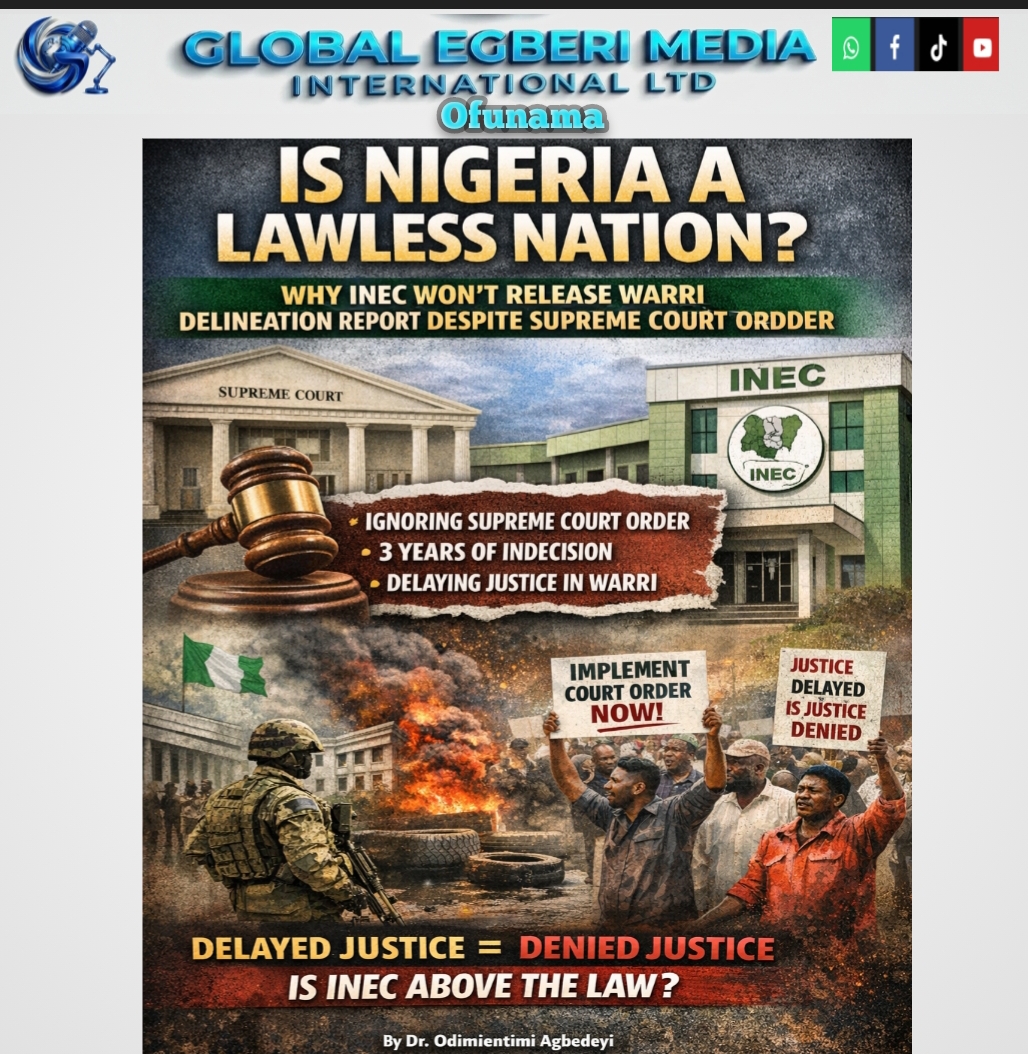
Editorial: Is Nigeria Becoming Lawless? Why INEC Has Still Not Released the Warri Delineation Report Despite Supreme Court Order
By Dr. Odimientimi Agbedeyi
Nigeria prides itself as Africa’s largest democracy, yet repeated institutional delays and selective obedience to court judgments continue to raise troubling questions about the strength of its rule of law.
One issue that has remained controversial is the continued delay by the Independent National Electoral Commission (INEC) in finalising and releasing the Warri Federal Constituency ward delineation report despite a clear Supreme Court judgment delivered on December 2, 2022, directing the Commission to undertake fresh delineation in Warri North, Warri South, and Warri South West Local Government Areas of Delta State. (TheCable)
More than three years after that judgment, the process remains unresolved, with many stakeholders questioning why the nation’s electoral umpire has not concluded a matter already decided by the highest court in the land.
The Supreme Court Gave Direction — Why the Delay?
According to public statements by INEC, the Commission began stakeholder consultations in February 2023, completed fieldwork by July 2024, and later presented a draft delineation report to stakeholders on April 4, 2025. (Punch Newspapers)
Yet, despite these milestones, INEC later stated that no final decision had been taken and that the proposed delineation had not been suspended. (INEC Nigeria)
This raises an obvious question:
If consultations were done, fieldwork completed, and a draft report presented, what exactly is preventing final release and implementation?
In functioning democracies, orders of the Supreme Court are not advisory suggestions—they are binding directives.
Warri Is Too Sensitive for Endless Delay
The Warri Federal Constituency is one of the most politically sensitive regions in Nigeria, involving historic demographic and territorial interests among Ijaw, Itsekiri, and Urhobo communities. Public debates around the delineation process have intensified because representation determines access to political offices, wards, polling units, and influence. (The Nation Newspaper)
This means delay is not neutral.
Every month of uncertainty creates room for:
- distrust between communities
- political tension
- misinformation
- suspicion of bias
- loss of confidence in INEC
- possible pre-election instability
Institutions must understand that indecision can be as damaging as a wrong decision.
Can INEC Obey Some Judgments and Ignore Others?
This is where many Nigerians become frustrated.
When ordinary citizens disobey court orders, the state acts swiftly. But when public institutions delay implementing judgments, excuses multiply.
If a Supreme Court judgment can remain in limbo for years on a constituency matter, what message does that send about constitutional supremacy?
It suggests to citizens that power, not law, determines outcomes.
That perception is dangerous for any democracy.
Nigeria Must Reject the Culture of Selective Compliance
Describing Nigeria as “lawless” comes from public anger, but the deeper issue is selective institutional compliance.
Nigeria cannot build investor confidence, electoral trust, or national unity where court judgments are implemented only when convenient.
The credibility of the electoral commission depends not just on conducting elections, but on showing neutrality, consistency, and obedience to lawful orders.
INEC must remember that delayed justice in electoral matters often becomes denied justice.
What INEC Should Do Now
To restore confidence, INEC should urgently:
- Publish a transparent timeline for completion of the Warri delineation process.
- Release the final report or clearly explain lawful obstacles preventing release.
- Engage all stakeholders publicly and equally.
- Ensure implementation well ahead of future elections.
- Demonstrate that Supreme Court judgments remain supreme.
Editorial Conclusion
Nigeria is not a zoo, and should never be spoken of as one. But when lawful orders are endlessly delayed, frustration grows and faith in institutions declines.
The Warri delineation matter is bigger than Delta State. It is now a test of whether Nigeria still respects the rule of law.
If the Supreme Court speaks and agencies hesitate indefinitely, then the real crisis is not Warri—it is governance itself.
Source:
INEC Official Statements / TheCable / Punch / Public Records
About the Author