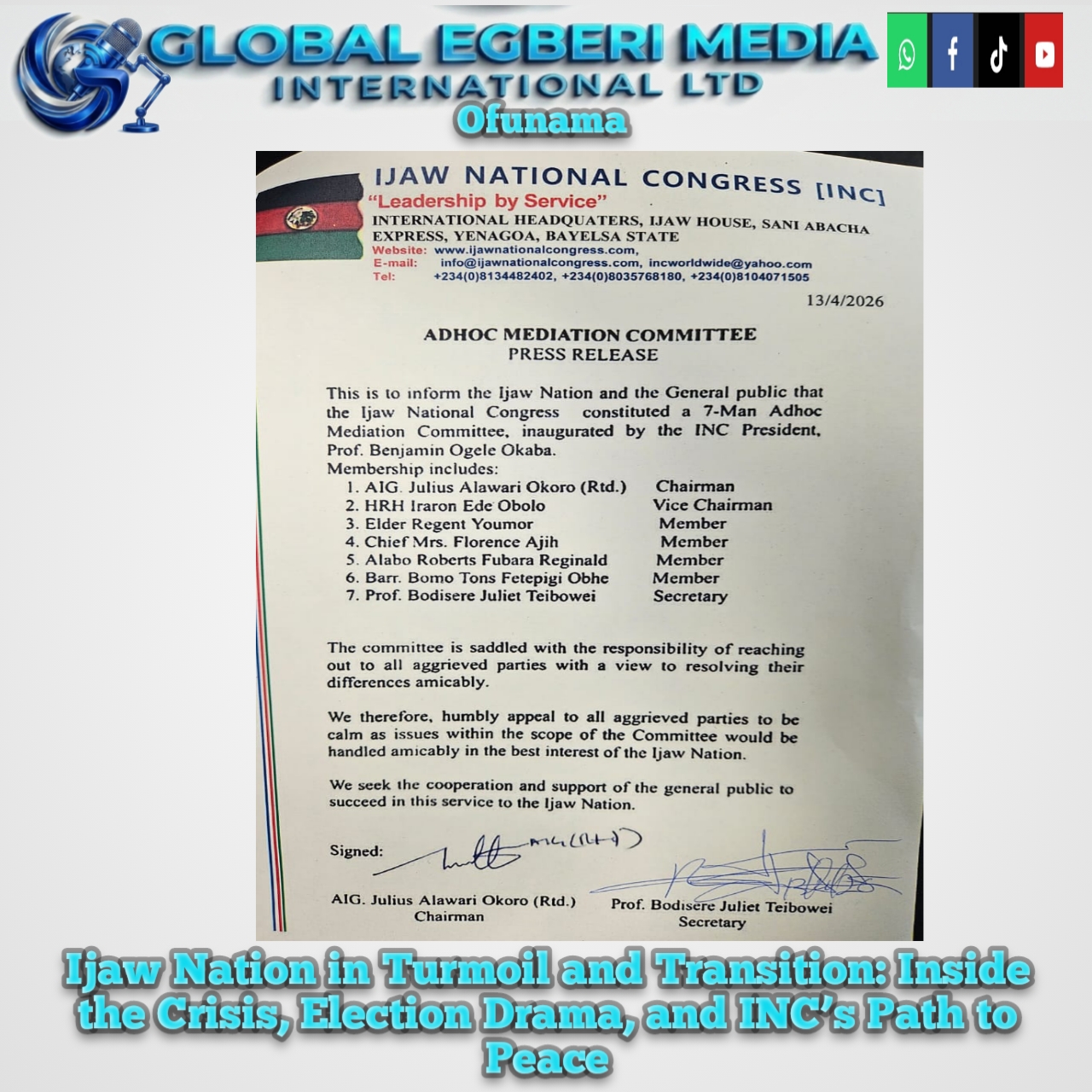
Ijaw Nation in Turmoil and Transition: Inside the Crisis, Election Drama, and INC’s Path to Peace
By Dr. Odimientimi Agbedeyi
The events surrounding the just-concluded leadership process of the Ijaw National Congress (INC) have exposed deep-rooted tensions within the Ijaw Nation—tensions that now make the inauguration of a mediation committee not only necessary but urgent.
What began as a routine electoral process gradually evolved into a full-blown institutional crisis, pitting key organs of the Congress against one another, and raising fundamental questions about constitutional authority, leadership legitimacy, and the future of Ijaw unity.
Pre-Election Crisis: A Nation Divided
The crisis did not start overnight. The INC national election, initially scheduled for March 7, 2026, was disrupted by legal and administrative challenges, including a court injunction that halted the process. (Vanguard News)
In a bid to move forward, the leadership of the Congress, under Prof. Benjamin Ogele Okaba, rescheduled the election for April 13, 2026. This decision, however, ignited a major confrontation with the Conference of Ijaw Traditional Rulers and Elders (CITRE), a powerful traditional institution within the Ijaw governance structure.
CITRE, invoking constitutional provisions, announced a suspension of the electoral process, citing unresolved disputes and the need to address petitions through a Dispute Resolution Committee. The body insisted that, as stipulated in the INC constitution, it holds final authority in settling electoral disputes within the Congress. (Vanguard News)
But the INC leadership rejected this move. Professor Okaba described the suspension as “ill-intended,” insisting that the National Executive Council (NEC) remained the supreme decision-making body and that the election must proceed as scheduled. (Vanguard News)
This disagreement created two parallel authorities within the Ijaw system—one rooted in modern organizational governance and the other in traditional legitimacy.
Stakeholder Tensions and Political Undercurrents
Behind the institutional conflict were deeper political undercurrents. Stakeholders, including elders, traditional rulers, and political actors, were sharply divided over the credibility of the electoral process and the neutrality of the electoral committee.
An expanded NEC meeting held in Yenagoa had earlier expressed confidence in the preparedness of the electoral body, endorsing the April 13 date and affirming the independence of the electoral committee. (Peoples Gazette Nigeria)
However, dissenting voices argued that the process lacked transparency and inclusiveness, fueling suspicion among various factions. The intervention of the King Bubaraye Dakolo, who warned that proceeding with the election would amount to a violation of the INC constitution, further heightened tensions. (Vanguard News)
At one point, security concerns escalated as authorities were reportedly urged to prevent gatherings at Ijaw House in Yenagoa, underscoring the volatile atmosphere surrounding the exercise. (Vanguard News)
Election Day: Defiance and Determination
Despite the controversy and calls for suspension, the INC leadership went ahead with the election on April 13, 2026.
Reports indicate that the election was conducted amid tension but also determination by stakeholders who believed that delaying the process further would deepen the crisis. The Board of Trustees and other organs of the Congress reportedly aligned with the position that the election should proceed in order to preserve institutional continuity. (Facebook)
The election itself symbolized more than a leadership transition—it became a test of authority within the Ijaw Nation.
For some, it was a victory for constitutional order as interpreted by the NEC. For others, it represented a disregard for traditional institutions and established conflict-resolution mechanisms.
Aftermath: A Fragile Peace and the Birth of Mediation
In the immediate aftermath of the election, it became clear that while a leadership process had been concluded, the underlying divisions remained unresolved.
It is within this fragile context that the INC inaugurated a 7-man Adhoc Mediation Committee, chaired by AIG Julius Alawari Okoro (Rtd.), to engage aggrieved parties and foster reconciliation.
The committee’s mandate is both delicate and critical—to bridge the gap between opposing factions, restore confidence in the leadership structure, and prevent further fragmentation of the Ijaw Nation.
Editorial Perspective: A Defining Moment for Ijaw Unity
This episode represents a defining moment in the political evolution of the Ijaw Nation. It highlights the enduring tension between tradition and modern governance, between authority and consensus.
The INC, as the apex socio-cultural body of the Ijaw people, carries a responsibility that transcends politics. It is a symbol of identity, unity, and collective aspiration.
The current crisis, therefore, must not be allowed to degenerate into lasting division.
The newly constituted mediation committee must act with urgency, fairness, and wisdom. More importantly, all stakeholders—whether aligned with CITRE, NEC, or other interest groups—must be willing to embrace dialogue and compromise.
The Way Forward
For sustainable peace to be achieved, three critical steps are necessary:
- Respect for Institutional Roles: Both traditional and administrative organs must operate within clearly defined constitutional boundaries.
- Inclusive Dialogue: All aggrieved parties must be given a fair hearing without prejudice.
- Commitment to Unity: Personal and political interests must give way to the collective good of the Ijaw Nation.
The future of the Ijaw Nation depends not on who wins elections, but on how well its people manage their differences.
As history unfolds, the success or failure of this mediation effort will determine whether this crisis becomes a turning point for unity—or a precedent for deeper division.
Source: Vanguard Nigeria / Peoples Gazette / INC Press Release
Website: https://globalegberi.com.ng
About the Author