
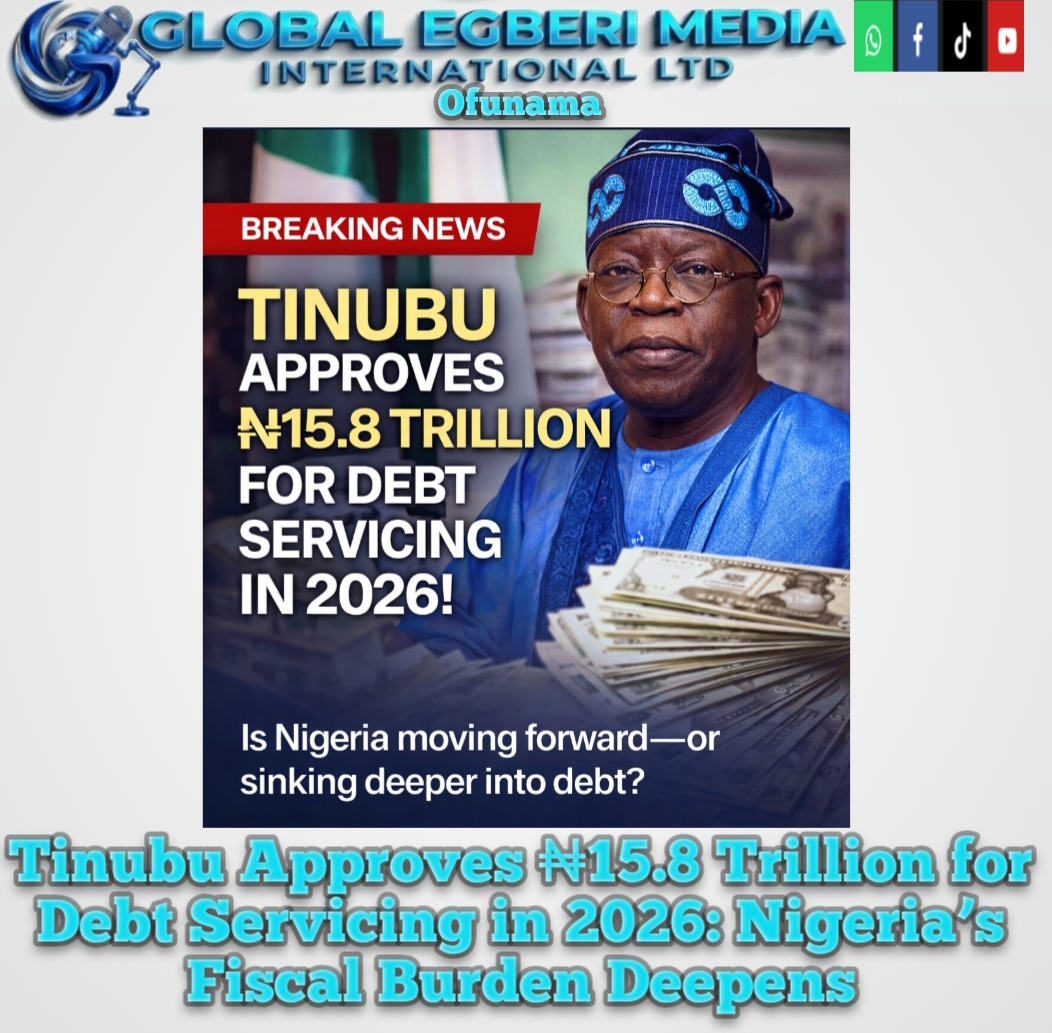
Tinubu Approves ₦15.8 Trillion for Debt Servicing in 2026: Nigeria’s Fiscal Burden Deepens
By Dr. Odimientimi Agbedeyi
For Global Egberi Media International Ltd
President Bola Ahmed Tinubu’s approval of ₦15.8 trillion for debt servicing in the proposed 2026 federal budget has once again brought Nigeria’s public finance challenges into sharp national focus. The allocation, one of the largest single expenditure components in the budget framework, reflects the increasing pressure debt obligations are placing on the country’s fiscal space and long-term economic planning.
The development has sparked conversations among economists, policymakers, business leaders, and ordinary Nigerians who are concerned about how much of the nation’s resources now go into repaying loans rather than directly funding development priorities such as education, healthcare, infrastructure, agriculture, and employment generation.
Rising Cost of Debt Management
Debt servicing refers to the repayment of both principal and interest on borrowed funds. For many developing nations, borrowing can be a useful tool for financing infrastructure, stabilizing the economy, or addressing short-term fiscal deficits. However, when debt obligations rise too quickly relative to revenue growth, governments may struggle to balance repayment with developmental spending.
Nigeria’s debt service bill has grown steadily over the last decade due to increased domestic borrowing, external loans, exchange rate pressures, and elevated interest rates. The proposed ₦15.8 trillion debt servicing vote for 2026 underscores how serious the challenge has become.
Financial analysts note that while debt-to-GDP ratios may still appear moderate when compared with some other countries, Nigeria’s more pressing problem is the debt-to-revenue ratio. In simple terms, the government spends a substantial share of what it earns simply paying existing debts, leaving limited room for productive investment.
The Structure of the 2026 Budget
The broader 2026 budget framework is expected to cover recurrent expenditure, capital projects, statutory transfers, and debt obligations. While the government has indicated plans to continue investments in roads, rail, security, energy, and social programs, the large debt servicing provision raises questions about how much fiscal flexibility truly remains.
Recurrent expenditure—including salaries, overheads, and administrative costs—already consumes a significant portion of federal revenue. When debt service is added, critics argue that the resources left for transformative capital projects become constrained.
This is particularly important for a country with a rapidly growing population, high youth unemployment, inflationary pressures, and urgent infrastructure needs.
Why the Debt Keeps Growing
Several factors have contributed to Nigeria’s expanding debt profile:
1. Revenue Shortfalls
Nigeria continues to struggle with low revenue generation relative to the size of its economy. Tax compliance remains weak, and oil revenue—historically a major source of income—has been volatile due to price swings, theft, underproduction, and global market uncertainty.
2. Budget Deficits
Successive administrations have relied on borrowing to bridge the gap between expenditure needs and actual income. While this approach can support government operations in the short term, it also increases future repayment obligations.
3. Exchange Rate Impact
A sizeable portion of Nigeria’s debt is external. Currency depreciation increases the naira cost of repaying foreign-denominated loans, making debt service more expensive.
4. High Domestic Interest Rates
Borrowing locally through treasury bills and bonds often comes with substantial interest costs, especially in inflationary periods.
Public Concerns and Economic Implications
Many Nigerians are asking a simple question: What visible benefits have these borrowings delivered?
That question reflects public frustration over persistent poverty, insecurity, unemployment, and inadequate infrastructure in several parts of the country. While some projects financed through borrowing have improved transport and energy systems, critics insist that the pace of impact has not matched the scale of indebtedness.
There are also concerns that heavy debt servicing can crowd out critical sectors:
- Education: Schools require improved facilities, teacher training, and expanded access.
- Healthcare: Hospitals need equipment, personnel, and affordable services.
- Agriculture: Farmers need support to strengthen food security.
- Youth Employment: More investment is needed in innovation, entrepreneurship, and industrial growth.
When debt payments dominate fiscal priorities, these sectors may receive less than required.
Government’s Position
Supporters of the Tinubu administration argue that borrowing is not inherently negative when funds are tied to productive investments capable of generating long-term returns. They maintain that current reforms—including subsidy removal, tax restructuring, exchange rate adjustments, and infrastructure expansion—are intended to place Nigeria on a stronger economic footing.
Officials also point to inherited fiscal pressures and global economic headwinds as realities the administration must manage.
From this perspective, debt servicing is an unavoidable responsibility that protects Nigeria’s creditworthiness and preserves investor confidence.
The Way Forward
To reduce dependence on borrowing and ease future debt burdens, experts recommend several policy directions:
Improve Revenue Collection
Broadening the tax base without overburdening low-income citizens remains essential. Efficient tax administration and plugging leakages can help.
Grow Non-Oil Exports
Diversifying the economy into manufacturing, agriculture, technology, and services can increase foreign exchange earnings.
Prioritize Productive Borrowing
Loans should be tied to projects with measurable economic returns rather than recurrent consumption.
Cut Wasteful Spending
Reducing duplication, inefficiency, and corruption in public finance can free resources for development.
Strengthen Transparency
Citizens deserve regular updates on how borrowed funds are used and what outcomes they deliver.
Conclusion
The approval of ₦15.8 trillion for debt servicing in 2026 is more than a budget headline—it is a reflection of Nigeria’s broader fiscal crossroads. Debt, if wisely managed, can finance growth. But debt without sufficient revenue, accountability, and visible returns can become a long-term burden on future generations.
President Tinubu’s administration now faces the difficult task of balancing repayment obligations with urgent national development needs. Nigerians will be watching closely, not only the numbers in the budget, but the real-life impact on jobs, inflation, infrastructure, and quality of life.
The true test of any fiscal policy is not how much is borrowed or repaid, but whether the people ultimately feel the benefits.
About the Author