
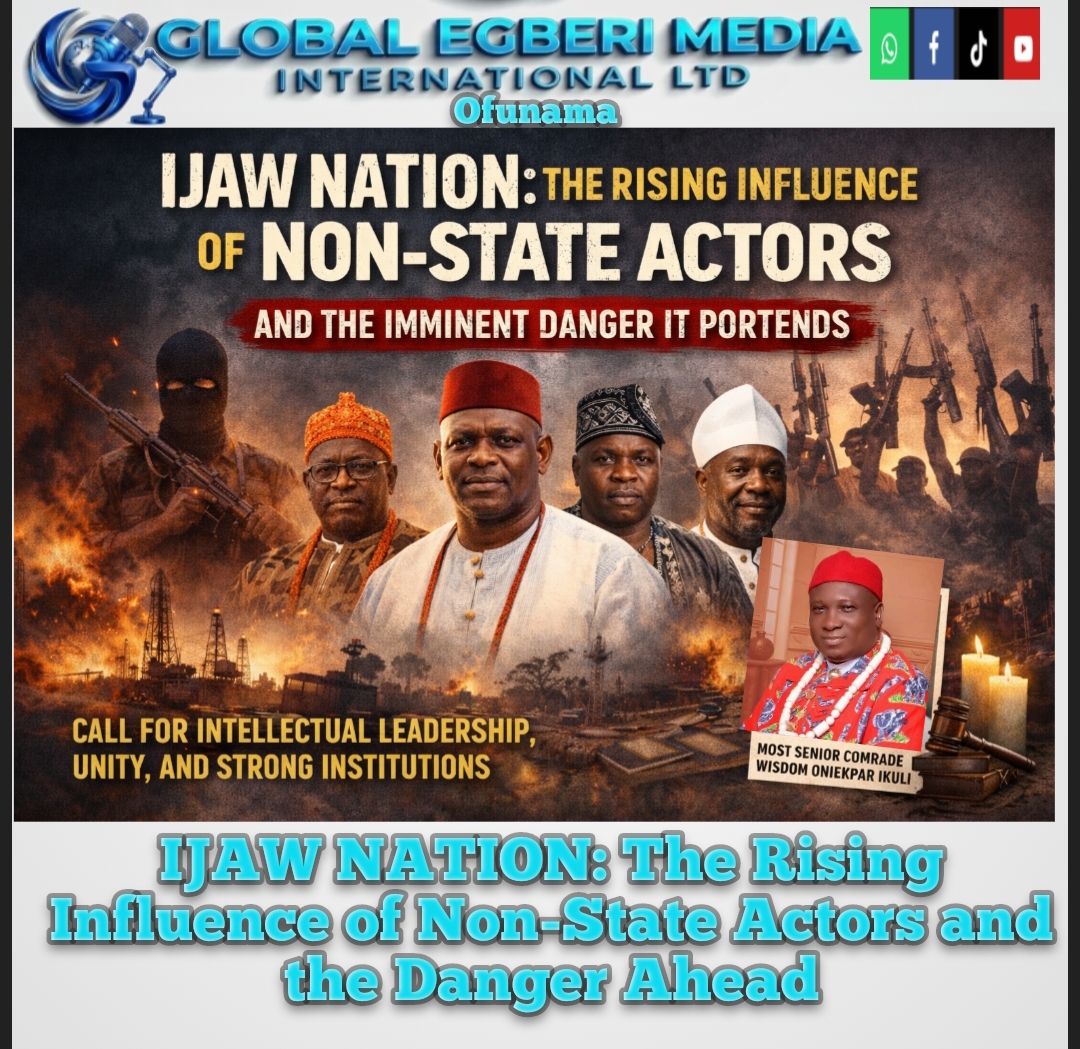
IJAW NATION: The Rising Influence of Non-State Actors and the Danger Ahead
By Most Senior Comrade Wisdom Oniekpar Ikuli
Mirror and Conscience of Society
The growing influence of non-state actors in many societies has become one of the defining political and security concerns of the modern era. For the Ijaw Nation, this development deserves urgent attention, reflection, and responsible action.
Understanding Non-State Actors
Non-state actors are organizations or individuals who operate outside the formal control of government institutions. They may include non-governmental organizations (NGOs), multinational corporations, militant groups, criminal networks, pressure groups, and social movements.
Across the world, non-state actors can play both positive and negative roles. Some help advance humanitarian causes, economic growth, and civic engagement. Others, however, become threats to peace, lawful authority, and public order.
When destructive non-state actors gain excessive influence, societies often experience instability, fear, and weakened institutions.
Why Governments Exist
Human civilization evolved partly because people recognized the need for structure, justice, and security. This gave rise to the idea of the social contract—a system in which individuals surrender some freedoms to a recognized authority in exchange for protection, fairness, and social order.
Political thinkers such as Thomas Hobbes, John Locke, and Jean-Jacques Rousseau explored this concept extensively.
Under this arrangement, governments are entrusted with the responsibility of protecting lives, managing public resources, and enforcing the rule of law through institutions such as the judiciary, law enforcement agencies, and civil administrations.
Where governments are effective, lawful authority remains supreme. Where governments are weak or absent, dangerous alternatives often emerge.
Lessons from Other Nations
History shows that violent or criminal non-state actors rarely become powerful overnight. They often rise gradually in environments where state institutions are weak, divided, corrupt, or ineffective.
Examples from different parts of the world include:
- Gang violence in Haiti
- Armed insurgencies in parts of Central Africa
- Extremist networks in Somalia
- Prolonged instability in Libya
- Drug cartel violence in Latin America
These cases demonstrate that when governments fail to respond early, minor threats can evolve into major crises.
The Ijaw Nation: A Land of Great Potential
The Ijaw Nation remains one of the most significant ethnic nationalities in Nigeria, blessed with vast human talent, strategic geography, and abundant natural resources.
Ijaw people have distinguished themselves in leadership, scholarship, activism, business, culture, and public service. Across generations, the nation has produced brilliant minds, courageous voices, and creative innovators.
Yet, despite these strengths, the challenge remains how to convert this enormous potential into coordinated progress.
The Danger of Neglecting Intellectual Leadership
One of the greatest risks facing any society is the marginalization of thinkers, professionals, educators, and visionary leaders while rewarding destructive influences.
As the saying goes, ideas rule the world. Nations that invest in education, innovation, and strategic leadership often rise faster than those that celebrate intimidation, lawlessness, or disorder.
When intellectual voices are ignored, space is created for opportunists, criminal elements, and power struggles that undermine long-term development.
A Call to Collective Responsibility
The future of the Ijaw Nation cannot be built on fear, violence, or rivalry. Sustainable progress requires the active cooperation of all key institutions, including:
- Political leadership
- Traditional rulers
- Religious institutions
- Youth organizations
- Women leaders
- Scholars and professionals
- Community stakeholders
Each group has a role to play in promoting peace, lawful conduct, education, and economic advancement.
Development, Not Disorder
No modern society thrives through the force of weapons alone. In the 21st century, nations are advancing through science, technology, entrepreneurship, infrastructure, and knowledge-driven economies.
For the Ijaw Nation to fully realize its destiny, priority must be placed on:
- Quality education
- Youth empowerment
- Innovation
- Security through lawful institutions
- Economic cooperation
- Respect for traditional and democratic structures
- Unity of purpose
Conclusion
The rise of harmful non-state actors is a warning sign that should never be ignored. For the Ijaw Nation, this is a moment for wisdom, unity, and strategic leadership.
The path forward lies not in chaos or confrontation, but in strengthening institutions, elevating ideas, and investing in people.
The Ijaw Nation possesses all the ingredients for greatness. What is required now is disciplined leadership and collective resolve.
About the Author