
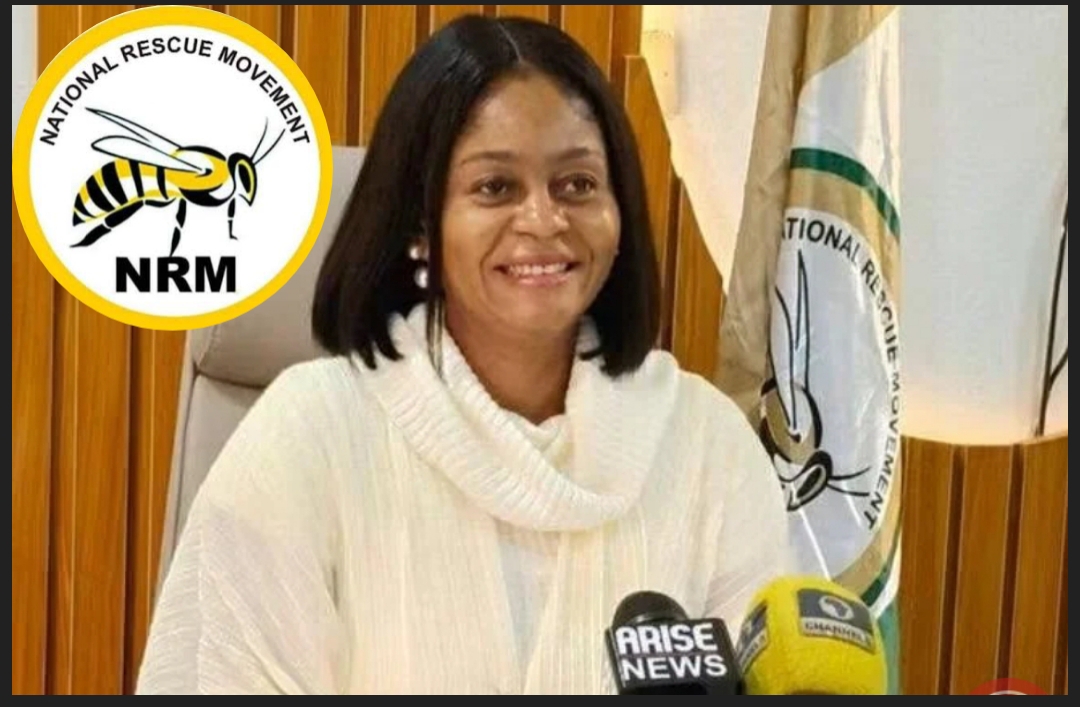
2027: NRM Presidential Candidate Esther Okereke Pledges 25,000MW Electricity in First 100 Days
By Dr. Odimientimi Agbedeyi
Global Egberi Media International Ltd
The National Rescue Movement (NRM) presidential candidate for the 2027 general election, Esther Okereke, has unveiled an ambitious energy-sector promise, pledging that her administration would raise Nigeria’s electricity generation to 25,000 megawatts within its first 100 days in office if elected President of the Federal Republic of Nigeria.
Okereke, while outlining her vision for Nigeria, identified the persistent electricity crisis as one of the first national challenges her administration would confront, arguing that darkness has become a major impediment to economic development, security and the general wellbeing of Nigerians.
According to the NRM presidential candidate, restoring dependable electricity would provide the foundation for confronting several other national problems, particularly insecurity.
She maintained that Nigeria is not deficient in human resources capable of transforming the power sector, but rather requires political leadership with the determination to give competent professionals the necessary mandate, resources and institutional backing to deliver results.
“In 100 days, we should achieve 25,000 megawatts. It is very possible.”
Okereke attributed many of Nigeria’s developmental failures to corruption and entrenched personal interests, arguing that the country possesses the human and technical capacity to solve its problems if political leaders are prepared to make difficult decisions in the national interest.
She further proposed an administration in which public officials would be held directly accountable for measurable performance, insisting that an official who receives a specific mandate to deliver results but fails should be prepared to give way to someone capable of achieving the objective.
NRM Candidate Proposes Renewable and Decentralised Energy
As part of her proposed approach to the power sector, the NRM presidential candidate said her administration would pursue renewable energy and decentralised electricity generation, while simultaneously confronting corruption and vested interests within the sector.
She argued that the responsibility of political leadership is to identify competent professionals, empower them and ensure that the national interest remains the overriding consideration in the implementation of government policies.
Her position places electricity at the centre of her proposed economic transformation strategy, with the expectation that improved power supply would stimulate businesses, strengthen industries, reduce dependence on expensive alternative energy sources and create a more productive economy.
“I Am Not Just an Actress” — Okereke
Addressing concerns about her background outside conventional politics, Okereke rejected the description of herself as merely an actress seeking political relevance.
She presented herself as a humanitarian, entrepreneur and grassroots-oriented candidate, pointing to her involvement in initiatives supporting widows, orphans and persons living with disabilities.
She also cited experience in hospitality, real estate, investments, construction and agriculture as part of the exposure she believes has prepared her for national leadership.
According to her, her interaction with ordinary Nigerians has enabled her to understand the challenges confronting people at the grassroots level.
She argued that her decision to enter politics was influenced by the realisation that humanitarian intervention alone could not adequately address the structural problems responsible for poverty, poor infrastructure, insecurity and inadequate social services.
Her argument is essentially that government must fix the system rather than perpetually rely on individuals to compensate for governmental failure.
The ESTHER Agenda
Okereke has also introduced what she describes as the ESTHER Agenda, a six-pillar programme intended to serve as her administration’s policy framework.
The agenda encompasses areas including economic development, energy, education, economic renaissance, security, social development, sustainable development, technology transformation, transparency, housing and health.
She described the programme as a people’s manifesto and indicated that the grassroots would constitute the principal constituency of her political movement.
For a country confronted by multidimensional challenges, the breadth of the agenda reflects an attempt to provide a comprehensive governance framework rather than concentrate exclusively on a single sector.
However, the ultimate test of any manifesto will remain its implementation architecture, funding mechanism, institutional capacity and measurable outcomes.
NRM Presidential Candidate Promises Stronger Community Security
On the question of insecurity, Okereke proposed increased funding for Nigeria’s security institutions and stronger community-based policing mechanisms.
She argued that people who understand the terrain of their communities are strategically positioned to provide useful intelligence and assist in protecting their localities.
Her proposal envisages the training and integration of local knowledge into a broader national security framework.
Such an approach, if properly regulated and coordinated with existing constitutional security institutions, could potentially strengthen intelligence gathering and improve the capacity of security agencies to respond to local threats.
A Call for a Different Political Approach
Perhaps the central philosophy behind Okereke’s campaign is her argument that Nigeria should be willing to try something different.
She maintained that the country’s challenges should not be viewed through the prism of gender, arguing instead that Nigerians should judge leadership by competence, commitment and the ability to make decisions in the national interest.
According to her, Nigeria’s problems are fundamentally national problems and require a national solution.
She further argued that the country’s political history should encourage Nigerians to examine alternative leadership models rather than perpetually reproduce familiar political patterns.
The 25,000MW Promise: A Major Test for the NRM
The pledge to deliver 25,000MW within 100 days is undoubtedly one of the most ambitious promises associated with the emerging 2027 presidential campaign.
It will therefore be important for the NRM and its presidential candidate to provide Nigerians with a detailed implementation roadmap showing how the proposed target would be achieved.
Such a roadmap would necessarily have to address generation capacity, gas availability, renewable energy, transmission infrastructure, distribution networks, financing, regulatory reforms and the relationship between federal institutions and private-sector operators.
The promise has consequently opened an important national conversation: Can political will, competent professionals and institutional reform finally unlock Nigeria’s enormous energy potential?
For the NRM presidential candidate, the answer appears to be an emphatic yes.
2027: The Election Beyond Personalities
As political activities gradually intensify ahead of the 2027 general election, Nigerians will have the opportunity to assess not only the established political actors but also emerging candidates proposing alternative pathways for national development.
The NRM’s presidential campaign, under Esther Okereke, is positioning itself around a message of different leadership, grassroots engagement, energy transformation, accountability, security, transparency and economic renewal.
Whether these promises will resonate sufficiently with the Nigerian electorate remains a matter for the political process.
What is indisputable, however, is that the 2027 election should provide Nigerians with an opportunity to interrogate every candidate’s promises with intellectual seriousness.
The electorate deserves to know not only what candidates intend to do, but how, when, at what cost and through which institutions they intend to do it.
The NRM presidential candidate has placed 25,000MW of electricity within 100 days on the political table.
The Nigerian electorate will ultimately determine whether that promise represents an achievable blueprint for national rescue or another ambitious campaign pledge.
Dr. Odimientimi Agbedeyi
Global Egberi Media International Ltd
Ofunama, Egbema Kingdom
About the Author





We are with you ma