BREAKING: Five Ijaw Kingdoms Draw The Line In Edo, Demand Political Recognition, Development Centres And Traditional Authority
By Dr. Odimientimi Agbedeyi
GlobalEgberiTV Ofunama
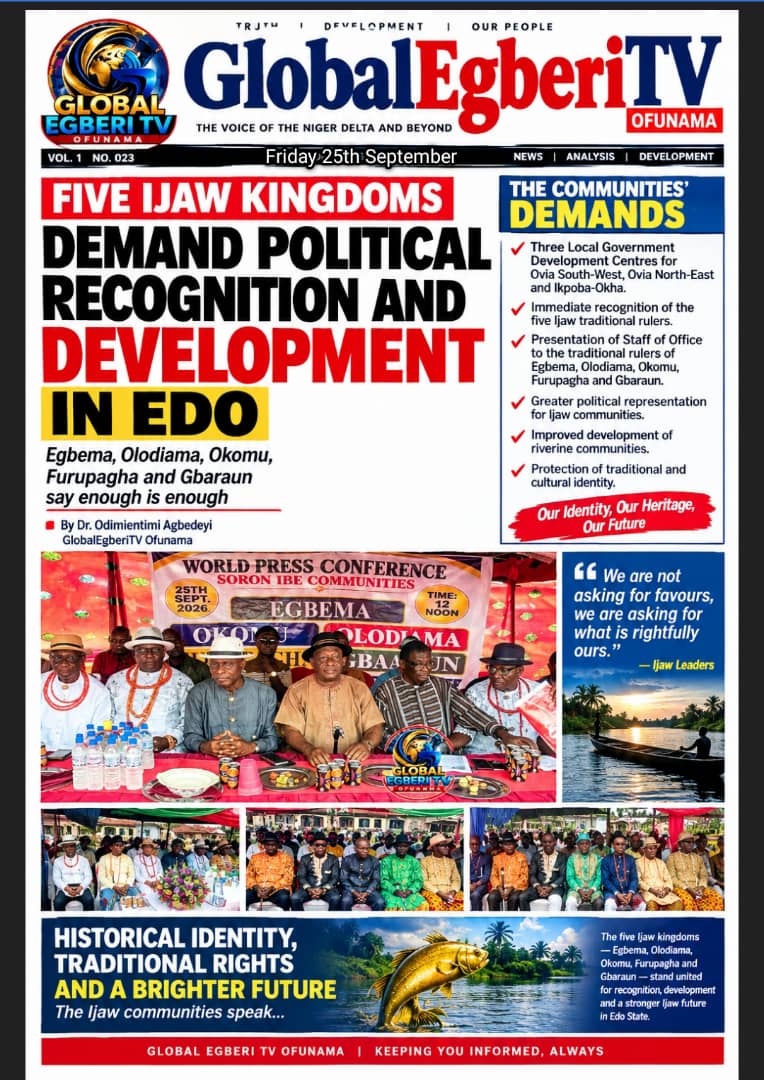
GELEGELEGBENE, EDO STATE — September 25, 2026: The long-running controversy over the political status, representation, traditional institutions and development of Ijaw communities in Edo State has taken a fresh and significant turn, as representatives of five Ijaw kingdoms have presented a comprehensive position demanding urgent government action.
The position was presented today, September 25, at a World press conference in Gelegelegbene, Edo State, by representatives of the Ijaw communities and kingdoms identified in the document as Egbema, Gbaraun, Okomu, Furupagha and Olodiama.
The document places before the Edo State Government a series of demands covering traditional recognition, political representation, administrative restructuring, development and the protection of the historical identity of Ijaw communities in the state.
GlobalEgberiTV Ofunama has reviewed the position presented at the conference and examined historical materials and publicly available records relating to the issues raised.
THE CENTRAL DEMAND: THREE DEVELOPMENT CENTRES FOR EDO IJAWS
At the heart of the declaration is a demand for the creation of three Local Government Development Centres for the Ijaw communities of Edo State.
The communities argue that their geographical location, riverine terrain, population distribution and distance from existing administrative headquarters have made access to government services and political representation difficult.
This demand is not new.
In December 2021, THISDAY reported that the Ijaw Youth Congress had called for at least three Local Government Development Centres covering the riverine areas of Ovia South-West, Ovia North-East and Ikpoba-Okha, alongside other measures to accelerate development. (Thisdaylive)
The latest declaration therefore places the demand back at the centre of the political conversation.
FIVE TRADITIONAL INSTITUTIONS SEEK OFFICIAL RECOGNITION
The conference also demanded the recognition of the traditional rulers of the five Ijaw kingdoms, with the group calling for the presentation of official Staff of Office.
The document argues that the traditional institutions of the affected communities should receive formal recognition consistent with their historical existence and role within their communities.
Gelegelegbene itself is identified by community records as an Ijaw community in Olodiama Kingdom, with the Pere of Olodiama described as the traditional overlord of the kingdom. (gelegele.org)
Publicly available Ijaw community records also list Egbema, Furupagha, Olodiama-West and Okomu-Ijaw among Ijaw clans and kingdoms in Edo State and identify Gelegelegbene, Ikoro, Inikorogha, Ofunama and other settlements within the wider Ijaw presence in the state. (Ijaw World Studies)
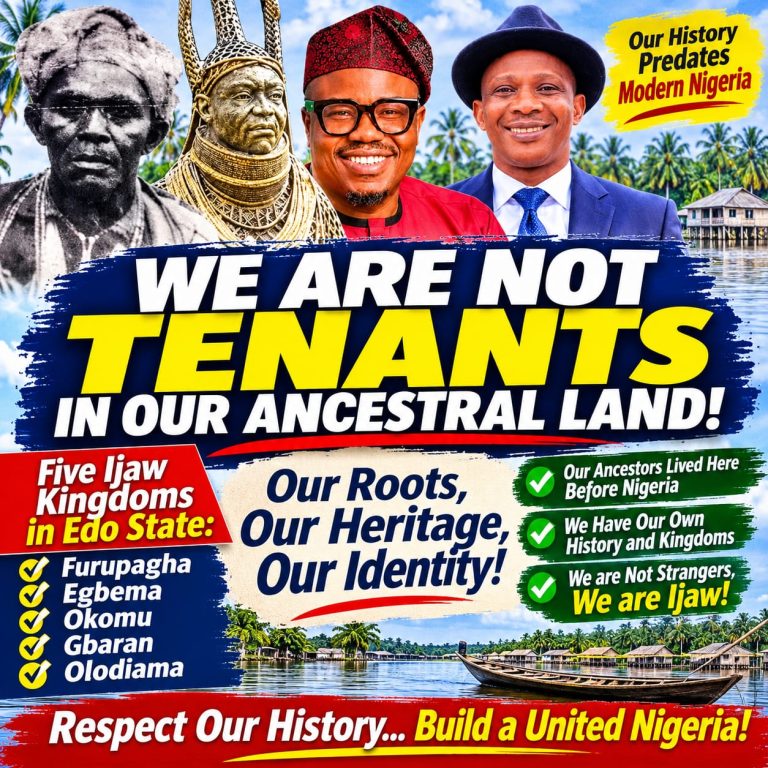
“WE ARE NOT SETTLERS” — THE HISTORICAL QUESTION
One of the strongest sections of the position statement deals with the historical identity of the Ijaw people in the territory.
The document rejects descriptions of the Ijaw communities as settlers, tenants or people without historical roots in the area.
It cites historical materials attributed to the late Chief Dr. Jacob Egharevba and other writers in support of the argument that Ijaw communities existed in the area before the consolidation of Bini political authority.
The statement also refers to historical administrative arrangements involving Ijaw villages, including the establishment of native courts and separate administrative arrangements for Ijaw communities during the colonial period.
Independent historical material available online similarly records the existence of Ijaw communities around Gelegele, Ikoro, Inikorogha, Iboro and other parts of the Ovia riverine area. (AJAKURAMAVOICE)
THE GELEGELEGBENE QUESTION
The choice of Gelegelegbene for today’s press conference carries particular significance.
Community records identify Gelegele-Gbene as an Ijaw community in Edo State and place it within Olodiama Kingdom. The community’s traditional structure includes the Ama-Okosuwei and other Ijaw traditional titles. (gelegele.org)
The area has also featured prominently in discussions surrounding the proposed Gelegele Port and the economic potential of Edo’s riverine corridor. Community records have documented repeated government interest in the Gelegele port project. (gelegele.org)
The communities’ argument is therefore that the riverine population should not be viewed only through the lens of natural resources and economic potential, but also through the question of political representation and development.
POLITICAL REPRESENTATION BECOMES A MAJOR BATTLEGROUND
Another major issue raised is political representation.
The statement argues that the dispersal of Ijaw communities across existing local government areas and wards has weakened their collective political voice.
GlobalEgberiTV had previously reported and documented calls for fresh ward delineation in Ovia South-West, Ovia North-East and Ikpoba-Okha, with the argument that existing electoral arrangements should be reviewed against current population, geographical and representation realities. (Global Egberi Media International Ltd)
The new declaration takes the issue further by connecting political representation with the wider question of administrative development.
THE OIL, LAND AND DEVELOPMENT QUESTION
The position paper also draws attention to the contradiction, as presented by the communities, between the natural resources found in the riverine areas and the level of development experienced by many inhabitants.
Several Ijaw communities in Edo are located in areas associated with oil, agriculture, waterways and other natural resources.
For example, an environmental audit concerning the Okomu Oil Palm Company identifies Gbelebu and Inikorogha as Ijaw-speaking communities in Ovia South-West Local Government Area, while documenting their relationship with the surrounding plantation area. (Scribd)
The communities argue that resource contribution should be accompanied by adequate infrastructure, political inclusion and accessible government services.
A HISTORY OF ADMINISTRATIVE AGITATION
The declaration also presents a timeline of events stretching back several decades.
Among the events referenced are:
- Historical Portuguese trade routes through riverine areas;
- The installation of traditional leadership structures;
- Correspondence between the Benin Palace, government authorities and Ijaw leadership;
- The 1988 attempt to introduce the Enogie/Dukedom title in Ijaw riverine communities;
- The 1989 meeting convened during the administration of Col. J. Tunde Ogbeha;
- The creation of Edo State in 1991;
- Later attempts to alter the names or administrative identity of Ijaw communities; and
- Continued disputes over traditional authority and administrative boundaries.
The document uses these events to argue that today’s demands did not emerge suddenly but developed from decades of unresolved disagreements.
THE FIVE KINGDOMS ARE DEMANDING A GOVERNMENT RESPONSE
The declaration ultimately places the following major demands before the authorities:
1. Immediate recognition of the five Ijaw traditional institutions and their rulers.
2. Presentation of Staff of Office to the recognised traditional rulers.
3. Creation of three Local Government Development Centres for Ijaw communities in Edo State.
4. Greater political representation and consideration of the geographical realities of riverine communities in electoral arrangements.
5. Recognition and protection of the historical and cultural identity of the Ijaw communities.
6. Greater integration and development cooperation involving Ijaw communities in Edo and neighbouring states.
The document also calls for urgent action by the government, stressing that prolonged delay could deepen existing tensions.
THIS IS NO LONGER JUST A COMMUNITY COMPLAINT
What happened today at Gelegelegbene goes beyond an ordinary community meeting.
It represents a coordinated presentation of historical, political, traditional and developmental grievances by representatives of multiple Ijaw kingdoms.
The central question now before the Edo State Government is whether these demands will receive a formal political response.
The issues raised touch on traditional authority, local government administration, electoral representation, historical identity, development and the relationship between indigenous communities and government institutions.
They therefore require responses based on verifiable historical records, constitutional provisions, administrative realities and meaningful consultation with the affected communities.
THE BALL IS NOW IN THE GOVERNMENT’S COURT
The five Ijaw kingdoms have spoken.
They have presented their historical arguments.
They have documented what they describe as decades of political and developmental challenges.
And they have placed specific demands before the authorities.
The next major development will be the response of the Edo State Government, the Edo State House of Assembly, relevant traditional institutions, INEC and other stakeholders to the issues raised at Gelegelegbene.
For the Ijaw communities involved, the declaration represents another chapter in a struggle they say has continued for generations.
GlobalEgberiTV Ofunama will continue to monitor the developments and publish responses from all relevant stakeholders as they emerge.
By Dr. Odimientimi Agbedeyi
GlobalEgberiTV Ofunama
About the Author