Lagos APC Criticises Opposition Over Rejection of Tinubu’s 30-Day Petrol Relief Proposa
By PINAIBA BOLOUERE FIRSTLADY
GlobalEgberi Media International Ltd
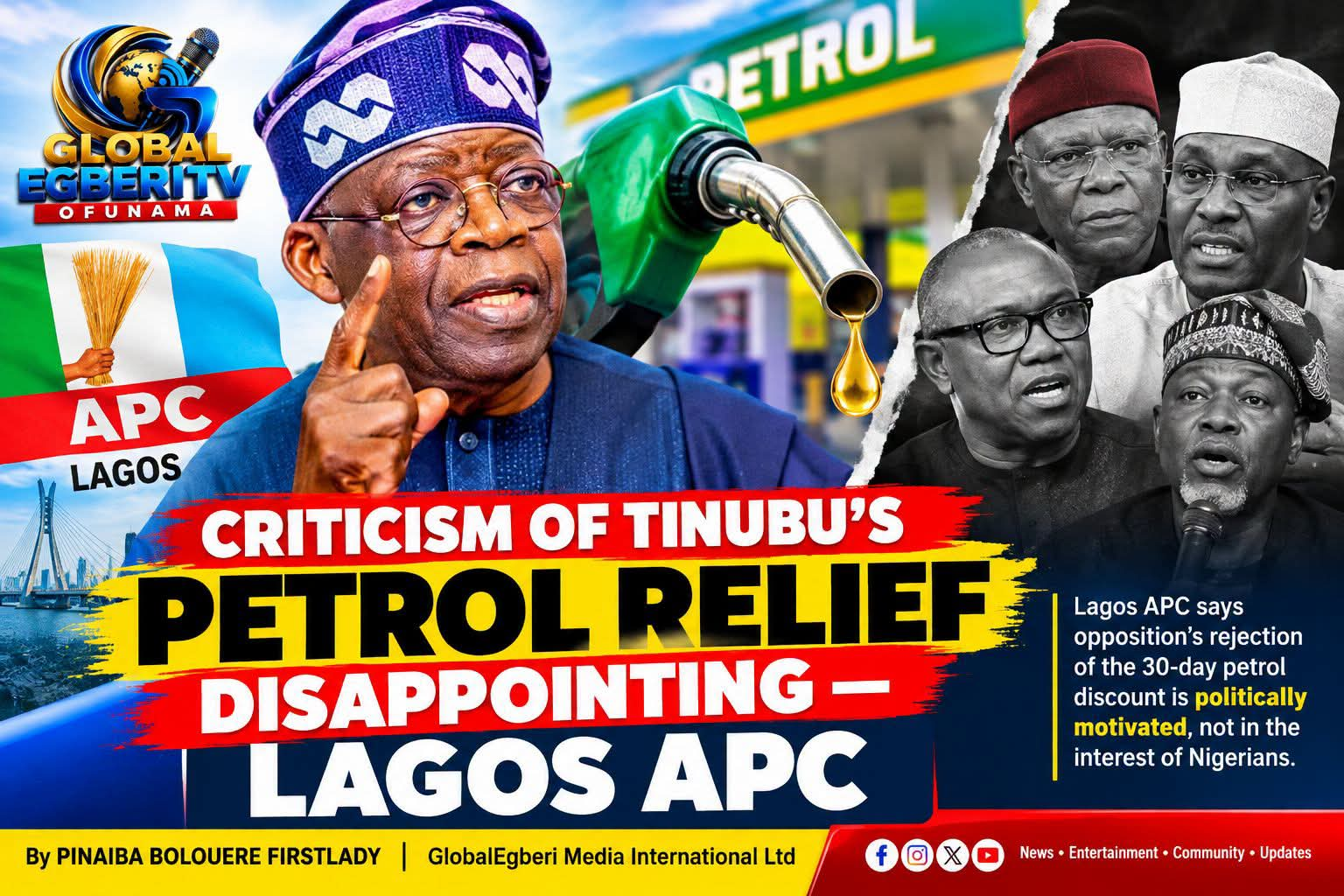
The Lagos State chapter of the All Progressives Congress (APC) has criticised opposition political parties over their rejection of the Federal Government’s proposed 30-day petrol discount, describing their response as politically motivated and disappointing.
The party argued that the proposed intervention was intended to provide temporary relief to Nigerians grappling with the rising cost of living and the increasing financial pressure associated with transportation, food prices and other essential commodities.
According to the Lagos APC, the opposition’s criticism of the initiative raises concerns about whether political considerations are being placed above the welfare of ordinary Nigerians.
APC Defends Federal Government’s Initiative
The Lagos APC maintained that any government policy designed to ease the economic burden on citizens should be assessed on its potential benefits rather than dismissed solely because it originates from the ruling party.
The proposed 30-day petrol discount is being presented as a temporary measure aimed at reducing the pressure of fuel expenses on households, commercial drivers, transport operators and small businesses.
Petrol prices have remained a major concern for Nigerians, with increases in transportation costs affecting the prices of food and other goods across different parts of the country.
For many households, the cost of commuting to work, transporting goods and running small businesses has become increasingly challenging. Consequently, any proposal capable of reducing these expenses is likely to attract significant public attention.
The Lagos APC believes that the Federal Government’s proposal deserves serious consideration as part of efforts to address the economic difficulties confronting Nigerians.
However, the actual impact of the initiative would depend on its implementation, the size of the discount, the beneficiaries covered and whether the savings would be reflected in the prices paid by consumers.
Opposition Criticism Sparks Political Debate
The disagreement over the proposed petrol relief has added another dimension to the ongoing political debate surrounding the Federal Government’s economic policies.
While the Lagos APC has condemned the opposition’s response, critics of the administration may argue that a 30-day discount is insufficient to address the broader challenges associated with high petrol prices and the rising cost of living.
For Nigerians facing persistent financial difficulties, temporary relief measures may provide some assistance but may not necessarily resolve the underlying problems affecting household incomes, transportation costs and business operations.
This raises an important question: should the proposed discount be viewed as a meaningful intervention or as a short-term measure that requires additional policies to deliver lasting benefits?
The answer will largely depend on the details of the proposal and the extent to which it translates into measurable savings for ordinary citizens.
Political parties also have a responsibility to explain their positions clearly to the public. While the ruling party is entitled to defend its policies, opposition parties play an important role in scrutinising government decisions and demanding accountability.
Consequently, the debate surrounding the petrol discount highlights the need for constructive engagement focused on practical solutions to Nigeria’s economic challenges.
Nigerians Want Relief That Will Make a Difference
Across Nigeria, the rising cost of living remains a major concern for workers, traders, transport operators, students and families struggling to meet their daily needs.
Fuel prices have a direct influence on the cost of moving people and goods. When transportation expenses increase, businesses often face higher operating costs, which can eventually be passed on to consumers through increased prices.
A temporary petrol discount could therefore provide some relief if it is properly implemented and its benefits reach the intended beneficiaries.
Nevertheless, Nigerians are likely to judge the proposal by its practical outcomes rather than political statements surrounding its introduction.
Important questions remain about how the discount would be administered, whether it would be available nationwide, how much consumers would save and what measures would follow after the 30-day period expires.
Clear communication and transparent implementation would be essential to building public confidence in the initiative.
Beyond Political Differences
The Lagos APC’s criticism of the opposition underscores the political divisions surrounding the Federal Government’s economic policies.
However, the country’s economic challenges require more than exchanges between political parties. They demand policies that can improve purchasing power, reduce the cost of essential services and create a more predictable economic environment for businesses and households.
While temporary relief measures may offer immediate assistance, sustainable improvements would also require broader efforts to address transportation expenses, food inflation, energy costs and the economic pressures facing small businesses.
The proposed petrol discount could therefore become an opportunity for the government and opposition to engage in a more productive conversation about how best to protect Nigerians from the effects of rising living costs.
Ultimately, the success of the initiative will be determined not by the political arguments surrounding it, but by whether ordinary citizens experience genuine and measurable relief.
GlobalEgberi Media International Ltd will continue to follow developments surrounding the proposed petrol discount and other government policies affecting the welfare of Nigerians.
About the Author