“You Fought Obasanjo Over ₦3 Fuel Hike” — Oshiomhole Challenged Over Support for Tinubu Amid Rising Petrol Price
By PINAIBA BOLOUERE FIRSTLADY
Reporter, GlobalEgberi Media International Ltd
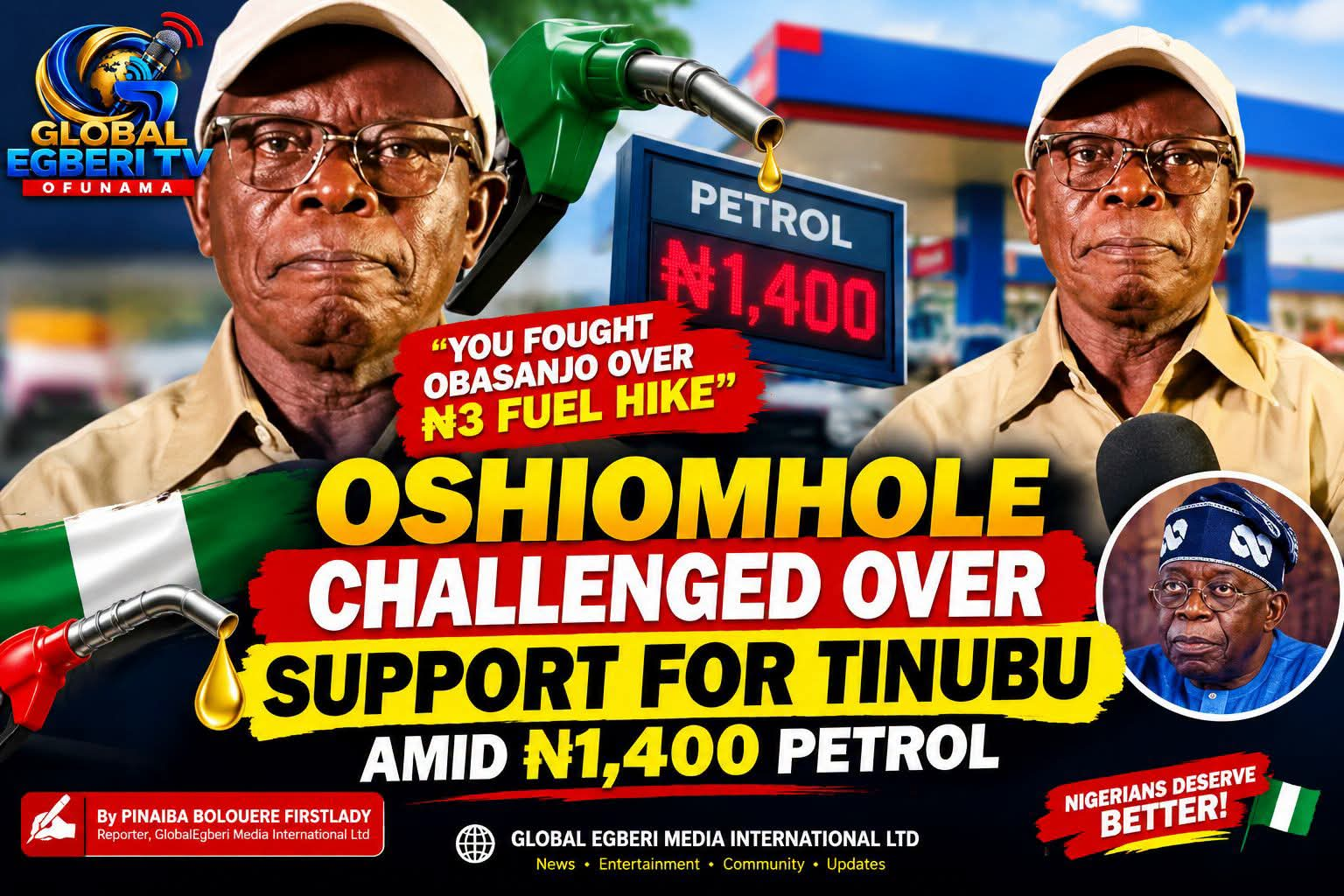
A political exchange involving Senator Adams Oshiomhole has sparked renewed debate over consistency in public office after an interviewer questioned his support for President Bola Ahmed Tinubu’s administration amid rising petrol prices in Nigeria.
During the interview, the interviewer reportedly reminded Oshiomhole of his past opposition to fuel price increases under former President Olusegun Obasanjo, citing his resistance to a petrol price adjustment of approximately ₦3 per litre.
The interviewer then challenged the senator to explain his current political position at a time when petrol prices have climbed significantly, with the reported price reaching approximately ₦1,400 per litre in some locations.
The exchange has generated reactions on social media, with some Nigerians questioning whether political leaders who previously protested against fuel price increases have maintained the same standards when their political allies are in power.
A LOOK BACK AT OSHIOMHOLE’S PAST STANCE
Oshiomhole, a former president of the Nigeria Labour Congress (NLC) and former governor of Edo State, built much of his public profile around labour activism and the defence of workers’ welfare.
During his years in organised labour, he was associated with protests and negotiations over government policies affecting workers, including fuel pricing and the cost of living.
His history as a labour leader has consequently become a reference point in discussions about his current political positions.
For critics, the contrast between his earlier opposition to relatively small fuel price increases and his support for the Tinubu administration raises questions about whether the same principles are being applied under different governments.
However, the full context of his remarks during the interview, including any explanation he offered for his position, remains important in assessing the exchange fairly.
TINUBU’S FUEL POLICY AND THE ECONOMIC DEBATE
President Tinubu’s decision to end Nigeria’s petrol subsidy at his inauguration in May 2023 fundamentally changed the country’s fuel-pricing system.
The policy was presented by the government as part of broader economic reforms intended to reduce the financial burden of petrol subsidies on public finances.
However, the transition has also brought significant economic pressure for many Nigerians, particularly as higher transport costs have affected food prices, business operations and household spending.
For many households, the central issue is not simply the amount paid at filling stations but the wider impact of petrol prices on the cost of everyday necessities.
Transport operators face higher operating expenses, businesses contend with increased production and distribution costs, and workers struggle to stretch their incomes to cover essential needs.
These economic realities have intensified public scrutiny of politicians’ positions on fuel pricing and the measures available to cushion the effects of the reforms.
INTERVIEWER’S QUESTION SPARKS ONLINE REACTIONS
The interviewer’s reference to Oshiomhole’s past opposition to fuel price increases has triggered discussions across social media platforms.
Some commentators have accused the senator of inconsistency, arguing that political leaders should be prepared to explain differences between their past positions and their present support for government policies.
Others have focused on the broader question of accountability, maintaining that elected officials should be questioned about the economic consequences of policies they support.
For these critics, the exchange highlights the importance of examining political statements against the background of current economic conditions and the experiences of ordinary citizens.
Nevertheless, online reactions represent the views of participating users and should not automatically be interpreted as the opinion of the entire Nigerian population.
A fair assessment also requires consideration of Oshiomhole’s complete response and any policy arguments he may have advanced in defence of his current position.
THE QUESTION OF POLITICAL CONSISTENCY
Beyond the personalities involved, the controversy raises a broader question about consistency in Nigerian politics.
Should political leaders who previously opposed fuel price increases be expected to maintain the same position when a different administration introduces similar or more substantial changes?
Or can changing economic circumstances, fiscal pressures and the structure of government policy justify a different approach?
These questions go to the heart of democratic accountability.
Political leaders routinely defend policies based on their understanding of prevailing economic conditions. However, citizens also have a legitimate interest in asking why a position has changed, what evidence supports the new position and how the consequences of a policy will be managed.
For former labour leaders in particular, such questions can carry additional significance because of their historical association with workers’ rights, industrial action and campaigns against increases in the cost of living.
Ultimately, the issue is not merely whether a politician supports or opposes a particular administration. It is whether the reasons behind that position are clearly explained and whether the concerns of ordinary citizens receive adequate attention.
NIGERIANS SEEK ANSWERS ON THE COST OF LIVING
As the debate continues, the rising cost of petrol remains a major concern for households and businesses across the country.
Many Nigerians want political leaders to explain not only their positions on economic reforms but also the practical steps being taken to reduce the pressure on citizens.
Questions surrounding wages, transportation, food prices, electricity costs and employment remain central to the national economic conversation.
The controversy involving Oshiomhole has therefore become part of a wider debate about political accountability, the consistency of public officials and the effects of government policies on everyday life.
Whether the senator’s complete explanation will address the concerns raised by the interviewer remains a key point for audiences seeking a clearer understanding of his position.
For now, the exchange has renewed attention on a question that continues to resonate across Nigeria: Should the standards politicians demanded while in opposition remain the same when they support the government in power?
GLOBAL EGBERI MEDIA INTERNATIONAL LTD
News • Entertainment • Community • Updates
About the Author