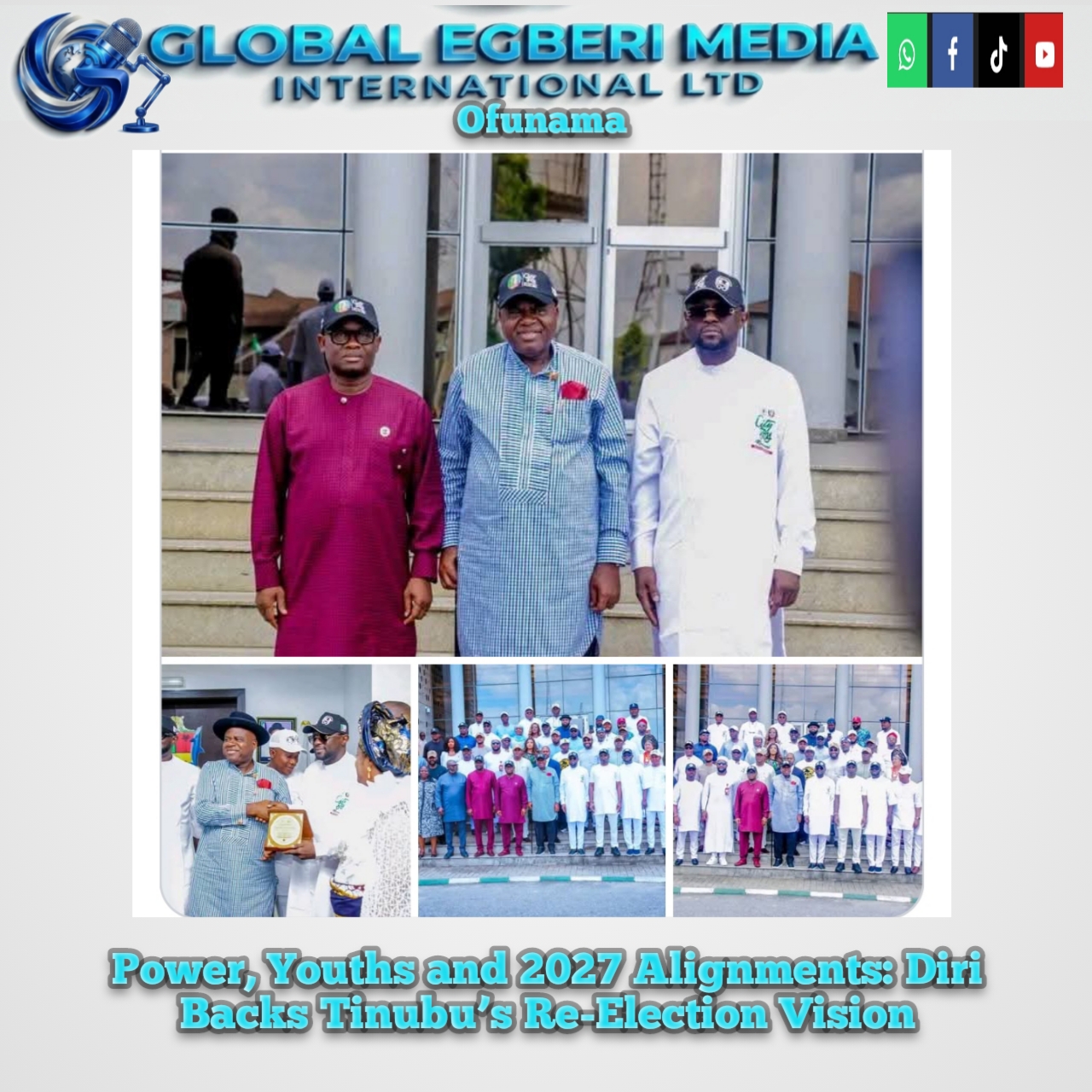
Power, Youths and 2027 Alignments: Diri Backs Tinubu’s Re-Election Vision
By Dr. Odimientimi Agbedeyi
Introduction: A Political Atmosphere Taking Shape
In an increasingly charged political environment ahead of the 2027 general elections, the recent declaration by the Governor of Bayelsa State, Senator Douye Diri, has introduced a significant layer of strategic political interpretation within Nigeria’s evolving democratic space.
During a courtesy visit by the leadership of the City Boy Movement (CBM) at the Government House in Yenagoa, Governor Diri publicly expressed support for the group’s broader objective of mobilizing backing for the re-election of President Bola Ahmed Tinubu in 2027. While the engagement was framed around youth empowerment and governance inclusion, the political implications of the statement are both clear and far-reaching.
A Strategic Political Convergence
The City Boy Movement, a youth-driven advocacy structure aligned with the “Renewed Hope Agenda,” has steadily positioned itself as a national mobilization platform seeking to consolidate support for President Tinubu’s second-term ambition.
Its engagement in Bayelsa State reflects a calculated effort to deepen influence within the Niger Delta region, a historically strategic zone in Nigeria’s electoral configuration.
Governor Diri’s response to the movement signals what political observers may interpret as a convergence of interests—where subnational governance priorities intersect with national political realignments. While CBM seeks youth mobilization for electoral support, the Bayelsa State Government continues to emphasize youth inclusion as a governance philosophy.
Speaking during the visit, Governor Diri reinforced the importance of youth participation in leadership, stressing that young people should not be confined to future expectations alone. His assertion that youths “must be leaders of today, not tomorrow” aligns with broader national discourse on generational inclusion in governance structures.
Youth Empowerment Beyond Political Mobilization
Beyond the political undertones, Governor Diri’s remarks extended into a broader governance philosophy centered on sustainable youth development.
He emphasized that youth empowerment must move beyond political mobilization into practical socio-economic transformation. According to him, genuine progress lies in equipping young people with skills, opportunities, and institutional access that enable long-term productivity.
This perspective is particularly significant in the Niger Delta region, where youth unemployment and socio-economic exclusion have historically contributed to unrest and political vulnerability.
Governor Diri further highlighted his administration’s ongoing efforts in youth inclusion, including the appointment of young persons into strategic government positions, signaling a deliberate policy shift toward generational participation in governance.
Governance Reform and the Six-Year Debate
One of the more striking elements of the Governor’s remarks was his renewed call for constitutional reconsideration of Nigeria’s executive tenure system.
Drawing from his legislative experience, Governor Diri reiterated his support for a single six-year tenure for presidents and governors. He argued that the current four-year electoral cycle often diverts attention toward re-election politics at the expense of governance delivery.
While this proposal remains a subject of national debate rather than immediate legislative reality, its re-emergence from a sitting governor adds weight to ongoing conversations about governance efficiency and political stability in Nigeria.
Condemning Political Violence and Youth Misuse
Governor Diri also used the opportunity to address one of Nigeria’s most persistent democratic challenges—the misuse of youths in political processes.
He strongly condemned the involvement of young people in political thuggery, misinformation campaigns, and acts of intimidation. According to him, such practices undermine democratic integrity and erode the developmental potential of the youth population.
He further advocated for a more responsible political culture, where opposition is based on ideas and constructive engagement rather than misinformation and hostility.
This message resonates strongly within the context of Nigeria’s approaching election cycle, where political tensions and youth participation are expected to intensify.
City Boy Movement’s Response and Engagement
In his remarks, the Director-General of the City Boy Movement, Mr. Oluwatosin Shoga, reaffirmed the organization’s commitment to mobilizing and empowering Nigerian youths for active participation in governance and national development.
He commended Governor Diri’s leadership style and developmental achievements in Bayelsa State, noting that the state has recorded visible progress under his administration. He also referenced the acknowledgment of Bayelsa’s developmental strides during President Tinubu’s recent visit to the state.
The CBM leadership further expressed readiness to continue collaborating with the state government in advancing youth-focused initiatives beyond political campaigns, signaling a dual agenda of political engagement and socio-economic development.
Editorial Reflection: Politics, Youth, and National Direction
From a broader analytical standpoint, the development underscores the evolving intersection between governance, youth engagement, and electoral politics in Nigeria.
While early political alignments are not unusual in the country’s political landscape, the involvement of youth-focused movements adds a new dimension to how political influence is being structured ahead of 2027.
Governor Diri’s position reflects a balancing act—supporting national political engagements while simultaneously emphasizing governance responsibility, youth development, and political stability.
The key challenge moving forward will be ensuring that such alignments translate into tangible developmental outcomes rather than purely electoral calculations.
Conclusion: Toward 2027 and Beyond
As Nigeria gradually moves closer to the 2027 general elections, political alliances, youth mobilization structures, and governance narratives will continue to evolve.
The engagement between the Bayelsa State Government and the City Boy Movement may represent an early indicator of broader political realignments that will shape the next electoral cycle.
However, beyond politics, the central question remains whether these engagements will deliver meaningful improvements in governance, youth empowerment, and national development.
The ultimate test will not be in declarations of support, but in the ability of these alliances to contribute to a more stable, inclusive, and development-driven Nigeria.
Source: Office of the Chief Press Secretary to the Governor of Bayelsa State
Website: https://globalegberi.com.ng
About the Author