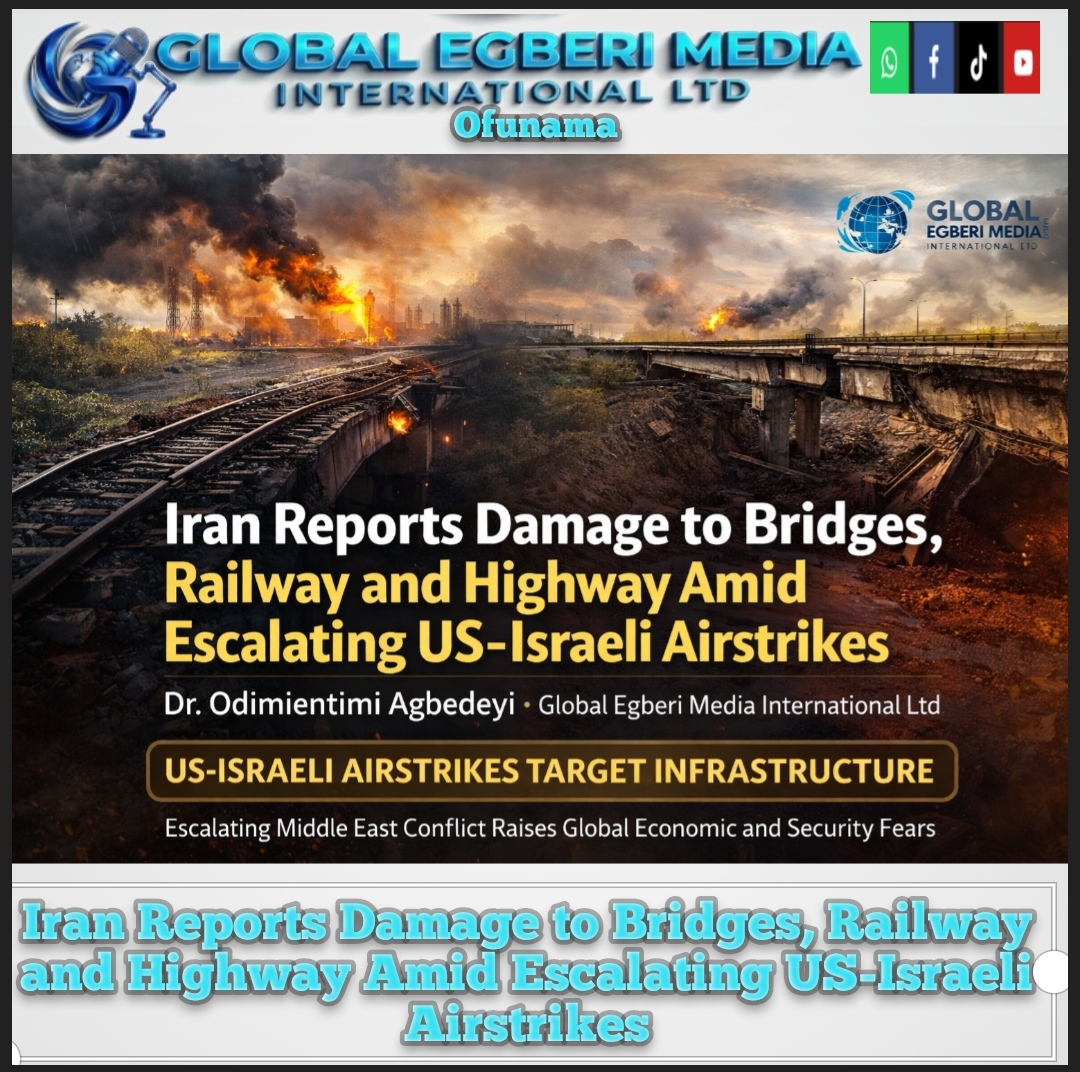
Iran Reports Damage to Bridges, Railway and Highway Amid Escalating US-Israeli Airstrikes
By Dr. Odimientimi Agbedeyi
Tensions in the Middle East escalated further on Tuesday after Iranian officials confirmed that several critical infrastructure facilities—including bridges, railway lines, and a major highway—were struck during a fresh wave of coordinated airstrikes reportedly carried out by the United States and Israel.
According to Iranian state media and regional authorities, at least two bridges and sections of railway infrastructure were damaged in the strikes, with the attacks forming part of a broader campaign targeting transportation and logistics networks across the country. (The New Arab)
The development has intensified fears of a wider regional conflict as both sides continue to exchange threats and military actions.
Bridges and Rail Infrastructure Hit
Reports indicate that one of the affected bridges is located near the holy city of Qom, a major religious and cultural center in Iran. Another bridge carrying a railway line in the central city of Kashan was also struck during the overnight bombardment.
Local officials confirmed that the Kashan railway bridge sustained severe structural damage, temporarily disrupting rail transportation in the region. Preliminary reports suggest that the strike on the railway infrastructure led to casualties, with at least two fatalities and several injuries recorded. (Wall Street Journal)
In addition to the bridges, a key highway connecting several major cities was also reportedly targeted. Iranian authorities say the attack caused significant damage to transportation routes that serve both civilian and logistical purposes.
The Iranian government has accused the United States and Israel of deliberately targeting infrastructure to cripple the country’s internal mobility and economic stability.
Strategic Transport Routes Targeted
Military analysts believe that transportation corridors—such as bridges, railways, and highways—have become primary targets because they serve as strategic logistical routes that can be used for moving military equipment and personnel.
Israeli officials have reportedly defended the strikes as part of a broader operation aimed at weakening Iran’s military capabilities and limiting the movement of weapons and personnel by the Islamic Revolutionary Guard Corps (IRGC). (Wall Street Journal)
Prime Minister Benjamin Netanyahu confirmed that Israeli forces had carried out attacks on railway lines and bridge networks across several Iranian cities as part of the ongoing campaign.
The strikes are believed to have targeted infrastructure in multiple locations including Tehran, Karaj, Tabriz, Kashan, and Qom.
Escalation in a Prolonged Conflict
The latest attacks come amid an already intensifying conflict between Iran on one side and the United States and Israel on the other.
The confrontation, which has now entered several weeks of sustained military exchanges, began following a series of escalating confrontations involving regional security concerns, nuclear tensions, and disputes over control of strategic waterways.
In recent weeks, the United States and Israel have reportedly conducted numerous strikes on Iranian military installations, research facilities, and industrial infrastructure. Iranian authorities claim that several civilian facilities have also been hit during the campaign.
Iranian officials say the attacks have damaged energy installations, academic institutions, and industrial complexes in different parts of the country.
Global Concerns Over Economic Impact
Beyond the humanitarian and military implications, the conflict is raising serious concerns in global economic and diplomatic circles.
Iran has warned that continued attacks on its infrastructure could lead to major disruptions in oil and gas supply routes, particularly if tensions spill over into the Strait of Hormuz—one of the world’s most important energy shipping corridors.
Energy markets have already begun reacting to the developments, with global oil prices rising amid fears that instability in the region could disrupt international supply chains.
The conflict has also sparked urgent diplomatic calls from international organizations and world leaders urging restraint and dialogue to prevent the crisis from escalating into a broader regional war.
Civilian Safety and Humanitarian Concerns
The destruction of transportation infrastructure has raised humanitarian concerns, particularly because bridges and railways are often vital for civilian mobility and emergency response.
Local reports suggest that several rail services have been suspended following the strikes as authorities assess the structural integrity of affected routes.
Human rights organizations have also expressed concern about the potential impact of infrastructure attacks on civilians who rely on such facilities for daily transportation and access to essential services.
Iran Vows Response
Iranian authorities have vowed that the country will respond decisively to what they describe as aggression against its sovereignty.
Officials in Tehran warned that continued attacks could trigger retaliation targeting strategic interests of the United States and Israel across the region.
The government has also reiterated its stance that it will not yield to military pressure and will continue to defend its territorial integrity.
As the conflict continues to unfold, the international community is watching closely, aware that any further escalation could significantly reshape the geopolitical landscape of the Middle East.
For now, the destruction of bridges, railways, and highways inside Iran marks another troubling chapter in a conflict whose end remains uncertain.
Source: The New Arab / Reuters / International Media Reports (The New Arab)
Global Egberi Media International Ltd
https://globalegberi.com.ng/wp
About the Author