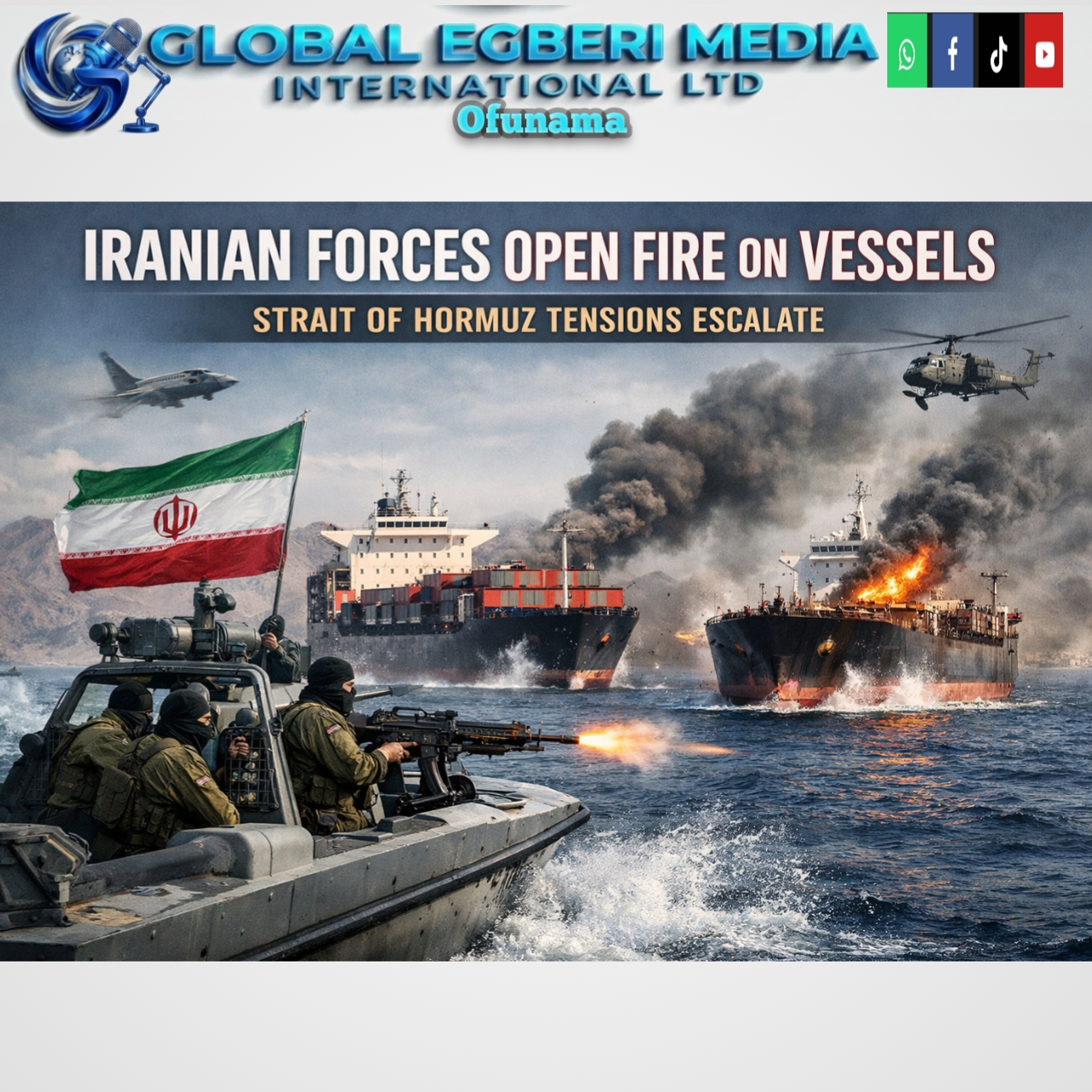
Iranian Forces Open Fire on Two Vessels in Strait of Hormuz: A Dangerous Signal for Global Stability
By Dr. Odimientimi Agbedeyi
For Global Egberi Media International Ltd
Fresh tensions have emerged in one of the world’s most strategically sensitive waterways after reports indicated that Iranian forces opened fire on two vessels in the Strait of Hormuz amid heightened restrictions and growing regional uncertainty. The incident has once again placed global attention on a maritime corridor whose stability is directly tied to international trade, energy security, naval strategy, and Middle East geopolitics.
Whenever conflict brews in the Strait of Hormuz, the world listens carefully. This narrow water passage is not an ordinary shipping lane. It is one of the most important arteries of the global economy, through which a substantial portion of the world’s oil and gas shipments transit daily.
Any disruption there sends immediate tremors through energy markets, diplomatic circles, and military command centres.
Why the Strait of Hormuz Matters
The Strait of Hormuz links the Persian Gulf to the Gulf of Oman and the Arabian Sea. It serves as the maritime gateway for several oil-producing nations, including Saudi Arabia, Iraq, Kuwait, the United Arab Emirates, and Iran itself.
This means that when tensions rise in the strait, consequences may include:
- Increased oil prices
- Insurance hikes for shipping companies
- Delays in commercial cargo movement
- Naval deployments by foreign powers
- Heightened risk of military miscalculation
- Pressure on fragile diplomatic relations
For many nations dependent on imported energy, stability in the strait is not optional—it is essential.
The Meaning of the Latest Incident
Reports that Iranian forces opened fire on two vessels suggest a serious escalation, especially if the ships were civilian or commercial in nature. Even warning shots or interception attempts can rapidly transform into larger confrontations.
In modern geopolitics, perception matters almost as much as action. A single exchange at sea can be interpreted as:
- A show of sovereignty
- A response to sanctions pressure
- A deterrence message to rivals
- A domestic political signal
- A bargaining tactic in wider negotiations
Yet whatever the intended message, the risk of unintended escalation remains extremely high.
Maritime Security Cannot Depend on Mood Swings
The world cannot afford a situation where a critical trade route becomes hostage to recurring confrontation. International waterways must operate under predictable legal norms, not fluctuating strategic tempers.
Commercial vessels crossing legitimate sea lanes should not become symbols in larger political disputes. Sailors, shipping crews, and maritime workers are not combatants in geopolitical rivalries.
Where shipping routes become militarized, ordinary citizens thousands of miles away eventually feel the consequences through rising fuel prices, inflation, supply chain stress, and economic instability.
Iran’s Strategic Calculus
Iran has long viewed the Strait of Hormuz as both a defensive frontier and strategic leverage point. Facing sanctions, diplomatic isolation, and military pressure from adversaries, Tehran often emphasizes its capacity to influence movement through the strait.
From Iran’s perspective, control over nearby waters is linked to national sovereignty and deterrence.
However, there is a profound difference between legitimate security enforcement and actions that create fear in international commerce. The line between assertion and provocation can be dangerously thin.
The Responsibility of Global Powers
Major powers also bear responsibility for the recurring instability of the region. Decades of sanctions, proxy conflicts, naval build-ups, covert operations, and failed diplomacy have created an atmosphere where mistrust dominates.
No regional actor operates in a vacuum.
The United States, European powers, Gulf states, Israel, and others all influence the strategic temperature of the Middle East. Selective outrage without serious diplomatic investment will solve little.
If global powers want calm waters, they must pursue calmer policies.
What Happens If Tensions Continue?
Should incidents like this persist, several consequences may unfold:
- Higher global crude oil prices
- Freight cost increases
- Insurance risk premiums for tankers
- Expanded naval escorts and military patrols
- Market anxiety in Asia and Europe
- Greater risk of accidental armed confrontation
For developing nations already battling inflation, such disruptions could deepen domestic hardship.
This is why a naval incident in the Gulf can affect families in Lagos, London, Mumbai, or São Paulo.
Diplomacy Must Return to the Centre
Military signalling may attract headlines, but diplomacy prevents catastrophe. The present moment demands:
- Independent investigation of the incident
- Clear communication channels between naval forces
- Respect for international maritime law
- Renewed regional security dialogue
- De-escalation measures by all sides
- Protection guarantees for civilian shipping
The Middle East has suffered enough from wars of ego, suspicion, and strategic brinkmanship.
An Editorial Truth the World Must Hear
Too often, nations mistake the ability to create crisis for the possession of strength. True strength is the capacity to preserve peace while defending legitimate interests.
Shooting at vessels in a globally vital waterway may produce temporary leverage, but it also deepens isolation and invites retaliation.
Likewise, powers that respond only with threats while neglecting diplomacy merely sustain the cycle.
The Strait of Hormuz should be remembered as a bridge of commerce, not a theatre of recurring tension.
Conclusion
The reported firing on two vessels in the Strait of Hormuz is more than a regional security event. It is a reminder that fragile waterways can hold the world economy hostage when diplomacy fails.
Iran must exercise restraint. Rival powers must avoid opportunistic escalation. International institutions must act with urgency.
The world does not need another maritime crisis. It needs responsible statecraft.
In an era already burdened by wars, inflation, and uncertainty, no nation should gamble recklessly with a route so vital to global stability.
About the Author