
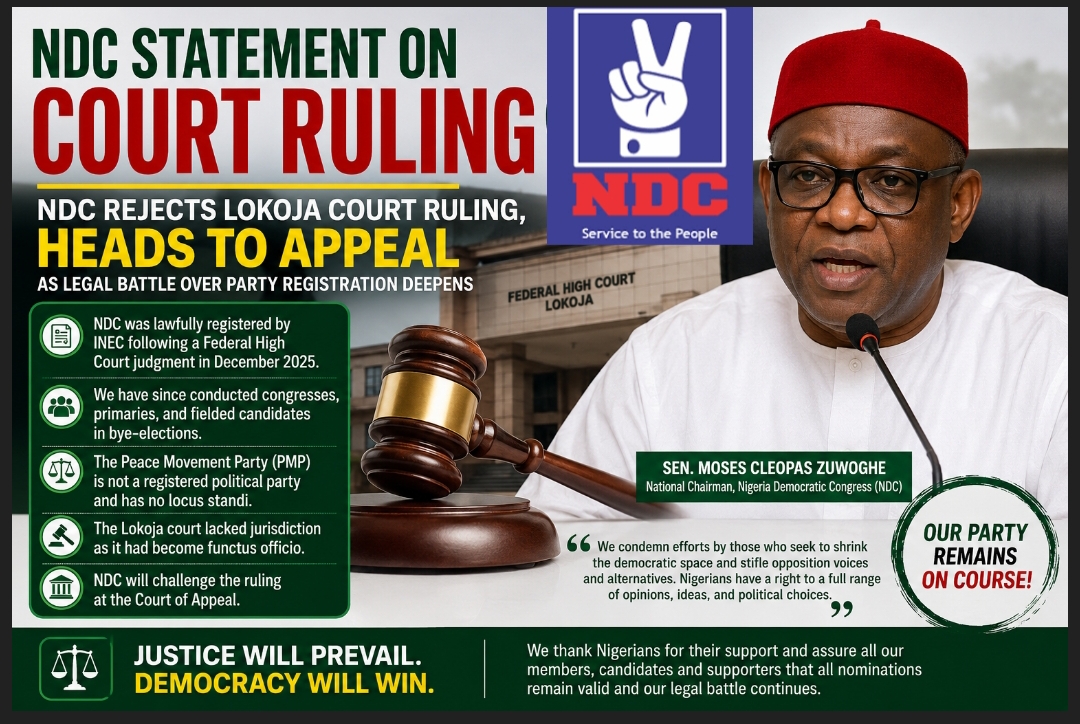
NDC Rejects Lokoja Court Ruling, Heads to Appeal as Legal Battle Over Party Registration Deepens
By Dr. Odimientimi Agbedeyi
Nigeria’s evolving political landscape has taken another dramatic turn following the Nigeria Democratic Congress (NDC)’s rejection of a recent ruling delivered by the Federal High Court sitting in Lokoja. The party has vowed to challenge the decision at the Court of Appeal, insisting that it remains a legally recognized political party and that no court has ordered its deregistration.
The controversy arose after Honourable Justice Isah Dashen reportedly ruled on an application brought by an association known as the Peace Movement Party (PMP), which sought to set aside an earlier judgment that had compelled the Independent National Electoral Commission (INEC) to register the NDC as a political party.
Reacting in a strongly worded statement signed by its National Chairman, Senator Moses Cleopas Zuwoghe, the NDC maintained that the ruling neither invalidates its existence nor affects the legitimacy of the political activities it has undertaken since its registration.
According to the party, its journey began in December 2025 when it approached the Federal High Court after INEC allegedly refused to register it despite meeting constitutional requirements. The court subsequently ruled in its favour, affirming its constitutional right to freedom of association and directing INEC to register the party.
Since that judgment, the NDC stated that it has functioned openly as a recognized political party. It said it has conducted ward, local government, state and national congresses, held its national convention, organized primary elections, registered members across the federation, nominated candidates for all elective offices, and actively participated in INEC’s official activities.
The party also noted that it successfully fielded candidates during the recently concluded bye-elections in Nasarawa and Enugu States, emphasizing that none of these activities was questioned by the electoral commission.
NDC further disclosed that its candidates for the House of Assembly, House of Representatives, Senate, Governorship, Vice-Presidential and Presidential elections have already emerged through duly conducted primaries and are currently being processed for submission to INEC in accordance with the Commission’s electoral timetable.
The leadership of the party expressed surprise that the Peace Movement Party, which it described as an unregistered association unknown to its structure, was able to obtain a ruling setting aside the earlier judgment.
According to the NDC, the Peace Movement Party based its application on a claim that it had unsuccessfully sought registration as a political party in 2015 with a “Victory” symbol similar to that adopted by the NDC.
However, the NDC argued that the association neither belongs to the present registration exercise initiated by INEC nor exists as a registered political party capable of participating in Nigeria’s current democratic process.
The party also questioned the legal competence of the proceedings, arguing that after delivering its final judgment in December 2025, the Federal High Court had become functus officio—a well-established legal doctrine which ordinarily prevents a court from reopening matters it has already conclusively determined except under very limited circumstances prescribed by law.
The NDC maintained that the issue concerning party symbols and colours had already been fully litigated during the original proceedings, with the court ruling against INEC on those objections.
It therefore contended that any aggrieved party ought to have pursued an appeal rather than seeking to reopen a concluded case through a motion before the same court.
Although acknowledging that the latest ruling reportedly set aside the earlier judgment, the NDC stressed that there was no express order directing INEC to deregister the party.
Consequently, the party announced that its legal team has received immediate instructions to approach the Court of Appeal to challenge what it described as serious jurisdictional errors and procedural irregularities in the Lokoja ruling.
While reassuring its members, candidates and supporters nationwide, the party insisted that all nominations already conducted remain valid pending the determination of the appellate process.
The leadership further accused unnamed interests of attempting to shrink Nigeria’s democratic space by using litigation to frustrate emerging political alternatives ahead of the 2027 general elections.
According to the statement, democracy thrives on competition, plurality of ideas and equal opportunities for citizens to organize politically, warning that attempts to narrow political participation would ultimately weaken democratic governance.
The party equally argued that if the Peace Movement Party genuinely believed its rights were affected by the earlier judgment, the proper legal remedy should have been an appeal filed within the period prescribed by law, rather than what it described as an indirect attempt to overturn a final judgment through a motion after the statutory period for appeal had expired.
NDC concluded by expressing confidence that the Court of Appeal would restore what it considers the correct legal position and reaffirm the party’s constitutional rights.
Editorial Insight
The dispute surrounding the NDC’s registration is no longer merely a disagreement between political associations; it has evolved into a constitutional test of judicial finality, electoral certainty and political inclusiveness.
At the heart of the controversy lies an important legal question: Can a court that has delivered a final judgment subsequently revisit and set aside that judgment upon the application of a non-party through a motion, particularly where the time for appeal has allegedly elapsed? This issue is likely to become one of the defining constitutional questions before the Court of Appeal.
Equally significant is the practical implication for Nigeria’s electoral process. Political parties have invested enormous resources in organizing congresses, conventions and primary elections under INEC’s timetable. Any uncertainty concerning the legal status of a participating party inevitably affects candidates, supporters and the integrity of the electoral calendar.
Ultimately, only the appellate courts can provide authoritative clarity on the jurisdictional questions raised by both sides. Until then, caution should prevail against drawing premature conclusions regarding the legal status of the NDC or the final effect of the Lokoja ruling.
As the judicial process continues, Nigerians will be watching closely, not merely because of one political party, but because the eventual decision may shape future interpretations of electoral law, constitutional rights and the limits of judicial powers in Nigeria’s democratic journey.
Source: Statement by the Nigeria Democratic Congress (NDC), signed by Senator Moses Cleopas Zuwoghe, National Chairman.
Homepage: https://globalegberi.com.ng
Author: Dr. Odimientimi Agbedeyi
About the Author