When Poverty Knocks on the Womb: The Disturbing Message That Left Me Speechless
By Dr. Odimientimi Agbedeyi
There are moments in journalism and public advocacy when a simple message says more about the state of a nation than a thousand political speeches ever could.
A few days ago, a young Nigerian woman sent me a private message. At first glance, it appeared to be just another routine inquiry. But as I read her words, I was struck by the depth of pain, desperation, and economic reality hidden behind the text.
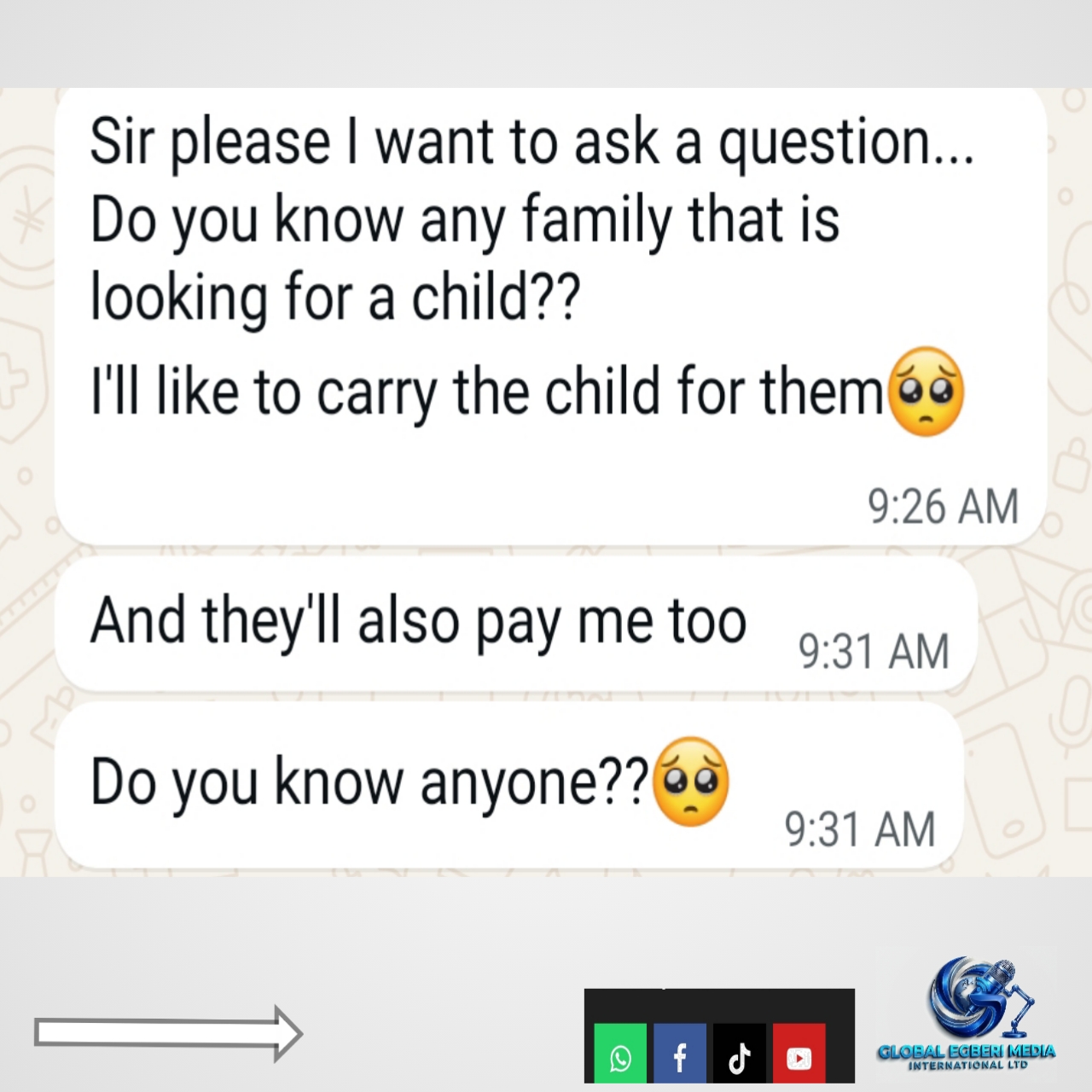
Her message read:
“Sir, please I want to ask a question. Do you know any family that is looking for a child? I’ll like to carry the child for them.”
A few minutes later, she added:
“And they’ll also pay me too.”
Then came the final question:
“Do you know anyone?”
I paused.
Not because I did not understand what she meant, but because I understood it too well.
This was not merely a young woman seeking information about surrogacy. This was a cry for survival in a country where millions are being pushed to the edge by economic hardship.
Behind those few sentences was a young lady who had apparently reached a point where her womb had become a potential source of income.
Behind those words was a citizen searching for opportunity in an economy that seems to offer fewer and fewer options to young people every passing day.
Behind those questions was a generation battling unemployment, inflation, rising food prices, and a cost of living crisis that continues to tighten its grip on ordinary Nigerians.
The tragedy is that her message is not an isolated case.
Across the country, many young Nigerians are struggling to survive. University graduates roam the streets in search of jobs. Skilled workers earn wages that can barely sustain a family. Parents skip meals so their children can eat. Young women and men are increasingly forced to consider options they would never have imagined under normal circumstances.
For some, migration becomes the dream.
For others, survival becomes the priority.
And for a growing number, the body itself becomes an economic asset.
The young lady who contacted me may genuinely wish to help a childless family experience the joy of parenthood. There is nothing inherently wrong with legal and ethical surrogacy arrangements conducted under proper medical and legal supervision.
However, when financial desperation becomes the primary motivation, society must begin asking difficult questions.
What kind of economy forces young women to see pregnancy as a business opportunity?
What kind of nation allows its youth to become so desperate that they are willing to rent out the most intimate parts of their existence simply to survive?
What does this say about our collective priorities as a people?
Nigeria is blessed with abundant human and natural resources. Yet millions of citizens continue to battle poverty amidst plenty. The widening gap between the wealthy and the poor is becoming increasingly visible in everyday interactions.
The message I received is more than a private conversation.
It is a social commentary.
It is an economic report.
It is a national alarm bell.
It reminds us that beyond government statistics and political debates are real human beings struggling with real challenges.
It reminds us that every percentage increase in inflation has a human face.
It reminds us that every unemployed youth has dreams waiting to be fulfilled.
It reminds us that economic hardship is not merely about numbers—it is about lives.
As Nigerians continue to navigate difficult times, policymakers, community leaders, religious institutions, and civil society organisations must pay closer attention to the silent cries coming from ordinary citizens.
Because when a young woman begins to see her womb as her most marketable asset, it may be a sign that something deeper is broken within the system.
The message that landed in my inbox lasted only a few seconds.
The questions it raised may remain with me for a very long time.
Source: Private Communication.
Global Egberi Media International Ltd
🌐 https://globalegberi.com.ng
About the Author