
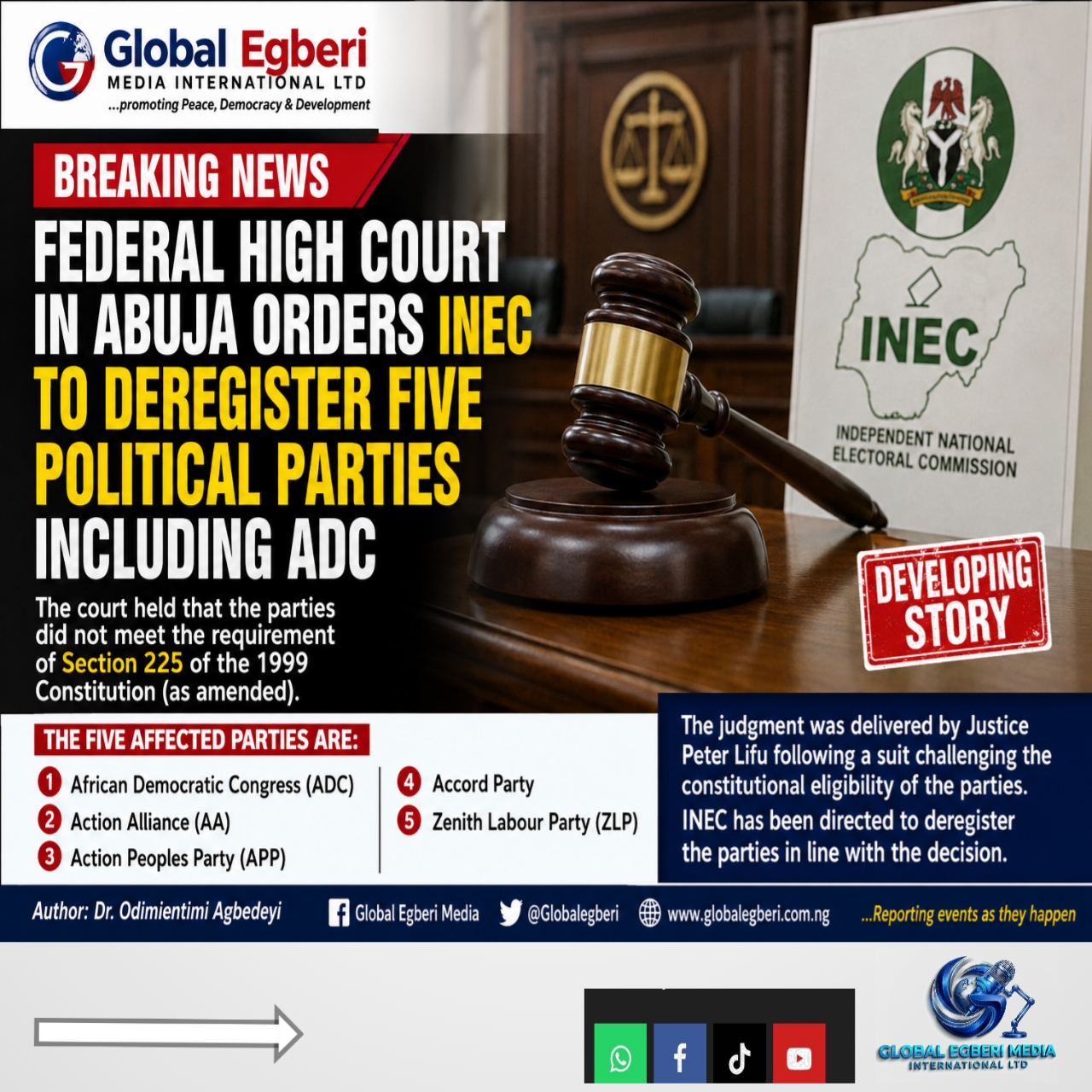
Federal High Court Earthquake: ADC, Four Other Political Parties Face Deregistration Order
Historic Abuja Judgment Sends Shockwaves Through Nigeria’s Political Landscape
Nigeria’s political arena was thrown into unprecedented turbulence on Monday as the Federal High Court sitting in Abuja reportedly ordered the deregistration of five political parties, including the African Democratic Congress (ADC), in a judgment that could significantly reshape the country’s democratic architecture ahead of the 2027 general elections.
The ruling, which has rapidly become one of the most discussed political developments in the country, was delivered by Justice Peter Lifu following a suit challenging the constitutional eligibility of certain political parties to retain their registration status under the provisions of the Constitution of the Federal Republic of Nigeria.
The parties reportedly affected by the court order are:
- African Democratic Congress (ADC)
- Action Alliance (AA)
- Action Peoples Party (APP)
- Accord Party
- Zenith Labour Party (ZLP)
The decision has generated widespread reactions across political circles, legal communities, civil society organizations, and among millions of Nigerians who view the affected parties as important components of the nation’s multi-party democratic system.
The Constitutional Question
At the heart of the legal dispute lies Sections 225 and 225A of the 1999 Constitution (as amended), provisions that establish regulatory standards and operational obligations for political parties operating within Nigeria.
The plaintiffs argued that the affected parties failed to satisfy constitutional benchmarks necessary for their continued existence as registered political entities.
According to reports, the court found merit in the arguments presented and consequently directed the Independent National Electoral Commission (INEC) to proceed with the deregistration of the parties.
The judgment has once again brought national attention to the perennial debate regarding the sustainability of Nigeria’s multi-party system and whether political parties that perform poorly in elections should continue to enjoy legal recognition.
ADC at the Centre of National Attention
Among the affected parties, the African Democratic Congress (ADC) has attracted the greatest public attention due to its increasing visibility in national political conversations and its role as a platform for several prominent politicians and political stakeholders.
Political analysts believe that any attempt to remove the ADC from the electoral landscape could have far-reaching implications, especially as political realignments ahead of the 2027 elections continue to gather momentum.
The development is therefore being closely monitored by political observers who view the ADC as one of the emerging alternatives within Nigeria’s evolving democratic framework.
Potential Implications for Nigeria’s Democracy
The court’s decision raises several important constitutional and democratic questions.
First, it reignites discussions about whether electoral performance should remain the primary determinant of a political party’s survival.
Second, it highlights the ongoing tension between political pluralism and administrative efficiency within Nigeria’s democratic system.
Supporters of deregistration argue that inactive or electorally insignificant parties unnecessarily clutter the electoral process, complicate ballot administration, and increase regulatory burdens on INEC.
On the other hand, critics contend that reducing the number of political parties could inadvertently weaken democratic participation, restrict political diversity, and limit opportunities for emerging political movements to gain traction.
Legal Battles May Not Be Over
Despite the significance of the ruling, legal experts suggest that the matter may still travel through higher judicial corridors.
The affected political parties are expected to carefully review the judgment and may pursue appellate remedies aimed at overturning or suspending the implementation of the court order.
Such legal processes could potentially delay any immediate deregistration pending the determination of appeals by superior courts.
Consequently, political observers caution against viewing the matter as conclusively settled until all judicial avenues have been exhausted.
What This Means for the 2027 Elections
With preparations for the 2027 electoral cycle gradually taking shape, the ruling introduces a new layer of uncertainty into Nigeria’s political calculations.
Potential candidates, party officials, coalition builders, and grassroots mobilizers affiliated with the affected parties may now be compelled to reassess their political strategies.
Should the judgment ultimately stand, significant political realignments could emerge, with politicians migrating to alternative platforms in search of electoral relevance and viability.
For many observers, the development underscores the dynamic and often unpredictable nature of constitutional democracy in Nigeria.
A Defining Moment
Whether upheld or overturned on appeal, the Federal High Court’s decision has already secured a place among the defining political developments of the year.
It serves as a reminder that democratic institutions operate within constitutional boundaries and that compliance with legal requirements remains essential for political organizations seeking to participate in the governance process.
As Nigerians await further reactions from INEC, the affected parties, and appellate courts, one thing remains certain: the unfolding legal and political drama will continue to dominate national discourse in the days ahead.
Source: The Guardian Nigeria, Channels Television, TheCable, court proceedings and political correspondents.
Global Egberi Media International Ltd
https://globalegberi.com.ng
Author: Dr. Odimientimi Agbedeyi
About the Author